Guide
How to inflate RV tires at home
Home is the easiest place to put air in an RV or trailer tire. The rig is parked, the tires can cool to ambient temperature, and there is a wall outlet for a corded compressor — three things a fuel stop or a campsite cannot always give you.
Why the driveway beats the road
An RV or trailer tire holds more air, and often at a higher pressure, than a passenger car tire. Our RV and trailer buying page notes trailer tires commonly specified between 65 and 80 PSI. That is a job you want to do parked and unhurried, not crouched at a truck-stop air hose with a line behind you.
The placard pressure is a cold pressure. At home you can let the tires sit until they are at ambient temperature, which is the condition the placard is written for. That one fact removes the most common way an RV tire ends up wrong: set warm, then under-inflated once it cools.
Match the compressor to a home outlet
At home you have the one power source the road does not always give you: a wall outlet. There are still three sensible ways to power a home inflation job, and they suit different compressors.
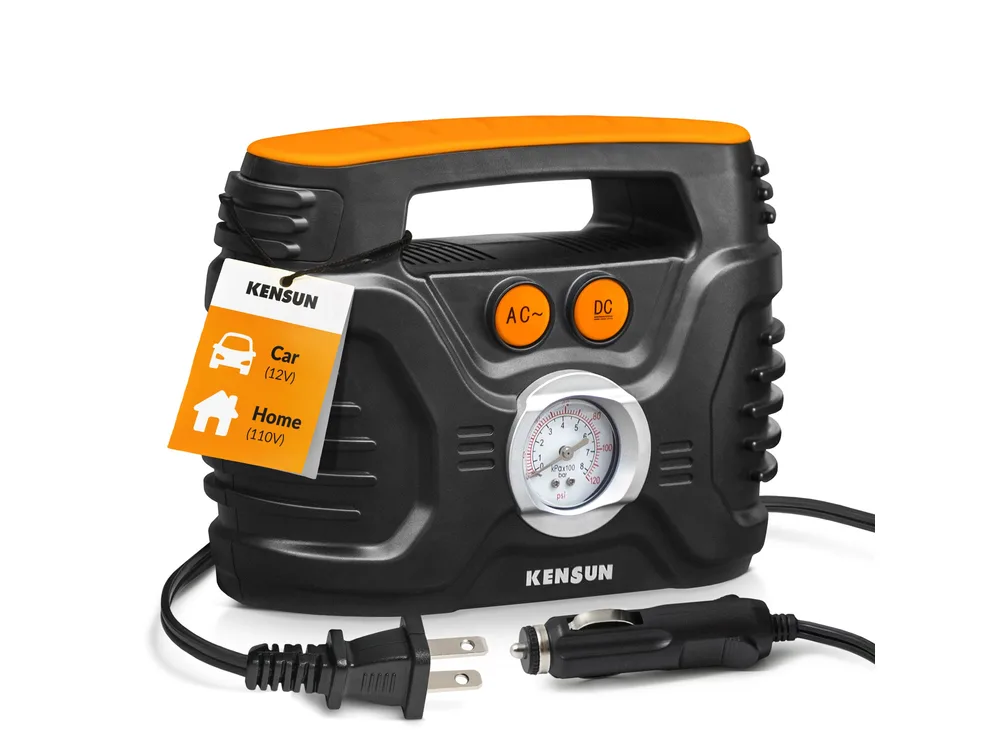
- A corded AC compressor plugged into a garage or household outlet. This is the simplest home setup, and it is what the Kensun AC/DC unit we reviewed is built for: 120V AC for the driveway and a 12V cigarette plug for the road. On AC it took 3 min 40 s to top a 225/65R17 from 28 to 36 PSI in our published measurements.
- A 12V compressor with alligator battery clamps, run from the vehicle battery with the engine on. The VIAIR 88P we reviewed is rated to 120 PSI with a 25-minute duty cycle at 30 PSI, which is the headroom a longer, higher-pressure job needs. It clamps to the battery rather than drawing through a small accessory socket.
- A cordless inflator on a battery charged at home. Convenient, but battery output falls in the cold and the unit is only as ready as the last charge — the trade-offs are in our corded versus cordless guide.
- A caution for the tow vehicle: its 12V accessory socket is fused for small accessories, and a high-draw compressor can exceed that fuse. Clamp leads are there because the unit needs a direct connection to the battery, not because it is a lesser tool.
Common mistakes at home
- Taking a pressure reading minutes after a drive and treating that warm number as the cold target.
- Letting air out of a warm tire to match the placard figure, which leaves it under-inflated once it cools back down.
- Reaching for the maximum pressure molded on the tire sidewall, when the placard on the vehicle or trailer is the figure the tires are meant to run.
- Running all four or six tires back to back and ignoring the duty cycle, then losing the last one to a thermal cut-off.
- Trusting the compressor's built-in gauge. The Kensun we measured read 2.5 to 3 PSI high when new and about 4 PSI high by month four; the VIAIR 88P read 2 PSI high.
- Storing the compressor with a flat or tired battery and discovering it at the start of a trip.
Step by step: topping up in the driveway
- Let the tires cool. Check before the day's drive, or after the rig has sat long enough to reach ambient temperature.
- Read the placard — the driver door jamb on a motorhome, the frame or axle sticker on many trailers — and note the front, rear and any loaded figure.
- Set up safely: chock the wheels, keep the compressor on the ground, and run the engine only if you are working from the vehicle battery with the unit's clamps.
- Inflate one tire at a time and stop a little short of the target, watching the on-board gauge rather than expecting the pump to shut off perfectly.
- Once the pump stops, read the tire again with a stand-alone gauge and let a little air out if you went past the target. The on-board dial gets you close; it does not certify the final number.
- Respect the duty cycle. The Kensun we measured is rated for 10 minutes; across four or six tires, a unit with a longer cycle is the difference between finishing and waiting for a thermal cut-off.
- Re-check cold before you leave. A small correction made in the morning is worth more than a reading taken at a hot midday stop.
Choosing a tool that can finish a home job
Maximum pressure and duty cycle are the two published specs that decide whether a home job finishes. A compressor can be rated for the placard pressure and still not be rated to run long enough for all the tires. Our RV and trailer ranking puts inflation speed and build quality first and states the weights, so you can see how that trade-off was made.
We have not measured an RV or trailer tire on our bench. Our published fill times come from a 225/65R17 and a 265/70R17, not from an RV tire, which is a larger volume again, so those numbers are a floor rather than an estimate. Each review carries the conditions behind its figure.
Frequently asked
Can you inflate RV tires at home?
Yes, and it is the easiest place to do it. Use a corded AC compressor on a household outlet or a clamp-on 12V unit on the vehicle battery, check the tires cold against the placard, and confirm the final pressure with a separate gauge.
What size compressor do I need for RV tires?
Match the compressor to the placard pressure — trailer tires are commonly specified between 65 and 80 PSI — and check the duty cycle, because four or six tires take longer than one. The VIAIR 88P we reviewed is rated to 120 PSI with a 25-minute duty cycle at 30 PSI.
How long does it take to inflate an RV tire at home?
Longer than a passenger tire, because there is more air to move and often a higher target. We have not measured an RV tire, so we do not quote a time for one. Our published fill times are for a 225/65R17 and a 265/70R17, and each review states the conditions.
Should I check RV tire pressure cold?
Yes. Placards specify cold inflation pressure, so a reading taken after towing is a warm reading and will be higher. Set the cold figure before the day's drive, and do not bleed a warm tire down to it.