Guide
How to inflate RV tires at a campsite
A campsite is a good place to top up RV tires — the rig is parked, the wheels are cold, and nobody is waiting on you. It is also where the job goes wrong, because the power you have at a campsite is not the power you have in your driveway.
Why the campsite changes the job
RV and trailer tires hold more air and often run at higher pressures than a passenger car. Our RV and trailer buying page notes trailer tires commonly specified between 65 and 80 PSI, and a motorhome is heavier again. The same top-up that takes a minute on a car is a longer, hotter run on an RV, and the compressor has to be rated for both the pressure and the runtime.
The second difference is power. At home you can reach a wall outlet. At a campsite you are working from what the site provides — a pedestal outlet, the tow vehicle battery, or a portable battery you brought — and that decision is what most often turns a straightforward job into a stalled one.
Match the compressor to the power you actually have
There are three practical ways to power an inflation job at a campsite, and they suit different compressors.
- A corded AC compressor plugged into the campsite pedestal outlet. This is the simplest option when the site provides hookups, because the compressor runs on AC power rather than a battery or a 12V circuit.
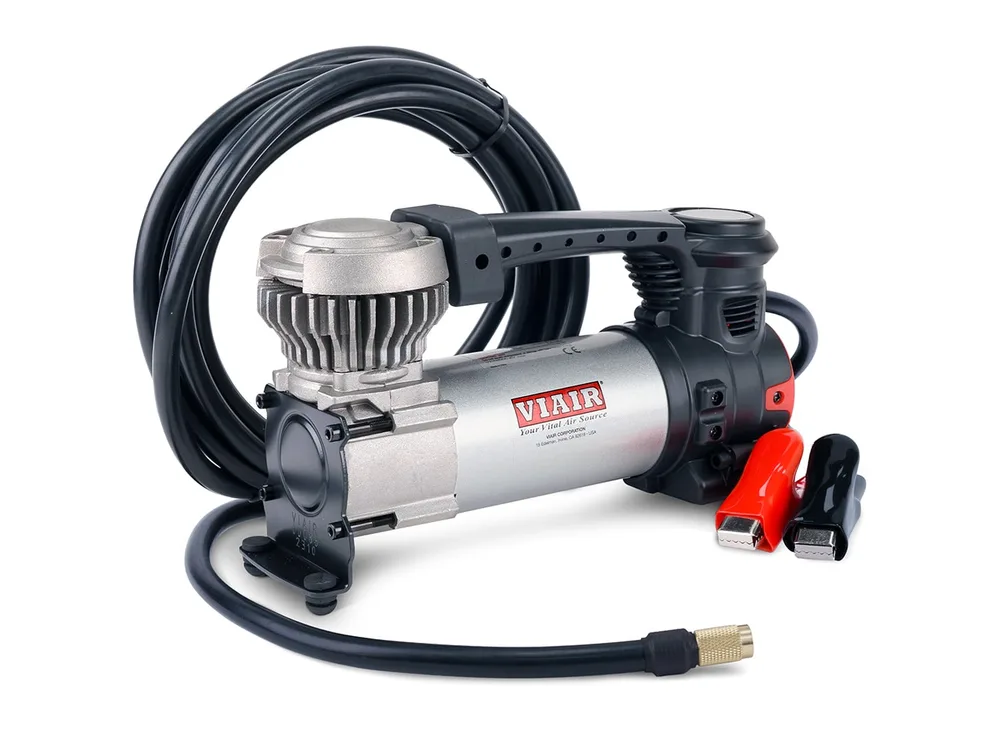
- A 12V compressor with alligator battery clamps, connected to the tow vehicle battery. This is the arrangement our VIAIR 88P review describes, and it draws its current directly from the battery rather than through a small accessory socket. Run the engine while you work if the vehicle allows it, so the battery is not asked to carry the load alone.
- A cordless inflator running on a battery you charged in the rig or at home. Convenient, but battery output falls in the cold and a unit left discharged in a storage bay may not finish the job — the trade-offs are in our corded versus cordless guide.
- Do not assume the RV's 12V accessory socket will run a large compressor. A socket circuit is fused for small accessories, and a high-draw compressor can exceed it. If the unit ships with battery clamps, that is a signal about its current draw, not a downgrade.
Common mistakes at the campground
- Bleeding air from a warm tire to hit the cold placard figure — the tire is then under-inflated once it cools.
- Checking pressures after towing all day, when the tires are hot, and treating that reading as the target.
- Using the maximum pressure molded on the tire sidewall instead of the vehicle or trailer placard.
- Trusting the compressor's built-in gauge and never confirming the final pressure with a separate one.
- Running a high-pressure top-up on four or six tires without watching the duty cycle, then hitting a thermal cut-off partway through.
- Leaving the job half done because the chosen power source could not sustain it — the compressor was fine, the outlet or battery was not.
Step by step: topping up at the campsite
- Let the tires cool. The placard figure is a cold pressure, so check before the day's drive or after the rig has sat long enough to cool.
- Read the placard — the driver door jamb on a motorhome, the frame or axle sticker on many trailers — and note the front, rear and any loaded or towing figure.
- Choose the power source deliberately: pedestal outlet for a corded unit, tow vehicle battery for a clamp-on 12V unit, or a charged battery for a cordless one.
- Set up safely: chock the wheels, keep the compressor on the ground rather than on a seat, and connect battery clamps with the engine off before starting it if you are going to run the engine.
- Inflate one tire at a time, stopping a little short of the target and watching the on-board gauge rather than trusting the pump to shut off perfectly.
- Verify each tire with a separate gauge and bleed a little air if you overshot. Our guides on choosing a gauge and checking pressure cover why the final number should not come from the pump.
- Watch the duty cycle on a long job. If the unit is rated for a set run time before it must cool, respect it on the second or third tire rather than waiting for a thermal cut-off.
- Re-check cold before you leave. A small correction made in the morning is worth more than a reading taken at a hot midday fuel stop.
Choosing a tool that can finish the job
For an RV or trailer, the two published specs that matter most are maximum pressure and duty cycle. A unit can be rated for the pressure and still not be rated to run long enough to do all the tires. Our RV and trailer ranking re-weights the sub-scores we publish — inflation speed and build quality first — for exactly that reason, and states the weights so you can disagree with them.
If you are buying for campsite use, weight the power source heavily too. A 12V corded unit with battery clamps works wherever the vehicle is parked, while a cordless unit trades that for battery state and cold-weather capacity. On the pressure side, the VIAIR 88P we reviewed publishes a 120 PSI maximum and a 25-minute duty cycle at 30 PSI, which is the kind of headroom an RV or trailer top-up needs.
We have not measured an RV or trailer tire on our bench, and this guide does not pretend otherwise. Our published fill times are for a 225/65R17 and a 265/70R17; an RV tire is a larger volume again, so treat those numbers as a floor rather than an estimate. The reviews state the conditions alongside every figure so you can compare them honestly.
Frequently asked
Can you inflate RV tires at a campsite?
Yes, provided the compressor is rated for the pressure and you have a sensible power source. A corded unit can run from the pedestal outlet, and a 12V unit with battery clamps runs from the tow vehicle battery. The limit is usually the power source and the duty cycle, not the campsite itself.
Can I run a tire inflator off the campsite hookup?
Only a corded AC compressor should run from the pedestal outlet. A 12V compressor is designed for the vehicle battery or a 12V socket, not for AC power, and a high-draw unit should not be run through a small accessory socket at all.
How long does it take to inflate an RV tire?
Longer than a passenger tire, because there is more air to move and often a higher target pressure. We have not measured an RV tire, so we do not quote a time for one. Our published fill times are for a 225/65R17 and a 265/70R17, and the reviews state the conditions with each figure.
Do I need to check RV tire pressure cold?
Yes. Placards specify cold inflation pressure, so a reading taken after towing is a warm reading and will be higher. Set the cold figure in the morning, and do not bleed a warm tire down to it.