Guide
RV tire inflation tips for cold weather: a winter checklist
A motorhome or trailer tire that was correct in October is often several pounds low by the first hard freeze. Nothing has failed — the air inside contracted — but a loaded RV is the wrong place to ignore it.
Why a cold snap matters more on an RV
Tire pressure falls as the air inside cools. The usual industry rule of thumb is about 1 PSI for every 10°F of temperature change, so a 30–40°F overnight drop — routine across much of the U.S. in winter — can move a tire several pounds without any air escaping. We explain the physics in our guide to why tire pressure drops in cold weather.
An RV or trailer raises the stakes in two ways. The tires often run at higher placard pressures than a passenger car — our RV and trailer buying page notes trailer tires commonly specified between 65 and 80 PSI — so the same temperature swing is a larger share of a smaller margin. And a motorhome or trailer may sit for weeks between trips, which is exactly when a slow leak and a cold snap combine.
What “cold” means when you check
Placards specify cold inflation pressure: the pressure before the tire has been driven and warmed. Check in the morning, before moving the RV, or after it has been parked long enough to cool. A reading taken after a highway run will be higher, and bleeding air to hit the cold number only leaves the tire under-inflated once it cools again.
Do not chase the pressure you set in summer. The target is the placard figure, measured cold, in the conditions you are in now.
Common mistakes
- Setting summer pressures in a warm garage and calling the job done.
- Treating a dashboard TPMS reading as a pressure gauge — it is a warning system, not a calibrated instrument.
- Bleeding air from a warm tire to hit a cold target.
- Assuming one tire that keeps reading low is a weather effect rather than a leak.
- Leaving a cordless inflator in a freezing storage bay and expecting a full battery in the morning.
- Using a car-sized compressor for a long, high-pressure top-up and stopping halfway through the fourth tire.
A cold-weather routine, step by step
- Check pressures cold, before the first move of the day.
- Use the vehicle placard — usually in the driver door jamb or on the trailer frame — not the number on the tire sidewall.
- Top up to the placard figure and verify the final number with a separate gauge.
- Re-check after the next sharp temperature drop, not just once a season.
- If one tire is consistently lower than the others, test for a leak instead of topping it up again.
Choosing a tool that can finish the job
On an RV or trailer, the two published specs that matter most are maximum pressure and duty cycle. A unit can be rated for the pressure and still not be rated to run long enough to do four tires. Our RV and trailer ranking reflects that duty by weighting inflation speed and build quality most heavily, with gauge accuracy close behind.
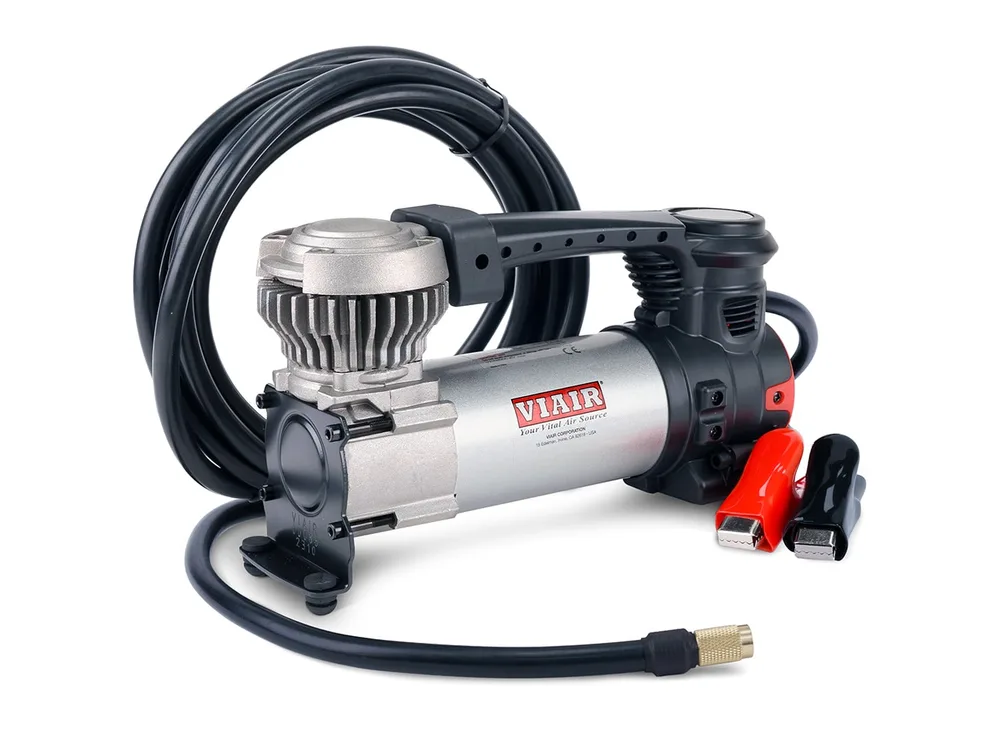
Cold adds two more constraints: battery output falls with temperature, and hoses stiffen. A 12V corded compressor avoids the battery problem, and the reviews on this site state which hoses stayed flexible in the cold. The VIAIR 88P we reviewed publishes a 120 PSI maximum and a 25-minute duty cycle at 30 PSI, with a 16 ft hose that the review notes stays flexible in the cold.
Whatever you carry, keep a separate gauge in the rig. The built-in gauge is convenient, and the accuracy figures in our reviews are exactly why we verify the final pressure independently.
Frequently asked
How much does RV tire pressure drop in cold weather?
About 1 PSI for every 10°F of temperature change is the common rule of thumb. It is an approximation from the gas laws rather than a fixed constant of ours, but it explains why the first cold snap moves every tire at once.
Should I run higher pressure in winter to compensate?
No. Set the placard pressure, measured cold, and re-check after the next sharp drop. A permanent winter offset just leaves you guessing for the rest of the season.
Can a portable inflator handle trailer tires at 80 PSI?
Some can. Check the maximum-pressure and duty-cycle specs before you buy, and expect a longer job than a passenger-car top-up — our RV and trailer page ranks the units that publish those figures.
Is it normal for trailer tires to lose pressure over winter storage?
Some loss is normal as the temperature falls. A tire that stays consistently lower than the others is a leak to investigate rather than a weather effect to top up.