
Guide
Why is my tire pressure gauge reading different?
Two gauges, one valve, two different numbers. The disagreement is rarely a mystery: it comes from a stated tolerance, a temperature difference, a poor seal, or the way the reading was taken. Here is how to work out which gauge to trust.
Two gauges, two numbers
You check a tire with the gauge in the glovebox and get 34 PSI. You check it again with the gauge in the garage and get 31. Nothing changed except the tool, and now you do not know which number to act on.
This is common, and it does not mean one of the gauges is broken. Every gauge is allowed to be wrong by some amount, and plenty of drivers own two gauges that are wrong in opposite directions.
What “accurate” actually means
A gauge is sold with an accuracy figure, and that figure is a tolerance, not a promise of perfection. A gauge rated ±3 PSI can read 33 when the true pressure is 30 and still be within its own specification. Two gauges rated ±3 PSI can legitimately disagree by 6 PSI and both be in spec.
Pay attention to how the tolerance is written. A fixed figure such as “±1 PSI” stays the same across the scale. A percentage such as “±2% of reading” grows with the pressure, so it is looser at 80 PSI than at 30. A gauge with no stated figure at all is the one to be suspicious of, because there is nothing to compare it against.
Resolution is separate from accuracy. A digital gauge that shows tenths of a pound looks more precise, but the decimal is only how finely it displays, not how close it is to the true pressure.
Why two gauges disagree
Temperature is the most common cause that is not the gauge at all. Air pressure falls as the air cools, so a tire checked in a warm garage and again on a cold morning will read differently even with the same gauge. The rule of thumb is about 1 PSI for every 10°F, which is a weather effect rather than a gauge error.
A leaking chuck or a poor seal on the valve stem is the second. If air escapes while the gauge is pressed on, the number you read is taken during a leak, and a slip-on chuck that does not seat fully will read low. A screw-on or locking chuck removes that variable.
The third is technique. Reading a dial from an angle, holding a digital gauge in direct sun, or taking a reading immediately after driving all shift the number. Cold pressure means the tire has not been driven; a reading taken after a highway run is a warm reading and will be higher.
The fourth is the gauge itself. A mechanical gauge can lose calibration after a drop, and a cheap one may never have been close. That is why the useful test is not “is this gauge accurate”, but “how far apart are these two gauges, and which one do I compare against a known reference”.
The mistakes that make a gauge look wrong
- Bleeding air from a warm tire to hit the cold placard number.
- Comparing a reading taken in a warm garage with one taken after a drive.
- Trusting a dashboard TPMS display as a calibrated gauge rather than a warning system.
- Reading a dial at an angle or through a dirty lens.
- Assuming a digital gauge is accurate because it shows a decimal.
- Using the number molded on the tire sidewall instead of the vehicle placard.
How to compare your gauges, step by step
- Check the tires cold — before the vehicle has been driven — so temperature is not one of the variables.
- Bring every gauge you own to the same valve, one after another, without adding or releasing air.
- Write down each reading and the gauge that produced it.
- Repeat on a second tire so a single bad valve does not decide the conclusion.
- If one gauge is consistently high or low by the same amount, you have found its offset, and you can keep using it as long as you allow for that offset.
- If the gauges disagree by more than their stated tolerances add up to, the outlier is the one to replace.
What we measured in our own reviews
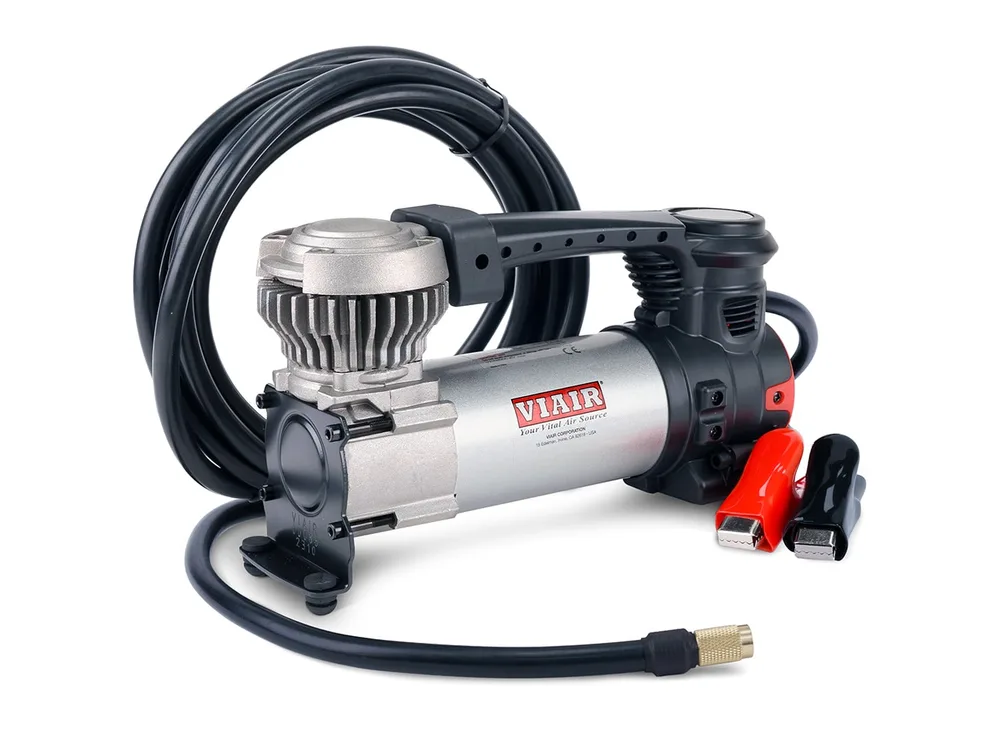
On this site we publish the gauge error we find, because it decides whether a built-in gauge is good enough to finish on. In our reviews, the VIAIR 88P analog dial read about 2 PSI high at a true 30 PSI, the AstroAI was within about 0.5 PSI, and the EPAuto read about 3.5 PSI high.
The spread is the point: a gauge being off is normal, and what matters is knowing the size and direction of the offset. If you want a gauge whose own reading you can lean on, our guide to choosing one walks through the features that decide it, and the best tire pressure gauge page ranks the models we have measured.
Frequently asked
Why is my tire pressure gauge reading different from the one at the gas station?
The station gauge, your gauge and the true pressure are three different things. Station inflators are handled thousands of times and are rarely calibrated, and their tolerance is usually wider than a handheld gauge. Treat your own gauge as the reference and use the station only to add air.
Can temperature make my gauge read differently?
Yes — a tire checked cold and again after a drive will read higher when warm, and a cold snap will drop every tire at once. That is the air contracting and expanding, not the gauge changing. Compare cold readings with cold readings.
Is a digital tire pressure gauge more accurate than an analog one?
Not automatically. Digital gauges are easier to read and often resolve to a tenth of a pound, but accuracy depends on the stated tolerance and the sensor, not the display. Some analog gauges are more accurate than some digital ones.
How do I know which of my two gauges is right?
You need a third reference — a gauge with a tighter published tolerance, or a shop you trust. Compare both against it cold, and keep the one that is closest. If neither has a stated accuracy figure, that is the real answer: neither is a reference.