
Guide
What PSI should I air down to for off-roading?
There is no single off-road PSI. Terrain, vehicle weight and tire construction set the range — and the door jamb still owns highway pressure. Use the chart below as a starting point, then adjust for how the vehicle behaves.
Starting ranges by terrain
These are common working ranges for light trucks and SUVs on LT or all-terrain tires — not manufacturer mandates. Always stay above the tire maker’s and vehicle maker’s minimums, and never drive aired-down at highway speed.
| Terrain | Typical starting range | Notes |
|---|---|---|
| Highway / pavement | Door-jamb placard | Always restore before the road home |
| Gravel / graded dirt | Placard −5 to −10 PSI | Modest drop; ride comfort and chatter |
| Forest roads / washboard | Often low-to-mid 20s PSI | Softens the chassis; watch heat if you speed up |
| Rock / technical trail | High teens to low 20s PSI | Longer contact patch; sidewall exposure rises |
| Sand / dunes | Mid-teens PSI (sometimes lower) | Bead retention becomes the limit — go carefully |
| Mud | Often similar to rock, then adjust | Too low can dig in; too high spins |
How to use the chart safely
- Set pressures cold before you leave pavement, or as soon as you hit the trailhead.
- Drop all four tires evenly — a dedicated deflator is faster and more consistent than chasing each valve by hand.
- Use a gauge that reads accurately in the teens; this is where on-board inflator dials are weakest.
- Air back up before highway speeds. Low pressure at road speed builds heat and risks the bead.
Why airing up is harder than airing down
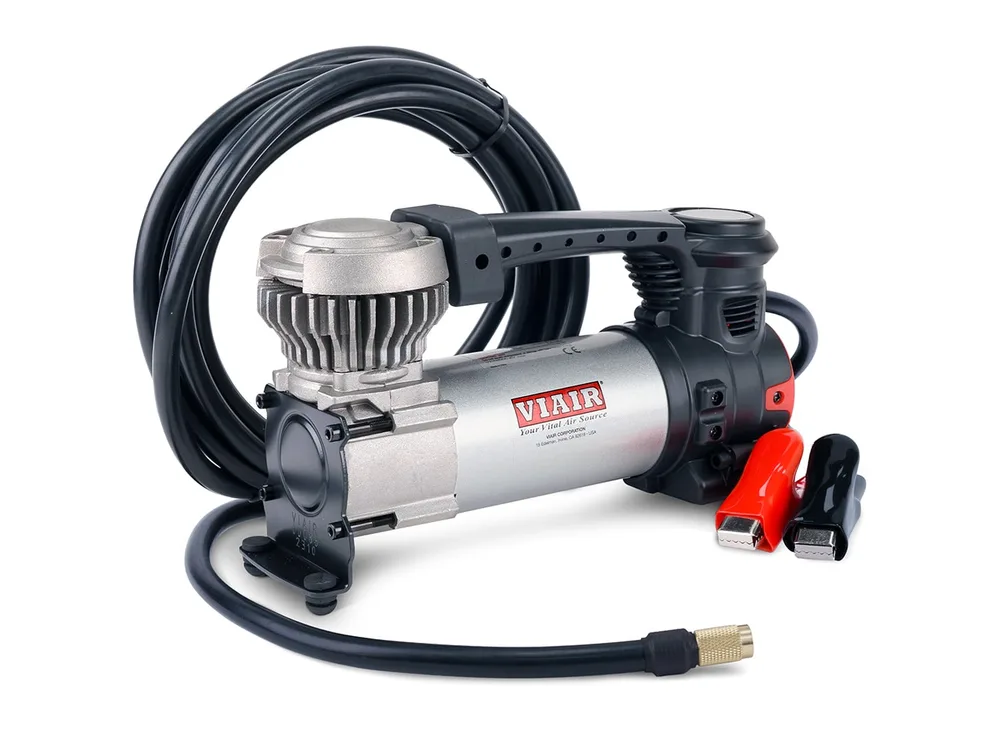
Letting air out is easy. Putting 15–20 PSI back into four oversized tires is a sustained heat job for a portable compressor. Duty cycle and airflow decide whether you finish on the trailhead or wait for a thermal cut-off.
That is why our off-road inflator ranking weights inflation speed and build quality first — and why a high max-PSI figure on the box is almost irrelevant here.
Tools that make the job honest
A low-pressure gauge, a set of deflators, and a compressor that can finish four tires belong together. Linking only one of them leaves the other half of the air-down / air-up loop unfinished.
Frequently asked
What PSI should I air down to for off-roading?
Start from the terrain ranges above, stay above manufacturer minimums, and adjust for vehicle weight and tire construction. There is no universal number.
Can I drive home on aired-down tires?
No. Restore placard pressure before highway speeds — heat and bead risk climb quickly when pressure is low and speed is high.
Do I need a special gauge to air down?
A gauge that is readable and accurate around 15–20 PSI helps more than a highway dial. Our low-pressure gauge ranking covers that job.