Guide
What PSI should my tires be?
Your car already knows the answer and has written it down. The correct pressure is on the vehicle placard — a sticker in the driver’s door jamb, on some vehicles the fuel door or glovebox — and it is a specific figure for your vehicle, not a general rule and not the number moulded into the tire.
The placard is the authority
Every vehicle sold carries a tire information placard, and it lists the recommended cold inflation pressure for the tires that vehicle was built with — usually one figure for the front axle and one for the rear, sometimes different, sometimes the same.
That figure was chosen for the weight the vehicle carries, the way it handles and the load the tires were rated for. It is the only number on the car that accounts for all three.
Not the sidewall, and not a round number
- The sidewall figure is the tire’s maximum cold pressure at its maximum load rating — a ceiling, not a target. Running it on a car that does not need it gives a harsh, less grippy ride and wears the centre of the tread.
- "32 PSI" is a habit, not a specification. Plenty of vehicles call for 33, 35, 36 or 39 PSI, and some specify different front and rear figures.
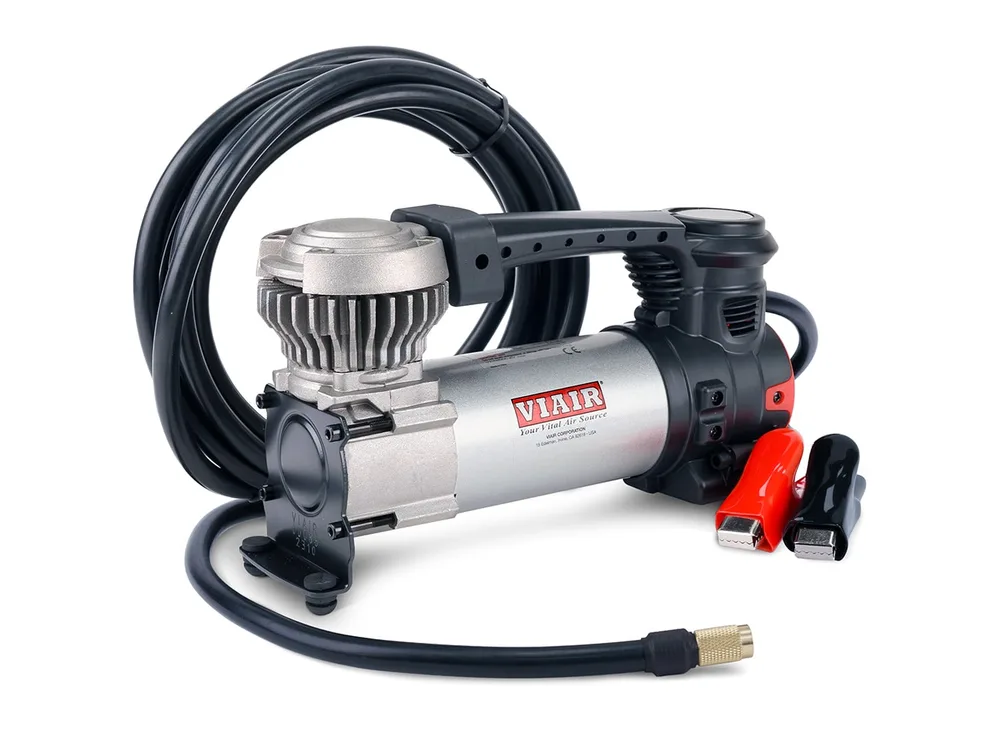
- "Max pressure" on a portable inflator is the pump’s ceiling, and has nothing to do with what your tires should hold.
Front and rear are often different
On many cars both axles take the same pressure. On trucks, vans and anything that regularly carries a load, the rear figure is often higher when the vehicle is loaded — some placards print two rear figures, one for normal and one for fully loaded, and sometimes add a towing figure.
If you tow or carry a heavy load regularly, the loaded figure is the one to use, and the one to go back to when the load comes off. Over-inflating an empty truck is the mirror image of the same mistake.
Cold means cold, and temperature moves the number
Pressures are specified cold — measured before the vehicle has been driven, and at ambient temperature. Driving heats the tire and raises the reading, which is why a hot reading taken at a fuel station is not directly comparable to the placard, and why letting air out of a hot tire to hit the placard figure is a mistake.
Ambient temperature matters too. Tire pressure falls roughly in step with temperature — a commonly cited rule of thumb is about 1 PSI per 10°F — so a tire set to 35 PSI in a warm garage can read several pounds low on a freezing morning. That is physics, not a leak, and it is why pressure checks belong in the routine before winter rather than after the first hard freeze.
Where to check it, and with what
Check when the tires are cold, in all of them, including the spare. Read the placard, compare, and correct — and if a tire is persistently low, that is a slow leak, not a pressure preference.
The gauge matters more than people expect: a cheap gauge that reads two pounds high or low will leave every tire wrong in the same direction, and you will not see it. We publish accuracy figures for the gauges we have tested; a TPMS warning light is not a substitute, because it typically only alerts well below the recommended pressure.
What this page is not
We have not measured your vehicle, and we do not publish a general table of pressures by car model — the placard is specific and we are not going to guess at it for you. What we do publish is measured accuracy and range for the gauges we own, so you can trust the number you are reading.
Frequently asked
Should I use the PSI on the tire sidewall or the door jamb?
The door jamb. The sidewall figure is the tire’s maximum at full load, which is usually higher than your vehicle needs; the placard is the pressure specified for your vehicle’s weight and handling.
Why does my tire pressure drop in cold weather?
Air contracts as it cools, so pressure falls with ambient temperature — roughly 1 PSI per 10°F as a common rule of thumb. A tire that was correct in a warm garage can read several pounds low on a cold morning.
Can I just set them all to 32 PSI?
Only if your placard says 32. Plenty of vehicles specify a different figure, and many specify a different one for the rear axle or for a loaded vehicle. Setting a habit rather than a specification is how tires end up wrongly inflated for years.