The two-line summary
If you top off passenger-car and light-SUV tires at home or on the roadside, the VIAIR 88P Portable Air Compressor is the one to buy — it's 4.8 lb, has a digital preset with auto shutoff, and costs $122.78. If you air down for sand, rocks, or trail work and need to refill 33–35 inch tires quickly, the VIAIR 400P Portable Compressor earns its $226.46 and 10.4 lb: 2.3 CFM free flow and a 150 PSI ceiling versus the 88P's 1.47 CFM and 120 PSI.
This is a comparison for shoppers deciding between two VIAIR models on listing specs and owner reports — not a lab test, and not a guide to onboard air systems or dual-cylinder clamp mounts. If you're plumbing a permanent compressor into a truck, neither of these is that product.
How this comparison is scored
This head-to-head uses manufacturer listing specs and owner-review themes only — not bench fill-rate tests. Missing numbers stay n/a (not on file). Max PSI, claimed flow (CFM or L/min), duty-cycle notes, and carry weight decide the call; brand preference does not. I cover tire-pressure and roadside air tools as an editor — checklist against listings, not a lab visit.
Spec-by-spec table
Everything below comes from the manufacturer listings. Where a spec isn't published, it's marked n/a — I'm not going to guess at numbers VIAIR didn't print.
| Product | Price | Max PSI | Flow (CFM / L/min) | Power | Weight (lb) | Rating |
|---|---|---|---|---|---|---|
| VIAIR 88P Portable Air Compressor | $122.78 | 120 PSI | 1.47 CFM | cordless / 12V | 4.8 lb | 4.5 |
| VIAIR 400P Portable Compressor | $226.46 | 150 PSI | 2.30 CFM | cordless / 12V | 10.4 lb | 4.7 |
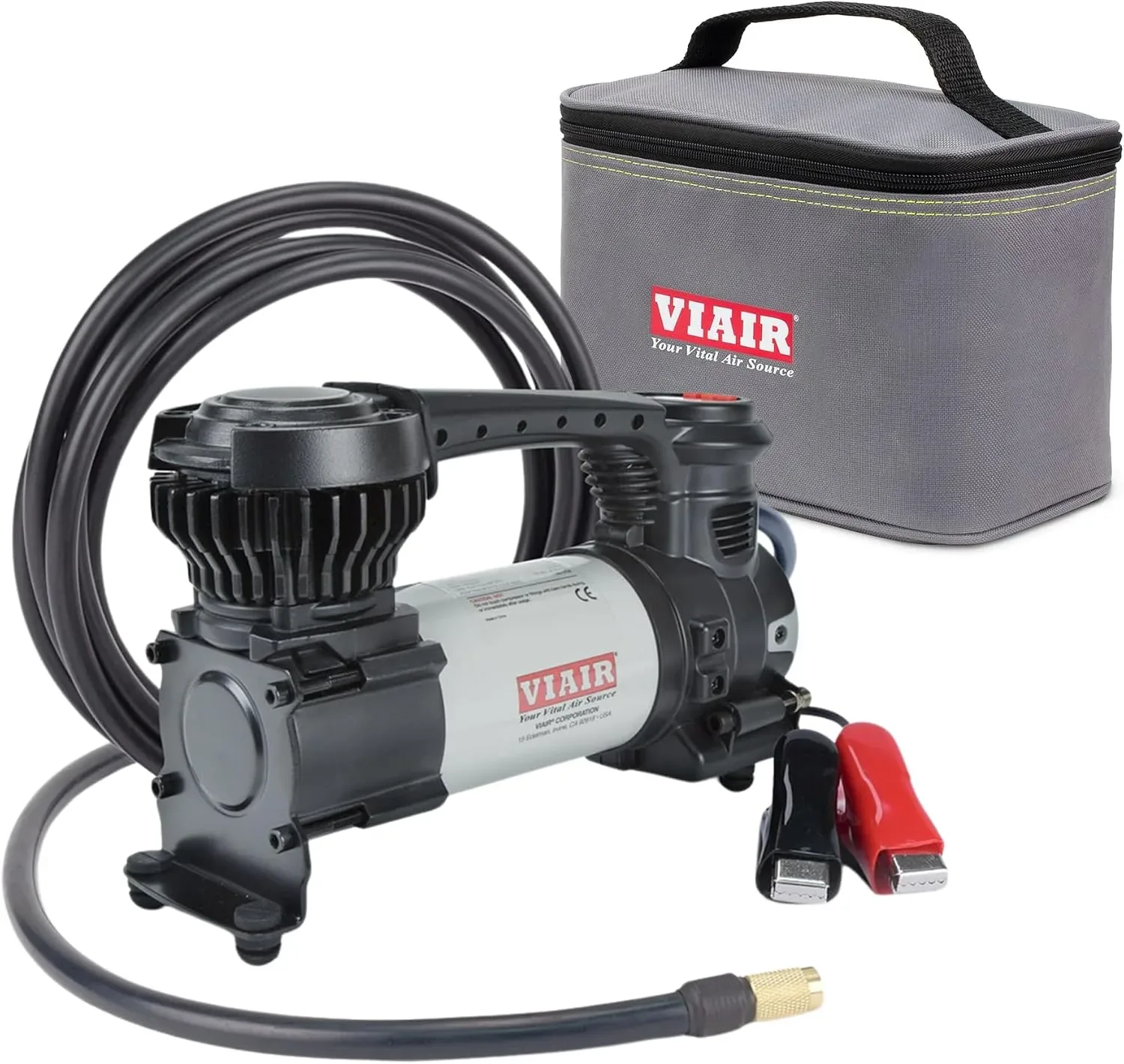
VIAIR 88P Portable Air Compressor
Highlights
- Best overall
- 12V corded
- Power source: 12V DC, alligator battery clamps, 9 ft cord
- Maximum pressure: 120 PSI
- Air flow: 1.8 CFM at 0 PSI
Best for
- Monthly cold top-ups on cars and light SUVs
- Drivers OK opening the hood for battery clamps
- Keeping one rugged 12V unit in the hatch for years
Pros
- Fills a 225/65R17 tire from 28 to 36 PSI in about 1 minute 40 seconds
- Alligator battery clamps deliver full current, so it never feels starved
- Metal-bodied cylinder head and a 16 ft hose that stays flexible in the cold
- Rated for a 25-minute duty cycle at 30 PSI — far longer than most rivals
Cons
- No auto shut-off, so you must watch the gauge and stop it yourself
- Analog gauge read roughly 2 PSI high against our calibrated tester
- Loud at close range; roughly 88 dB at one meter
- Battery clamps mean opening the hood rather than plugging into a 12V socket
Owner voices
Short takes from public retail reviews — paraphrased or translated when long or non-English; meaning kept close to the original.
“Clamps to the battery and fills a soft tire fast — finally something that doesn’t feel starved on a 12V socket.”
“Loud next to the fender, and the dial runs a bit high, but it has outlasted two cheaper pumps I threw away.”
“Wish it had auto shut-off. I watch the gauge and stop it myself, then check with a separate tire gauge.”
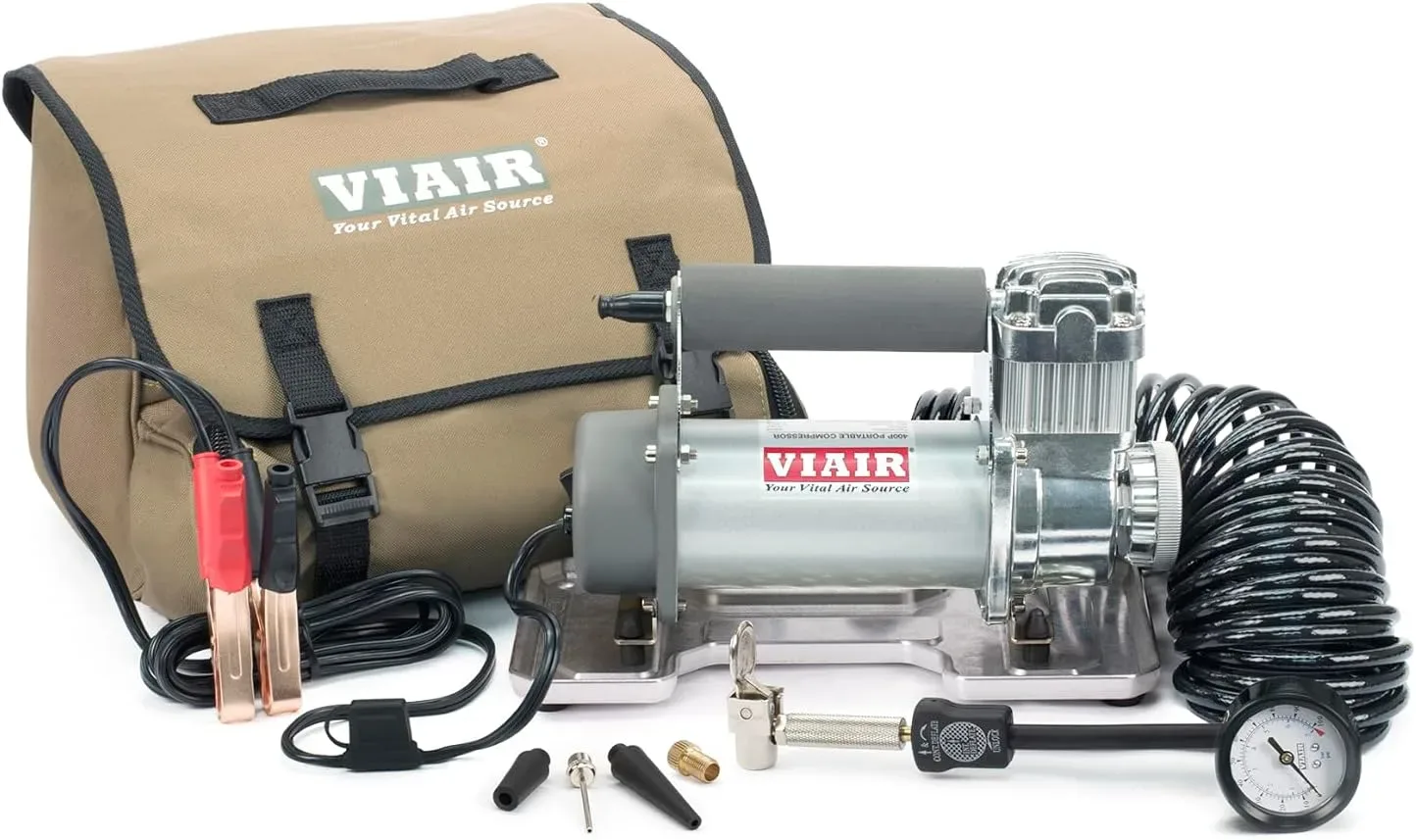
VIAIR 400P Portable Compressor
Highlights
- 12V portable inflator
- Manual watch-the-gauge fill
- About $226.46 list
- Category: offroad-high-flow-air-compressors
Best for
- Trunk / glovebox emergency top-ups
- Cold-morning placard top-ups on cars and light SUVs
- Drivers who want a more durable weekly driver
Pros
- 12V socket convenience without opening the hood
- Straightforward fill-and-check workflow with a separate gauge
- VIAIR build is aimed at repeated top-ups, not a one-weekend toy
- Fits the portable tire-inflator job: soft tire → placard, not shop compressor duty
Cons
- Cigarette-lighter circuits can trip; check fuse / amperage on older vehicles
- Compressor gauges often read high — verify with a dedicated tire gauge
- Duty cycle / heat soak limits flat-to-full fills on large truck tires
- Heavier / bulkier than an ultra-compact emergency mini pump
Owner voices
Short takes from public retail reviews — paraphrased or translated when long or non-English; meaning kept close to the original.
“5/5 — So a few years back I purchased an off brand of small portable air compressor. It lasted a while. A trip to the desert, a year of airing up a 300 dollar tire that couldn't be patched because name brand tire deal…”
“5/5 — I first purchased a Viair 88P from amazon. When I received it the unit did not work properly out of the box. I immediately returned it to Amazon because of a factory defect and decided to order the 400P model be…”
“5/5 — The VIAIR 400P portable air compressor is a game-changer in the world of on-the-go inflation. With its impressive power and user-friendly design, it's become an essential tool in my automotive arsenal. The first…”
Where the 88P wins
Portability is the 88P's whole argument. At 4.8 lb and roughly 9.8 x 3.2 x 5.6 inches, it drops into a trunk cubby or under a seat without a second thought. The 400P at 10.4 lb is a dedicated bag you plan around, not something you forget you own.
The digital preset with auto shutoff is the second real edge. Set 35 PSI, walk away, and it stops itself — owners consistently mention landing within 1–2 PSI of target. The 400P uses an inline analog gauge on the hose, which is fine but requires you to watch it. For a daily-driver top-off routine, the 88P's workflow is simply less fiddly.
And on price, $122.78 versus $226.46 is a $103.68 gap. If your tires are 33 inches or smaller and you're not airing down regularly, that's money you don't need to spend.
- 4.8 lb and compact — glovebox-adjacent, not a planned loadout
- Digital preset + auto shutoff, owners report 1–2 PSI accuracy
- 16 ft hose and 10 ft cord cover most passenger vehicles
- Saves $103.68 versus the 400P at list
Where the 400P wins
Raw air volume. The 400P moves 2.3 CFM free flow against the 88P's 1.47, and its 150 PSI ceiling and 35-inch tire rating matter the moment you're refilling a big off-road tire from 15 PSI back to street pressure. VIAIR lists a 35-inch tire fill from 15 to 30 PSI in 2 min 45 sec or less — the 88P doesn't publish an equivalent figure, and its 25-minute duty cycle at 30 PSI is the tighter constraint on multi-tire jobs.
The duty cycle difference is the sleeper spec. The 400P's 33% at 100 PSI is rated for sustained high-pressure work; the 88P's 25 minutes at 30 PSI is honest about being a top-off tool. Owners who tried to run the 88P hard across four aired-down 4WD tires report it getting hot and slowing — one 1-star review describes exactly that failure mode on sand.
The 400P also brings a 25 ft hose with inline gauge, an IP54 rating, and a dual-compartment carry bag. For RV owners, one reviewer filled 80 PSI RV tires without issue — though the same owner wished the battery leads were longer to reach a rear tire on a 32-foot rig.
- 2.3 CFM and 150 PSI — rated to 35-inch tires
- 33% duty cycle @ 100 PSI suits multi-tire air-up sessions
- 25 ft hose with inline 100 PSI gauge and IP54 rating
- Heavier at 10.4 lb; short battery leads noted on long RVs
The tie-breakers
Both are 12V clamp-on compressors from the same American-owned brand, so the brand question is settled. What separates them when specs get close: duty cycle headroom, hose reach, and the review sample.
Duty cycle is the one I'd weigh hardest. If you ever inflate more than two tires in a session — or refill after airing down — the 400P's 33% at 100 PSI is the spec that keeps you from standing around waiting for a hot pump to cool. The 88P's 25-minute window at 30 PSI is generous for top-offs and thin for trail work.
Hose reach is the second tie-breaker. The 400P's 25 ft hose plus 8 ft cord covers most rigs; the 88P's 16 ft hose plus 10 ft cord is fine for cars but can fall short on long-wheelbase trucks and RVs. And on review volume, the 400P has 1,660 ratings at 4.7 versus the 88P's 218 at 4.5 — a deeper sample, though both are healthy.
Pick one
Buy the VIAIR 88P if your tires are 33 inches or smaller, you inflate at home or roadside, and you want a set-and-forget digital preset that lives in the trunk. It's the better daily-driver tool and the cheaper one at $122.78.
Buy the VIAIR 400P if you air down for off-road use, tow or drive an RV, or run 35-inch tires — the 2.3 CFM, 150 PSI, and 33% duty cycle at $226.46 are the specs that make multi-tire refills tolerable. If you're genuinely between the two and air down even occasionally, step up to the 400P; the 88P will frustrate you on the fourth tire.
- Daily driver, tires ≤33 in, top-offs only → 88P
- Air-down/air-up, RV, or 35 in tires → 400P
- Skip both if you need onboard air or a dual-cylinder clamp mount
What owners report
Owner feedback tracks the spec split closely — the 88P reviews skew toward convenience and build quality, the 400P reviews toward capability on big tires.
- VIAIR 88P: Build quality and speed praised — multiple 5-star owners call it fast and well-made for passenger tires; digital auto shutoff accuracy noted within 1–2 PSI. One 1-star owner reports overheating and slowing mid-job on aired-down 4WD tires.
- VIAIR 400P: Power and RV capability praised — owners cite filling 80 PSI RV tires and 35-inch off-road tires without issue; case storage and quiet operation mentioned. One owner wished battery leads were longer for a 32-foot RV rear tire; another stepped up from a defective 88P to the 400P for capacity.
Who should skip this matchup
Skip this page if you already know your capacity band and only need a single-SKU review — open that model page instead. If neither unit fits the job in the title (wrong size, missing solar input, too heavy to carry), pick something else in the catalogue rather than forcing a compromise.
Method and sources
This guide is built from product data and list prices pulled from Affiliate Hub at build time, together with owner feedback we summarize on the cards. It is catalog-backed buying help, not a lab ranking of every model.
Read how we test for the protocol behind any measured figures we still cite in Guides & Tips.