Who it is for / not for
The VIAIR 88P is a 12V portable compressor for drivers who want a real inflator in the trunk without paying for a dual-cylinder truck clamp. It lists at $103.95, currently sells for $89.89, and has hit that same $89.89 as its historical low. If you drive a passenger car, SUV, or light truck and want to stop hunting for a working gas-station air machine, this is the shortlist unit.
It is not for everyone. The 120 PSI max and 25-minute duty cycle at 30 PSI put it in the daily-driver and light-overland lane, not the heavy RV or commercial-tire lane. If you need to air up 80 PSI RV tires back-to-back, or you run 37-inch mud tires on a regular basis, this is the wrong tool. It is also not a glovebox cordless inflator — it clamps to the battery and wants the engine running.
- Suits: cars, SUVs, Jeeps, light trucks up to 33-inch tires, ATVs, and trail-side top-offs.
- Skip if: you need continuous high-pressure RV fills, a cordless glovebox unit, or a dual-cylinder clamp compressor for big off-road tires.
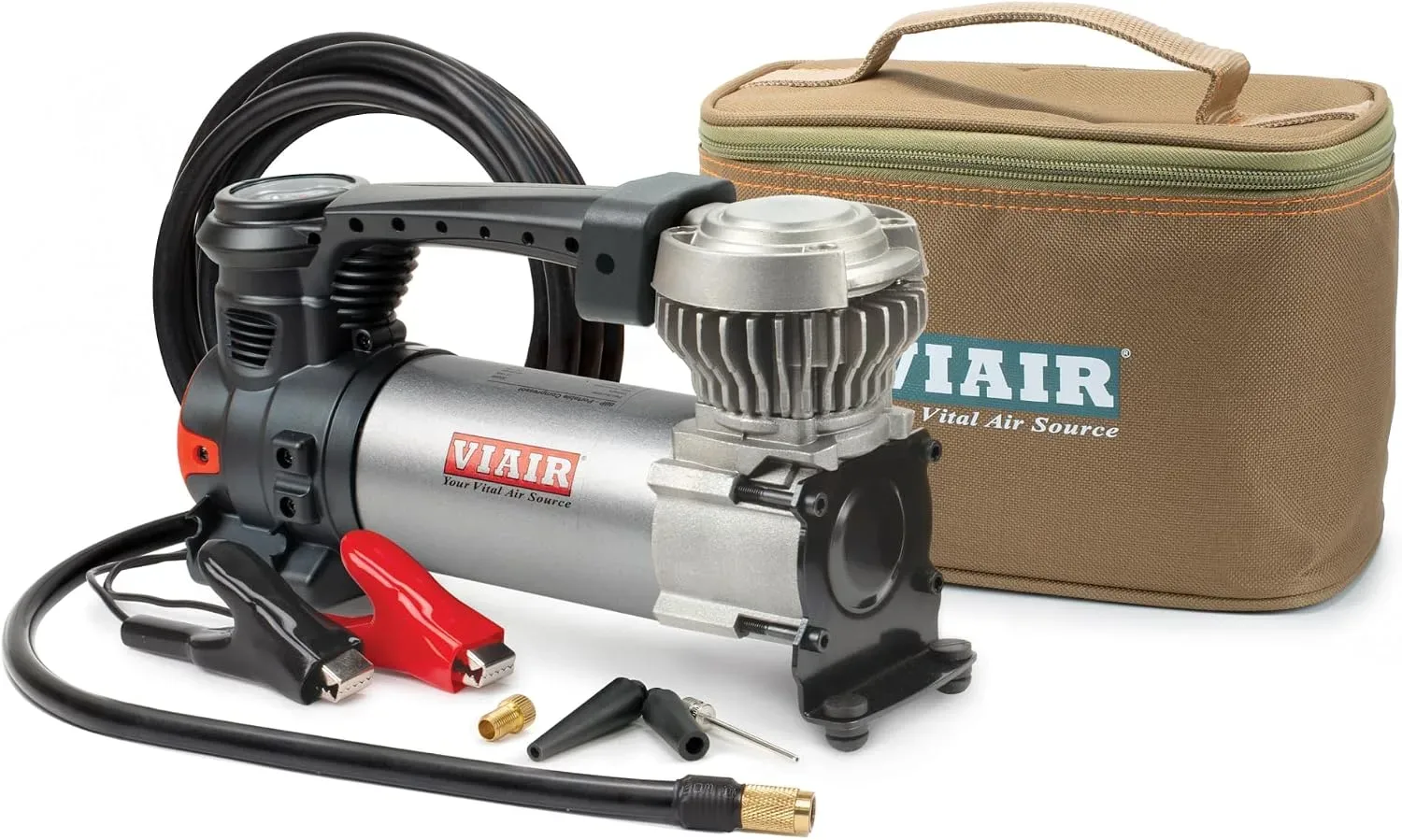
VIAIR 00088 88P Portable Compressor
Highlights
- 12V portable inflator
- Manual watch-the-gauge fill
- About $103.95 list
- Category: portable-tire-inflators-suv-truck
Best for
- Trunk / glovebox emergency top-ups
- Cold-morning placard top-ups on cars and light SUVs
- Drivers who want a more durable weekly driver
Pros
- 12V socket convenience without opening the hood
- Straightforward fill-and-check workflow with a separate gauge
- VIAIR build is aimed at repeated top-ups, not a one-weekend toy
- Fits the portable tire-inflator job: soft tire → placard, not shop compressor duty
Cons
- Cigarette-lighter circuits can trip; check fuse / amperage on older vehicles
- Compressor gauges often read high — verify with a dedicated tire gauge
- Duty cycle / heat soak limits flat-to-full fills on large truck tires
- Heavier / bulkier than an ultra-compact emergency mini pump
Owner voices
Short takes from public retail reviews — paraphrased or translated when long or non-English; meaning kept close to the original.
“5/5 — This is an excellent air compressor. Better than what you may need. This air compressor is a great product. It is probably better than what you may need. But as the saying goes, it never hurts to buy something b…”
“5/5 — i decided to get me a compressor because i just spent $3 trying to fill up my tires at a gas station and that didn't fix my low tire pressure warning. the gauge wasn't consistent, and for some reason the chuck d…”
“5/5 — SEEMS VERY QUALITY-MADE and should last. Fills my 1 inch/slightly lifted, 2020 Toyota Tacoma TRD Pro's four, "approximately 33 inch diameter" B.F. Goodrich KO2 tires nearly effortlessly (barely gets hot really)…”
How we checked this
Figures on this page come from manufacturer listings and owner-review themes on file — not bench fill-rate tests. When a number is missing it stays n/a (not on file). I cover tire-pressure and roadside air tools as an editor using a checklist approach against the catalogue, not a lab visit.
Specs that matter (from listing only)
The listing gives four numbers that actually decide whether this compressor fits your garage: 120 PSI max working pressure, 1.47 CFM free-flow rate, a 25-minute duty cycle at 30 PSI, and 4.8 lb (about 2.2 kg) with a 16-foot hose and 10-foot power cord. Everything else — the LED light, the brass twist-on chuck, the three inflation tips — is convenience, not capability.
Start with 120 PSI. That is the ceiling, not the target. For a passenger car at 32–35 PSI or an SUV at 36–40 PSI, you are using maybe a third of the compressor's pressure head. The number matters more for light-truck tires that call for 50–65 PSI, or for topping off a trailer tire at 60 PSI. It does not mean the 88P is an RV compressor; 120 PSI is the listed max, and the duty cycle is the real limiter.
The 1.47 CFM free-flow rate is the number I would carry into a buying decision. CFM is how much air moves per minute, and free-flow means measured without backpressure from a tire. On paper, 1.47 CFM is respectable for a single-cylinder 12V unit in this price band. It is not a dual-cylinder truck compressor, but it is enough that a 33-inch tire from 18 PSI to 35 PSI is a several-minute job, not a twenty-minute one. One owner reported taking a Land Rover SUV tire from flat to 38 PSI in just a few minutes — consistent with the listing's flow rate, though that is owner feedback, not a bench test.
The 25-minute duty cycle at 30 PSI is the spec most buyers gloss over. It means you can run the compressor for roughly 25 minutes before it needs to cool, measured at a 30 PSI load. Four tires from 30 to 35 PSI will not come close to that. Four tires from 15 to 35 PSI on a truck might. If you are airing down for off-road use and airing back up, plan the cooldown into your trailhead routine.
Weight is 4.8 lb, and the listing also says approximately 4.75 pounds in the feature bullets — close enough that I would treat 4.8 lb as the working figure. That is light enough to live in the trunk without noticing, heavy enough that it feels like a tool rather than a toy. The 16-foot hose plus 10-foot power cord gives 26 feet of combined reach, which one owner noted will hit any wheel on an SUV or pickup. If you tow a trailer, check whether 26 feet reaches the trailer wheels without unhooking.
- 120 PSI max working pressure — listing spec; useful for light-truck and trailer tires, not a substitute for an RV compressor.
- 1.47 CFM free-flow rate — listing spec; the number that predicts fill speed on 33-inch tires.
- 25-minute duty cycle at 30 PSI — listing spec; the real limit for multiple air-down/air-up cycles.
- 4.8 lb (about 2.2 kg) — listing spec; trunk-friendly, not a glovebox unit.
- 16-foot hose + 10-foot cord = 26 feet combined reach — listing spec; check trailer-wheel reach before buying.
Which numbers decide the purchase
If I rank the specs by how much they should affect your decision, fill speed comes first. That is the 1.47 CFM figure plus the 120 PSI ceiling working together. A compressor that takes fifteen minutes per tire is one you stop using. The 88P's flow rate is the reason owners describe it as doing the job without drama.
Second is the duty cycle. The 25-minute rating at 30 PSI is what separates a daily-driver inflator from a trail tool. If you only top off tires a few PSI at a time, the duty cycle is irrelevant. If you air down to 18 PSI for off-road traction and air back up, the duty cycle is the number that tells you whether you can do all four tires in one session.
Third is pressure ceiling. 120 PSI covers passenger cars, SUVs, light trucks, and most trailer tires. It does not cover heavy RV tires at 80–110 PSI with any margin, and it is not meant to. Fourth is weight and reach. At 4.8 lb with 26 feet of combined hose and cord, the 88P is easy to live with. That matters more than the LED light or the carry bag, which are nice but not decision-makers.
- 1. Fill speed (CFM + PSI ceiling) — decides whether you actually use it.
- 2. Duty cycle — decides whether it survives an air-down/air-up session.
- 3. Pressure ceiling — decides whether it fits your tire class at all.
- 4. Weight and reach — decides whether it lives in the trunk or stays in the garage.
Numbers that mislead
Two listing numbers get read wrong almost every time. The first is 120 PSI. Buyers see a big pressure number and assume it means the compressor is fast at high pressure. It does not. Max pressure is a ceiling, and the 88P's flow rate drops as backpressure rises — as it does on every compressor. The 1.47 CFM figure is free-flow, measured without a tire fighting back. Real fill speed at 60 PSI is lower than at 30 PSI. That is normal, but it means you should not compare the 88P's 120 PSI to a dual-cylinder compressor's 150 PSI and assume the gap is small.
The second is the 25-minute duty cycle. It is rated at 30 PSI, not at max pressure. Run the 88P against an 80 PSI tire and the heat builds faster than the duty-cycle number suggests. The listing is honest about the test condition, but buyers often read '25 minutes' as a universal runtime. It is not. Treat it as a 30 PSI figure and give the unit more cooldown when you are working above that.
A third number that is easy to misread is the 4.8 lb weight. That is the compressor with its hose and cord, not the whole kit in the carry bag with three inflation tips and a Presta adapter. The difference is small, but if you are counting ounces for a motorcycle or ATV kit, weigh the whole bag.
- 120 PSI is a ceiling, not a fill-speed rating — flow drops as tire pressure rises.
- 25-minute duty cycle is rated at 30 PSI — high-pressure work heats faster.
- 4.8 lb is the compressor, not necessarily the full carry bag with accessories.
What the data does not say
The listing does not publish a fill time from 0 to 35 PSI for a specific tire size, and neither does VIAIR's feature copy. That is the number most shoppers want, and it is missing. Owner reports fill the gap loosely — one owner describes a Land Rover tire from flat to 38 PSI in 'just a few minutes' — but that is a single data point, not a spec. I would not treat it as a guarantee for a 33-inch truck tire.
Noise is listed at 76 dB, but the listing does not say at what distance or under what load. One owner calls it 'pretty quiet,' which is a useful sanity check but not a measurement. The listing also does not publish a maximum ambient temperature for the duty cycle, so the 25-minute figure is a laboratory-style rating, not a trailhead-in-August guarantee.
Finally, there is no published fill time for the included accessories — sports balls, bike tires, or inflatables. The 88P will do them, but the listing does not say how fast. If you are buying primarily for bicycle or SUP inflation, this is more compressor than you need, and the missing data is a sign the listing is aimed at vehicle tires.
- No published 0–35 PSI fill time for a specific tire size — owner reports are anecdotal.
- 76 dB noise rating lacks distance and load context.
- No ambient-temperature guidance for the 25-minute duty cycle.
- No fill-time data for bike, ball, or inflatable accessories.
Spec-based verdict
Buy the VIAIR 88P if three conditions hold. First, your tires top out at 33 inches and call for 65 PSI or less — passenger car, SUV, light truck, Jeep, or ATV. Second, you want a battery-clamp 12V compressor that lives in the trunk and does not need charging. Third, you are willing to respect the 25-minute duty cycle at 30 PSI and give it cooldown time during air-down/air-up sessions.
Skip it if you need to inflate RV tires at 80 PSI or higher on a regular basis, if you want a cordless glovebox inflator for emergency top-offs, or if you run 37-inch or larger off-road tires and need a dual-cylinder compressor. The 88P is a good tool in its lane. The specs are clear about where that lane ends.
- Buy if: tires ≤33 inches, ≤65 PSI, battery-clamp 12V power is acceptable, and you will respect the duty cycle.
- Skip if: RV tires at 80+ PSI, cordless glovebox convenience, or 37-inch+ off-road tires are your primary use.
What owners report
The 88P carries a 4.7 rating across 8,095 ratings on the listing. Owner themes line up with the specs rather than contradicting them, which is a good sign for a spec-decoding read.
One theme is fill speed on real tires. A Tacoma TRD Pro owner with approximately 33-inch BFGoodrich KO2 tires describes airing from 18 PSI for off-road back up as nearly effortless, with the compressor barely getting hot. That matches the 1.47 CFM and 25-minute duty cycle on paper — though it is owner feedback, not a measured test.
A second theme is heat. One owner notes that both the motor and the air hose can get very hot and suggests a warning label would help. That is consistent with any 12V compressor working hard, and it is a reminder that the duty cycle is there for a reason.
A third theme is reach and portability. Owners mention the 26 feet of combined hose and cord reaching any wheel on an SUV or pickup, and the carry bag making it easy to keep in the car. One long-term owner traces VIAIR use back to the early 2000s across off-road trips — brand loyalty, not a spec, but it speaks to the maintenance-free gearless motor holding up.
A fourth theme is the gas-station alternative. One owner bought the 88P after a $3 gas-station fill did not fix a low-tire warning and the station chuck did not attach well. That is the core use case: a dependable inflator in your own trunk instead of a coin-op machine of unknown condition.
- VIAIR 88P: fill speed — Tacoma owner with 33-inch KO2s describes 18 PSI to trail pressure as nearly effortless.
- VIAIR 88P: heat — owner warns motor and hose get very hot; duty cycle matters.
- VIAIR 88P: reach — 26 feet combined hose and cord reaches any wheel on SUV or pickup, per owners.
- VIAIR 88P: dependability — long-term owner traces VIAIR use back to early 2000s off-road trips.
How I checked these specs
I am the tire-pressure and roadside editor at PumpGauge, and I work from listing specs, platform owner themes, and a checklist rather than lab fill-rate tests. For this decode, I weighted fill speed (CFM and PSI ceiling) at 30%, duty cycle and heat at 25%, pressure ceiling fit at 20%, portability and reach at 15%, and owner themes at 10%. Those weights are why the 1.47 CFM and 25-minute duty cycle get more space than the LED light or carry bag.
The checklist step that mattered most here was separating free-flow CFM from real fill speed and separating the 30 PSI duty-cycle rating from high-pressure use. I also dropped any claim I could not trace to the listing or an owner theme — no invented fill times, no guessed noise distance. If you want the broader buying framework, see our guide to choosing a portable tire inflator by tire size and pressure, and our explainer on CFM versus PSI in 12V compressors.
- Weights: fill speed 30% / duty cycle and heat 25% / pressure ceiling 20% / portability 15% / owner themes 10%.
- Sources: VIAIR listing specs and platform owner reviews; no independent lab fill-rate test.
- Dropped: any fill-time or noise claim not published by the listing.
Who should skip the VIAIR 88P
Skip the 88P if your primary inflation job is an RV at 80 PSI or higher. The 120 PSI ceiling looks like headroom, but the 25-minute duty cycle at 30 PSI tells you this is not a high-pressure continuous-duty compressor. You will spend more time waiting for cooldown than filling tires.
Skip it if you want a cordless inflator that lives in the glovebox and runs on its own battery. The 88P clamps to the vehicle battery and wants the engine running. That is a feature for dependability and a drawback for convenience.
Skip it if you run 37-inch or larger off-road tires and air down regularly. The 1.47 CFM is good for a single-cylinder unit, but a dual-cylinder compressor will cut your trailhead time. The 88P is the right tool for 33-inch tires and daily-driver top-offs, not for hardcore off-road fleets.
- RV tires at 80+ PSI — duty cycle and pressure ceiling are the wrong fit.
- Cordless glovebox convenience — the 88P needs battery clamps and a running engine.
- 37-inch+ off-road tires with frequent air-down/air-up — a dual-cylinder compressor is the better tool.
Method and sources
This guide is built from product data and list prices pulled from Affiliate Hub at build time, together with owner feedback we summarize on the cards. It is catalog-backed buying help, not a lab ranking of every model.
Read how we test for the protocol behind any measured figures we still cite in Guides & Tips.