The two-line summary
If you want a shop-grade gauge with a flexible hose and 0.10 PSI resolution, the JACO ElitePro Digital Tire Pressure Gauge is the one to beat. If you want a sub-$12 gauge that slips into a glovebox and reads to 0.5 PSI, the Accutire Digital Tire Pressure Gauge (MS-4021B) does the job without fuss.
This is not a comparison for someone shopping for a tire inflator or a TPMS kit — these are standalone pressure gauges. The decision comes down to how much you value precision and reach versus price and pocket size.
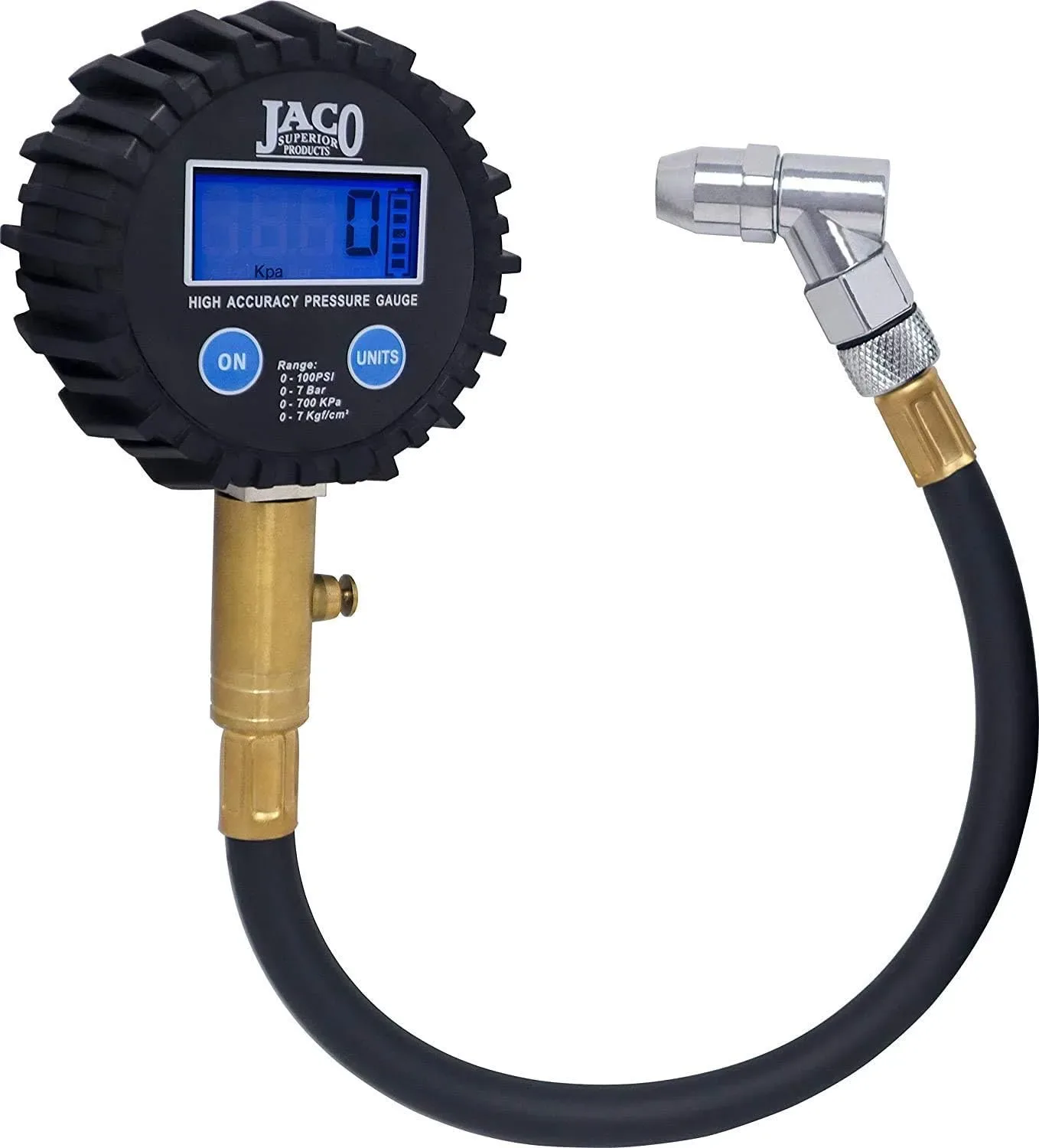
JACO ElitePro Digital Tire Pressure Gauge
Highlights
- Digital readout
- Check gauge
- Passenger / light-truck oriented
- About $44.99 list
Best for
- Monthly cold placard checks on daily drivers
- Night checks and drivers who want a lit/hold reading
- Quick cross-check against TPMS
Pros
- Easy-to-read digits beat guessing between dial hash marks for many owners
- JACO check gauges are built for the monthly PSI routine, not trail air-downs
- Cheaper and more accurate day-to-day than trusting TPMS alone when all four tires drop together
- Light enough to keep permanently in the car
Cons
- Electronics and seals still dislike glovebox heat and drops long-term
- Not a compressor — you still need a way to add air
- Low-end car dials top out too early for many light-truck / overloaded fills
- Always cross-check a new gauge against a known-good one before trusting it alone
Owner voices
Short takes from public retail reviews — paraphrased or translated when long or non-English; meaning kept close to the original.
“5/5 — Let's be honest, my relationship with my old tire gauges were complicated. They was less 'precision instruments' and more 'mood rings for tires' – I'd take three readings, average them, then cross my fingers and…”
“5/5 — I am happy with the purchase. I can't tell how accurate it is, but it is precise (reports to the first decimal point, which is all you need), repeatable. It was favorably reviewed by the professionals at car mag…”
“5/5 — Our cars are supposed to report low tire pressures, but the tire pressure has to be very too low for the notification to come up. I used an AC plug-in air pump to set the tires at the recommended pressures, but…”
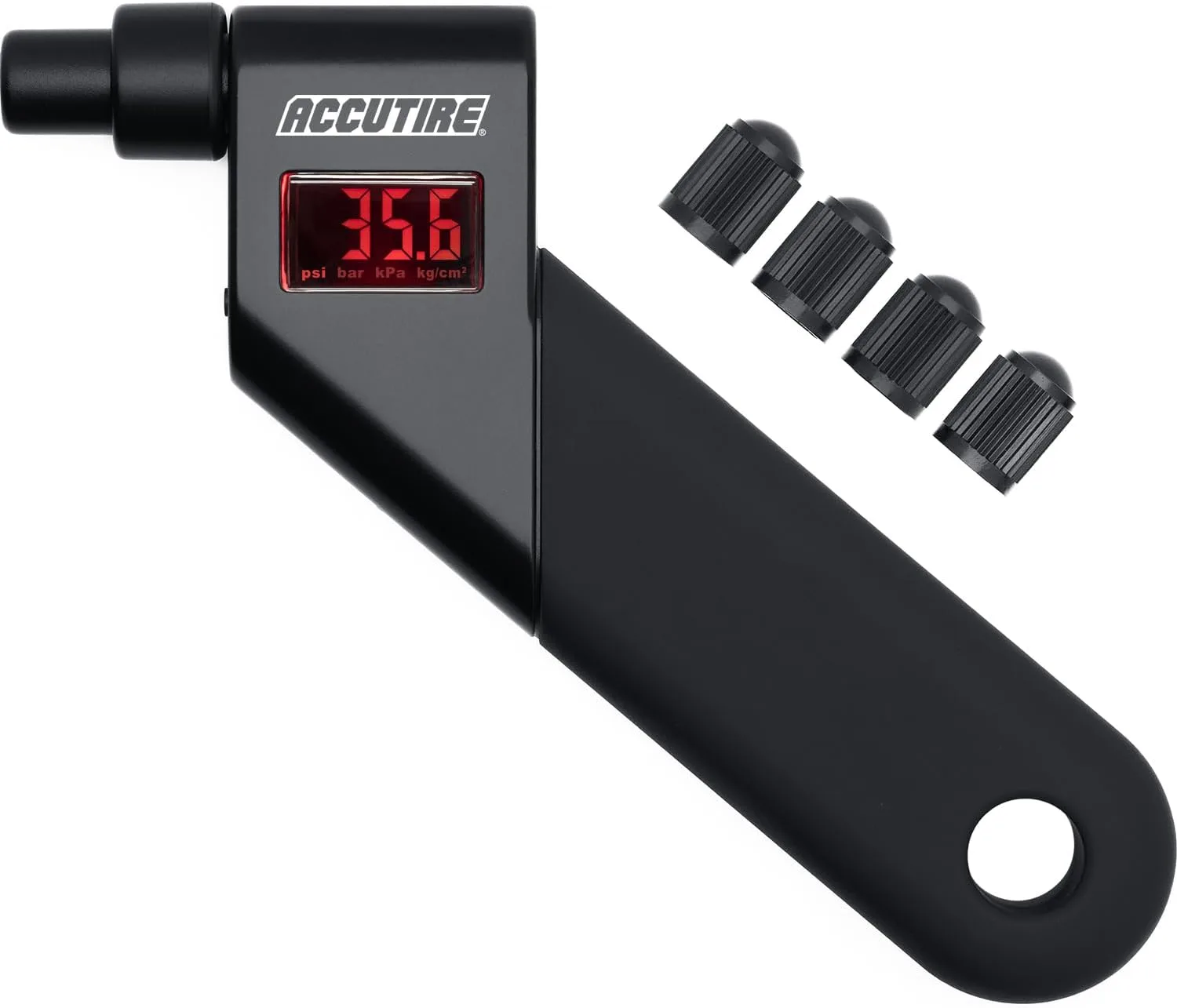
Accutire Digital Tire Pressure Gauge
Highlights
- Digital readout
- Check gauge
- Passenger / light-truck oriented
- About $11.95 list
Best for
- Monthly cold placard checks on daily drivers
- Night checks and drivers who want a lit/hold reading
- Quick cross-check against TPMS
Pros
- Easy-to-read digits beat guessing between dial hash marks for many owners
- Accutire check gauges are built for the monthly PSI routine, not trail air-downs
- Cheaper and more accurate day-to-day than trusting TPMS alone when all four tires drop together
- Light enough to keep permanently in the car
Cons
- Electronics and seals still dislike glovebox heat and drops long-term
- Not a compressor — you still need a way to add air
- Low-end car dials top out too early for many light-truck / overloaded fills
- Always cross-check a new gauge against a known-good one before trusting it alone
Owner voices
Short takes from public retail reviews — paraphrased or translated when long or non-English; meaning kept close to the original.
“4/5 — Tire pressure gauges can run from the simple pencil types to the more sophisticated versions with dial or digital displays. Picking a good one depends on your personal needs, more than anything. Bought this Accu…”
“5/5 — Tire pressure gauges are about as unsexy a product as you can think of, but this one comes across as a top-notch example of industrial design. Its appearance is just as attractive when it’s in your hand as it is…”
“4/5 — Reasonably priced digital tire gauge. It replaced an older dial gauge I had for decades and stopped giving reliable results. I take my 4X4 on the beach and have to air down to drive on the sand. I take it down t…”
How this comparison is scored
This head-to-head uses manufacturer listing specs and owner-review themes only — not bench fill-rate tests. Missing numbers stay n/a (not on file). Max PSI, claimed flow (CFM or L/min), duty-cycle notes, and carry weight decide the call; brand preference does not. I cover tire-pressure and roadside air tools as an editor — checklist against listings, not a lab visit.
Spec-by-spec table
Both listings publish different levels of detail. Where a spec isn't listed, I've marked it n/a (not on file) rather than guess.
| Product | Price | Max PSI | Flow (CFM / L/min) | Power | Weight (lb) | Rating |
|---|---|---|---|---|---|---|
| JACO ElitePro Digital Tire Pressure Gauge | $44.99 | 50 PSI | n/a (not on file) | cordless | n/a (not on file) | 4.7 |
| Accutire Digital Tire Pressure Gauge | $11.95 | 150 PSI | n/a (not on file) | cordless | 0.5 lb | 4.3 |
Where the JACO ElitePro wins
The ElitePro's headline advantage is resolution. It reads to 0.10 PSI, while the Accutire steps in 0.5 PSI increments. For a daily driver at 35 PSI, that finer readout lets you see a 0.2 PSI drift that the Accutire would round away. Owners who care about repeatability mention this — one reviewer called it 'precise and repeatable' and noted the first-decimal display as the reason.
Then there's the hose. A 10-inch flexible hose with a 360-degree swivel chuck makes it much easier to reach valve stems on duallies, trailers, or motorcycles without contorting your wrist. The Accutire's angled head is fine for cars, but the JACO's hose is a genuine ergonomic upgrade for anyone checking multiple vehicles.
Build quality also favors JACO: brass and steel internals with a shock-resistant guard, versus the Accutire's ABS plastic body. If the gauge lives in a toolbox or gets dropped on concrete, the JACO is more likely to survive. The lifetime warranty backs that up.
- 0.10 PSI resolution vs 0.5 PSI — better for spotting slow leaks
- 10" hose and swivel chuck reach awkward valve stems
- Brass/steel construction with lifetime warranty
Where the Accutire MS-4021B wins
Price is the obvious one. At $11.95, the Accutire costs roughly a third of the JACO's current $29.90 street price. For a second gauge to keep in the glovebox or under the seat, that's an easy call — you won't wince if it gets lost or borrowed.
It also wins on range and size. The Accutire reads up to 150 PSI, which covers heavy-duty truck tires and some RV applications that exceed the JACO's 100 PSI ceiling. And at 0.5 lb, it's light enough to forget it's there. The JACO's weight isn't published, but the brass-and-steel build suggests it's substantially heavier.
One more practical point: the Accutire runs on LR44 coin cells that are easy to find, and the listing says batteries are included. The JACO uses two AAA batteries (also included). Neither is a dealbreaker, but coin cells are smaller to stash.
- Half the price of the JACO at current street price
- 150 PSI max — covers higher-pressure tires
- 0.5 lb and compact — true glovebox size
The tie-breakers
When the specs don't separate them, look at warranty and owner feedback. JACO offers a lifetime warranty; Accutire's listing doesn't mention one. If you keep tools for a decade, that matters.
Owner sentiment is close but slightly favors JACO on accuracy confidence. JACO reviewers frequently mention trusting the reading on the first try, while Accutire reviewers praise the design and value but occasionally note battery or durability quirks. Neither has a pattern of serious failures in the highlights I reviewed.
Finally, consider the chuck. The JACO's swivel chuck can be swapped for any 1/4" NPT chuck — useful if you have a favorite fitting. The Accutire's angled head is fixed.
- Lifetime warranty (JACO) vs none stated (Accutire)
- Owner confidence in first-try accuracy skews JACO
- Swappable chuck on JACO adds long-term flexibility
Pick one: decision rules
Buy the JACO ElitePro if you check tire pressures weekly, own multiple vehicles, or want the most precise reading short of a professional gauge. The finer resolution and hose make it a better daily-use tool.
Buy the Accutire MS-4021B if you need a reliable, cheap gauge for occasional checks or a spare to keep in the car. It's also the better choice if your tires run above 100 PSI.
Skip both if you're looking for an inflator with a built-in gauge — these are standalone pressure checkers, not air compressors.
What owners report
Themes from listing reviews, not lab tests. Ratings are as of this writing.
- JACO ElitePro: Owners praise repeatable, precise readings — one called it a 'why didn't I do this sooner' upgrade over pencil gauges. A few mention the display lock-on feature as handy for hard-to-reach stems.
- Accutire MS-4021B: Reviewers highlight the value and industrial design — 'top-notch example of industrial design' — and ease of one-touch use. Some note battery issues out of the box, so check the included cells before a road trip.
Who should skip this matchup
Skip this page if you already know your capacity band and only need a single-SKU review — open that model page instead. If neither unit fits the job in the title (wrong size, missing solar input, too heavy to carry), pick something else in the catalogue rather than forcing a compromise.
Method and sources
This guide is built from product data and list prices pulled from Affiliate Hub at build time, together with owner feedback we summarize on the cards. It is catalog-backed buying help, not a lab ranking of every model.
Read how we test for the protocol behind any measured figures we still cite in Guides & Tips.