Who it is for / not for
If you are standing in a driveway trying to decide whether the JACO ElitePro is worth $29.90 when a $6 stick gauge will technically do the job, the answer comes down to one question: do you need a number you can trust to a tenth of a PSI, or just a rough idea? The ElitePro is built for the first camp. It is a 100 PSI digital gauge with a claimed ±0.50% full-scale accuracy and a 0.10 PSI readout, which puts it in shop-tool territory rather than glovebox-afterthought territory.
This is not the gauge for someone inflating a 20 PSI SUP or a bicycle tire at 80 PSI — the 100 PSI ceiling covers those, but the resolution and price are overkill. It is also not a substitute for a TPMS sensor or a four-tire inflation station. It reads one tire at a time, and you still have to walk around the vehicle.
- Suits: daily drivers, motorcyclists, and trailer owners who check pressure monthly and want repeatable numbers.
- Suits: anyone who fills tires at home with a portable compressor and wants to verify the pump's built-in gauge.
- Skip if: you only need a rough top-off reading and don't care about 0.1 PSI differences.
- Skip if: you need a gauge for high-pressure RV tires above 100 PSI — this one tops out there.
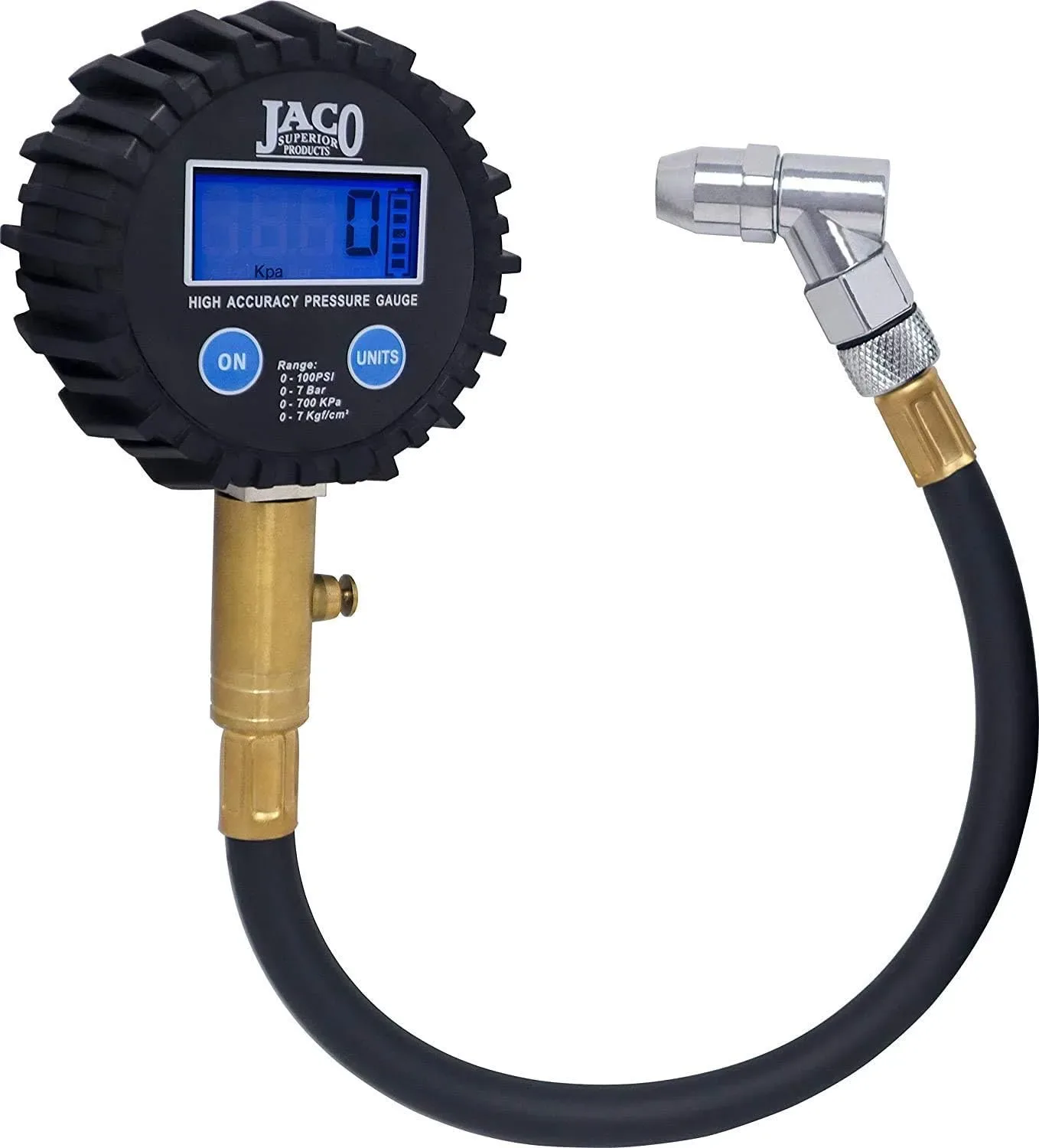
JACO ElitePro Digital Tire Pressure Gauge
Highlights
- Digital readout
- Check gauge
- Passenger / light-truck oriented
- About $44.99 list
Best for
- Monthly cold placard checks on daily drivers
- Night checks and drivers who want a lit/hold reading
- Quick cross-check against TPMS
Pros
- Easy-to-read digits beat guessing between dial hash marks for many owners
- JACO check gauges are built for the monthly PSI routine, not trail air-downs
- Cheaper and more accurate day-to-day than trusting TPMS alone when all four tires drop together
- Light enough to keep permanently in the car
Cons
- Electronics and seals still dislike glovebox heat and drops long-term
- Not a compressor — you still need a way to add air
- Low-end car dials top out too early for many light-truck / overloaded fills
- Always cross-check a new gauge against a known-good one before trusting it alone
Owner voices
Short takes from public retail reviews — paraphrased or translated when long or non-English; meaning kept close to the original.
“5/5 — Let's be honest, my relationship with my old tire gauges were complicated. They was less 'precision instruments' and more 'mood rings for tires' – I'd take three readings, average them, then cross my fingers and…”
“5/5 — I am happy with the purchase. I can't tell how accurate it is, but it is precise (reports to the first decimal point, which is all you need), repeatable. It was favorably reviewed by the professionals at car mag…”
“5/5 — Our cars are supposed to report low tire pressures, but the tire pressure has to be very too low for the notification to come up. I used an AC plug-in air pump to set the tires at the recommended pressures, but…”
Specs that matter (from listing only)
The listing throws a lot of numbers at you. Here are the four that actually change how the tool behaves in your hand, translated out of marketing speak.
Accuracy: ±0.50% FS (0.50 PSI), per the listing. FS means full scale — so the 0.50 PSI figure is the worst-case error across the whole 0–100 PSI range, not a percentage of whatever you're reading. In plain terms, if your tire calls for 35 PSI, the gauge should land within half a PSI of true. That is tighter than most pencil gauges and on par with what mechanics use. For a daily driver, half a PSI is well inside the noise of tire temperature and load; for track or autocross use, it matters more.
Resolution: 0.10 PSI readout, per the listing. Resolution is not accuracy — it just means the display shows one decimal place. A gauge can show 35.1 and still be off by half a PSI. But the finer readout makes it easier to see small changes over time, like a slow leak or the pressure rise after a highway run. Owners repeatedly mention the decimal as the thing that made them trust the tool.
Hose and chuck: 10-inch HybridFlex hose with a 360-degree swivel and angled chuck, per the listing. This is the spec that separates the ElitePro from a pocket gauge. The hose lets you reach a valve stem without crouching at a weird angle, and the swivel means the chuck can thread onto a stem in tight spaces — think motorcycle wheels or dual rear tires on a truck. The chuck is 1/4" NPT, so you can swap it for a different head if you have a preference.
Pressure range: up to 100 PSI, per the listing. That covers passenger cars (typically 30–36 PSI), light trucks (35–50 PSI), most trailers, and motorcycles. It does not cover large RV tires that run 80–110 PSI, or heavy-duty truck tires. If you own a Class A motorhome, this is the wrong tool.
- Accuracy: ±0.50% FS (0.50 PSI) — manufacturer-stated, ANSI 2A claimed.
- Resolution: 0.10 PSI — display precision, not a guarantee of accuracy.
- Hose: 10 in, 360-degree swivel, 1/4" NPT chuck — the reach-and-angle spec.
- Range: 0–100 PSI — passenger cars, light trucks, trailers, motorcycles; not big RV tires.
- Power: 2x AAA batteries, included — no charging, no 12V cord.
- Weight: n/a (not on file) — the listing's 9.93 g figure looks like a data error; JACO does not publish a reliable weight.
Which numbers decide the purchase
If I were ranking these specs by how much they should influence your buy decision, accuracy and the hose come first, resolution second, and the 100 PSI ceiling third.
Accuracy is the whole point of a gauge. A tool that reads 35.1 but is off by two PSI is worse than a stick gauge you can calibrate against a known source. The ElitePro's ±0.50 PSI claim is the reason to pay $29.90 instead of $8. It is also the number you cannot verify without a reference gauge — more on that below.
The hose and swivel chuck are the second deciding factor because they determine whether you actually use the tool. A pocket gauge that requires you to kneel at each wheel is the one that stays in the glovebox. The 10-inch hose and 360-degree swivel make the ElitePro a stand-up tool, which matters more than the decimal readout for most owners.
Resolution is nice but secondary. The 0.10 PSI display helps you track changes, but it does not make the gauge more accurate. If you are choosing between two gauges with similar accuracy claims, the one with the better hose wins.
- 1. Accuracy (±0.50 PSI claimed) — the reason to buy a digital gauge at all.
- 2. Hose and chuck (10 in, 360 swivel) — the reason you'll keep using it.
- 3. Resolution (0.10 PSI) — useful for trend-watching, not a substitute for accuracy.
- 4. Range (100 PSI) — fine for cars and light trucks; check before buying for RV use.
Numbers that mislead
Two figures on this listing are easy to misread. The first is the accuracy claim itself: ±0.50% FS sounds like half a percent of your reading, but it is half a percent of the full 100 PSI scale — so the error band is 0.50 PSI everywhere, not 0.17 PSI at 35 PSI. That is still good, but it is not the same as a percentage-of-reading spec. JACO states it clearly in the bullet, but the shorthand gets repeated online without the FS qualifier.
The second is the 0.10 PSI resolution. A finer display does not mean a more accurate gauge. Plenty of cheap digital gauges show two decimal places and are off by two PSI. The ElitePro's resolution is only meaningful because the accuracy claim backs it up — and because owners report repeatable readings, which is a different (and more useful) virtue than absolute accuracy.
A third number to treat carefully: the listing's item weight of 9.93 g. That is about the weight of two AAA batteries, not a brass-and-steel gauge. It is almost certainly a data-entry error, and JACO does not publish a reliable weight elsewhere. I would not use weight as a deciding factor here; the tool is hand-sized and the listing dimensions (1.57 x 3.7 x 7.56 in) are more useful for judging whether it fits a glovebox.
- ±0.50% FS is not ±0.50% of reading — the error band is fixed at 0.50 PSI across the range.
- 0.10 PSI resolution is display precision, not an accuracy guarantee.
- The 9.93 g weight figure is likely a listing error; treat weight as n/a.
What the data does not say
The biggest gap is independent verification. JACO claims ANSI 2A calibration and dual sensors certified to ±0.50% FS, but neither the listing nor the owner reviews include a third-party test against a reference gauge. Owners say the gauge is repeatable — take three readings, get the same number — and that is valuable, but repeatability is not the same as absolute accuracy. A gauge can be consistently wrong.
The second gap is long-term durability. The listing describes a shock-resistant gear-style guard and brass/steel construction, and owners mention the solid feel, but there is no published drop-test data or warranty claim rate. JACO offers a lifetime warranty, which is a strong signal, but it is a policy, not a measurement.
Finally, battery life is stated only as an auto shut-off after 150 seconds. No published runtime in hours or number of readings. Owners do not report battery complaints in the highlights I reviewed, but that is absence of evidence, not evidence of long life.
- No independent accuracy test on file — the ±0.50 PSI figure is manufacturer-stated.
- No published drop-test or durability data beyond the warranty.
- Battery runtime not specified; only the 150-second auto shut-off is listed.
Trade-offs / cons
The ElitePro is not a cheap tool, and the current price of $29.90 (listed at $44.99, historical low $29.90) puts it in the same bracket as some cordless inflators. If you only check pressure a few times a year, a $10 gauge will get you close enough. The ElitePro's value comes from repeatable, fine-grained readings — a benefit that compounds if you check monthly or track pressure at the track.
It is also a one-tire-at-a-time tool. There is no memory, no averaging, no Bluetooth. You read the tire, write it down or remember it, and move on. For fleet use or four-tire checks, a gauge with a memory function or a TPMS tool makes more sense.
The 100 PSI ceiling is a hard limit. If you own a motorhome with 110 PSI tires, this gauge cannot read them. JACO makes higher-range models; this one is not it.
- Price: $29.90 current, $44.99 list — not a budget gauge.
- No memory or averaging — manual record-keeping required.
- 100 PSI max — excludes some RV and heavy-truck tires.
- Weight not published — cannot judge pocketability from specs alone.
Decision / buy-skip
Buy the JACO ElitePro if you want a digital gauge you can trust to half a PSI, you check tire pressure at least monthly, and you value the 10-inch hose and swivel chuck for reaching awkward valve stems. It is a buy-once tool with a lifetime warranty, and the owner feedback consistently points to it replacing a drawer full of cheap gauges.
Skip it if you only need a rough reading, if you are shopping strictly on price, or if your tires run above 100 PSI. Also skip if you need memory or multi-tire logging — this is a single-reading tool.
For a deeper look at how digital gauges compare on accuracy and hose design, see our guide to digital tire pressure gauge accuracy, and if you are pairing a gauge with a portable inflator, our cordless tire inflator buying guide covers the fill-rate side.
- Buy if: you want ±0.50 PSI claimed accuracy and a hose that reaches tight stems.
- Buy if: you are replacing a cheap gauge that gives different readings each time.
- Skip if: you need >100 PSI, memory functions, or a sub-$15 price.
What owners report
Owner feedback on the ElitePro clusters around three themes: repeatability, the end of guesswork, and the hose making the job easier. The 4.7-star average across 7,119 ratings suggests broad satisfaction, though as with any listing, the reviews skew toward people who cared enough to write one.
One recurring note is that the gauge gives the same reading on repeated presses — a theme several reviewers mention as the thing that made them trust it. Another is the decimal readout: owners say seeing 35.1 instead of a needle between marks changed how they check pressure. A third is the hose and chuck, which owners describe as making it easy to reach valves without kneeling. The most common reaction is some version of 'why didn't I buy this sooner.'
- JACO ElitePro: repeatable readings — owners report consistent numbers across multiple presses, which they value more than the accuracy claim itself.
- JACO ElitePro: decimal display — reviewers say the 0.10 PSI readout removes the guesswork of analog gauges.
- JACO ElitePro: hose and chuck — owners mention the 10-inch hose and swivel as the reason the tool is easy to use at each wheel.
- JACO ElitePro: replacement effect — several reviewers describe retiring a collection of cheap gauges after buying this one.
How we checked these specs
This is a listing-and-owner-theme read, not a lab test. I translated the manufacturer's published specs — accuracy, resolution, hose length, pressure range, battery type — and cross-checked them against what owners actually report in reviews. I did not independently measure fill rate or accuracy against a reference gauge; those figures are JACO's claims, labeled as such.
As PumpGauge's founding editor covering tire-pressure and roadside tools, I use a checklist approach: does the spec answer a real buyer question, and does owner feedback support or contradict it? Where the data is missing — weight, battery runtime, independent accuracy — I say so rather than guess.
Who should skip the JACO ElitePro
Skip it if your tires need more than 100 PSI. Skip it if you want a gauge that logs readings or averages them. Skip it if you are shopping on price alone and a $10 stick gauge meets your needs. And skip it if you need a gauge that doubles as an inflator — this is a read-only tool.
If you are unsure whether you need a digital gauge at all, our guide to analog vs digital tire pressure gauges walks through the trade-offs. For most daily drivers who check pressure monthly, the ElitePro is a reasonable buy-once choice.
- Skip if: RV or heavy-truck tires above 100 PSI.
- Skip if: you need memory, averaging, or logging.
- Skip if: budget is the primary constraint.
- Skip if: you want an all-in-one inflator and gauge.
Method and sources
This guide is built from product data and list prices pulled from Affiliate Hub at build time, together with owner feedback we summarize on the cards. It is catalog-backed buying help, not a lab ranking of every model.
Read how we test for the protocol behind any measured figures we still cite in Guides & Tips.