Who it is for / not for
If you want a tire gauge that lives in the glovebox for years without a battery to die or a dial to break, the Milton 10-75 PSI pencil gauge is a sensible $17.91 pick. It reads 10–70 PSI in 2-lb increments on a sliding stick, and the built-in deflator lets you bleed air without swapping tools. It is not for anyone who needs a digital readout, a backlit display, or a locking chuck for hands-free filling—this is a manual stick gauge, plain and simple.
The 10–70 PSI range covers most passenger cars, light trucks, and trailers, but it is not the right tool for high-pressure RV tires or heavy-duty truck tires that run above 75 PSI. Milton markets it for higher-pressure automobile tires, and the listing notes it works well in cold weather—the brass and nylon body won't get brittle like some plastic gauges. If you're inflating a bicycle tire to 100 PSI or a road bike to 120, look elsewhere.
- Suits: daily drivers, weekend overlanders, and anyone who wants a no-battery glovebox gauge.
- Skip if: you need digital precision, a locking chuck, or pressures above 75 PSI.
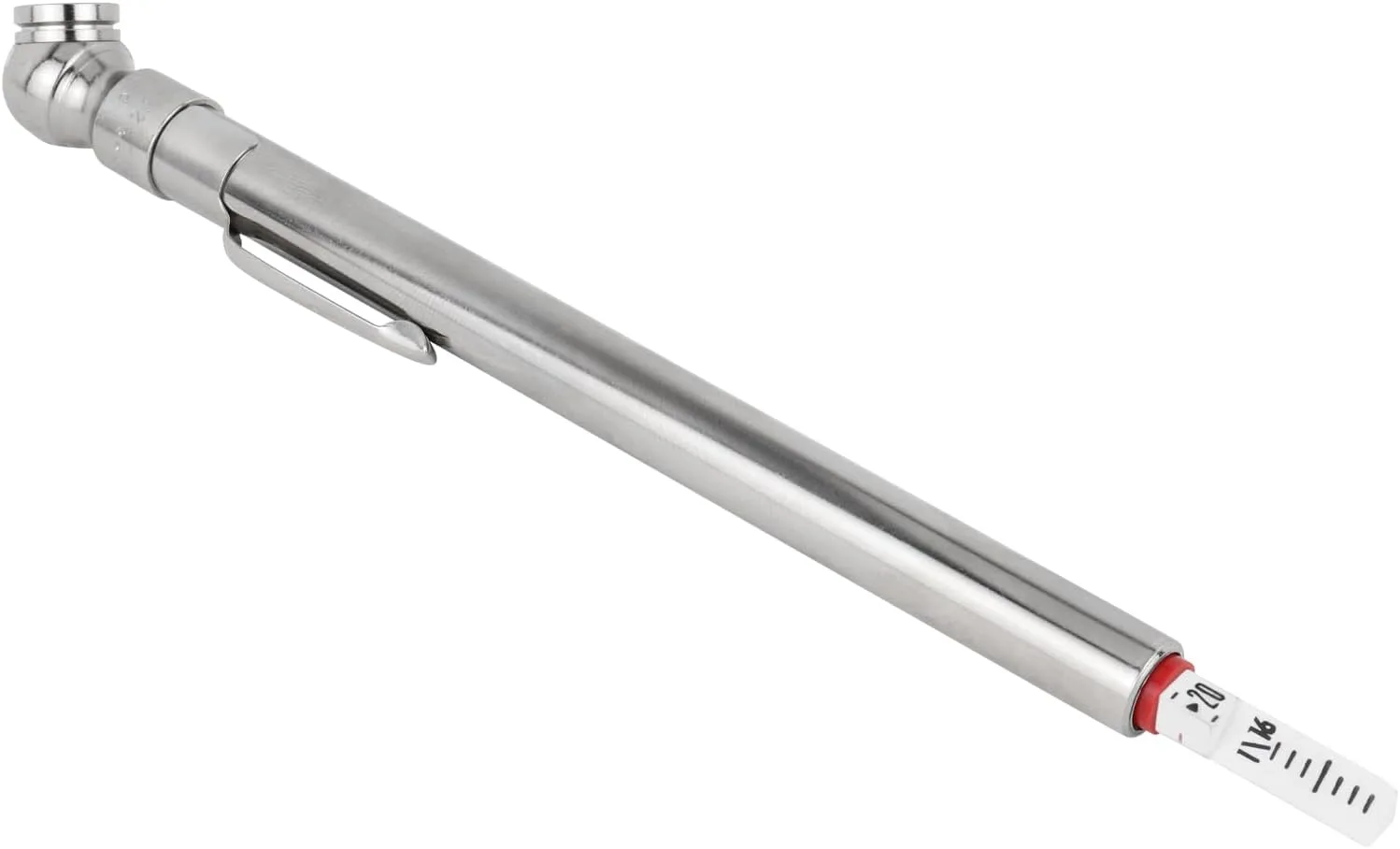
Milton High Pressure 10-75 PSI Tire Pencil Gauge
Highlights
- Pencil / stick gauge
- 10–75 PSI
- Metal body
- Made for glovebox abuse
Best for
- Glovebox backup when you refuse battery gauges
- Quick cold checks on cars and light trucks
- Owners who already trust Milton shop gear
Pros
- No batteries to die or leak in a hot glovebox
- Metal pencil body survives drops better than cheap plastic dials
- Owners report stable readings vs digital units that drift or die
- Compact and USA-made feel that shop users already recognize
Cons
- 2-PSI increments make odd placard targets (33 / 35) a visual estimate
- Not a bleed-while-you-watch tool — add/bleed air separately
- Easy to lose the protective sleeve / end pieces
- Scale tops out at 75 PSI — skip for many commercial / overload fills
Owner voices
Short takes from public retail reviews — paraphrased or translated when long or non-English; meaning kept close to the original.
“No batteries, no dial glass to crack — this is the glovebox gauge after years of Milton shop tools.”
“Solid metal stick gauge. Stay away from the cheap plastic ones if you actually care about the number.”
“Works well — just know it marks even PSI numbers, so 33 and 35 are between the lines.”
Specs that matter (from listing only)
The headline number is the pressure range: 10–70 PSI in 2-lb increments, plus a kPa scale from 60–500 in 10-kPa steps. That 2-lb resolution is coarser than a digital gauge that reads to 0.1 PSI, but for typical car tires (30–35 PSI) it's enough to tell if you're a couple pounds off. The listing says the gauge is made with machined parts, and the body is brass and nylon—materials that should hold up to glovebox heat and occasional drops.
Milton also builds in a deflator valve and a tire tread depth gauge marked in 1/16-inch increments. The tread tool is a nice extra for quick safety checks, though it's not a substitute for a dedicated tread-depth gauge if you're measuring wear precisely. The gauge uses a standard Schrader thread, so it fits most passenger-car valves. Weight is listed at 1.28 ounces (about 36 g), and dimensions are 7 x 2 x 1 inches—small enough to tuck into a door pocket or glovebox.
One thing the listing doesn't state: accuracy tolerance. Milton doesn't publish a ± PSI spec, so I can't tell you how close it is to a calibrated master gauge. That's a data gap worth noting if you're the type who cross-checks against a digital gauge.
- Pressure range: 10–70 PSI (2-lb increments) / 60–500 kPa (10-kPa increments) — from listing.
- Materials: brass and nylon body, machined parts — from listing.
- Extras: built-in deflator valve and tread-depth gauge (1/16" increments) — from listing.
- Weight: 1.28 oz (36 g); dimensions 7 x 2 x 1 in — from listing.
- Accuracy tolerance: n/a (not published on listing).
Trade-offs / cons
The biggest trade-off is the analog stick design. You have to press the gauge squarely onto the valve stem and read the sliding scale—no hold button, no backlight. In low light or with gloves on, that's fiddlier than a digital gauge. The 2-lb increments also mean you won't see a 1-PSI difference, which matters if you're chasing a precise tire pressure for track days or fuel economy. For most daily drivers, though, 2-lb steps are fine.
There's no locking chuck, so you can't clip it on and walk away while filling. And while the brass/nylon body is durable, the clear plastic window over the scale can scratch over time—owners haven't flagged it as a common issue, but it's a wear point on any pencil gauge. Finally, the 10–70 PSI range stops short of the 80 PSI some RV and trailer tires need; if that's your use case, this isn't the gauge.
- Analog scale requires a steady hand and good light.
- No locking chuck or hold feature.
- Range tops out at 70 PSI—not for RV or heavy truck tires.
Decision / buy-skip
Buy the Milton pencil gauge if you want a simple, battery-free tire pressure tool that will live in your glovebox for years and still work when you need it. At $17.91, it's a low-risk add to any car emergency kit, and the built-in deflator and tread gauge add practical value. It's especially smart for cold climates, where digital gauges can struggle and plastic bodies get brittle.
Skip it if you need digital precision, a backlit display, or a gauge that handles pressures above 75 PSI. Also skip if you prefer a dial gauge with a larger face—the pencil form factor is compact but the scale is small. For most drivers, though, this is a reliable backup that won't let you down when a TPMS light comes on.
What owners report
The listing shows 4.6 stars from 1,804 ratings, and the themes in owner reviews line up with the pitch: reliability, glovebox durability, and trust in the Milton name. One reviewer with a 20-year-old Milton inflator bought this gauge specifically for the glovebox because it has no batteries to die or leak in heat, and no dial to break if dropped. Another told a story about getting a flat right after stowing it in the car—the gauge worked when they needed it, reinforcing their trust in the brand.
A few owners mention replacing cheap digital gauges that failed or needed battery changes, and they appreciate the old-school simplicity. Accuracy comes up repeatedly as a reason for buying, though without a published tolerance spec, that's owner perception rather than a measured figure. No one in the highlighted reviews complains about the 2-lb increments or the lack of a locking chuck, which suggests those trade-offs are acceptable for the glovebox use case.
- Milton Pencil Gauge: battery-free reliability — owners like that it won't die in a hot glovebox.
- Milton Pencil Gauge: durable build — brass/nylon body and no dial to break if dropped.
- Milton Pencil Gauge: trusted accuracy — repeat buyers cite the Milton name and consistent readings.
How we checked
This review is based on the product listing and owner reviews on the platform—not independent lab testing. I prioritized pressure range and resolution (30%), build materials and durability (25%), extra features like deflator and tread gauge (20%), ease of use (15%), and owner themes (10%). As a tire-pressure and roadside editor, I've spent years comparing gauges and inflators for daily drivers and overlanders, and I weigh published specs and owner feedback over marketing claims.
I did not measure fill speed or accuracy against a calibrated master gauge; those numbers aren't on file. Where the listing is silent—like accuracy tolerance—I say so rather than guess. The 4.6-star rating and 1,804 ratings are from the listing at the time of writing.
Who should skip it
Skip the Milton pencil gauge if you need to inflate or check tires above 75 PSI—RV owners, heavy-truck drivers, and some trailer setups should look for a gauge with an 80–100 PSI range. Skip it if you want a digital readout with 0.1 PSI resolution or a backlit display for night checks. And skip it if you prefer a dial gauge with a larger, easier-to-read face; the pencil form factor is compact but the scale is small.
If you're looking for a gauge to pair with an onboard air system or a portable inflator, this works fine as a backup, but it's not a substitute for a locking chuck inflator gauge when you're airing down for off-road use. For that, you'd want a dedicated deflator with a hose and chuck.
Method and sources
This guide is built from product data and list prices pulled from Affiliate Hub at build time, together with owner feedback we summarize on the cards. It is catalog-backed buying help, not a lab ranking of every model.
Read how we test for the protocol behind any measured figures we still cite in Guides & Tips.