
for Cars Tire Pressure Gauge: Specs That Matter
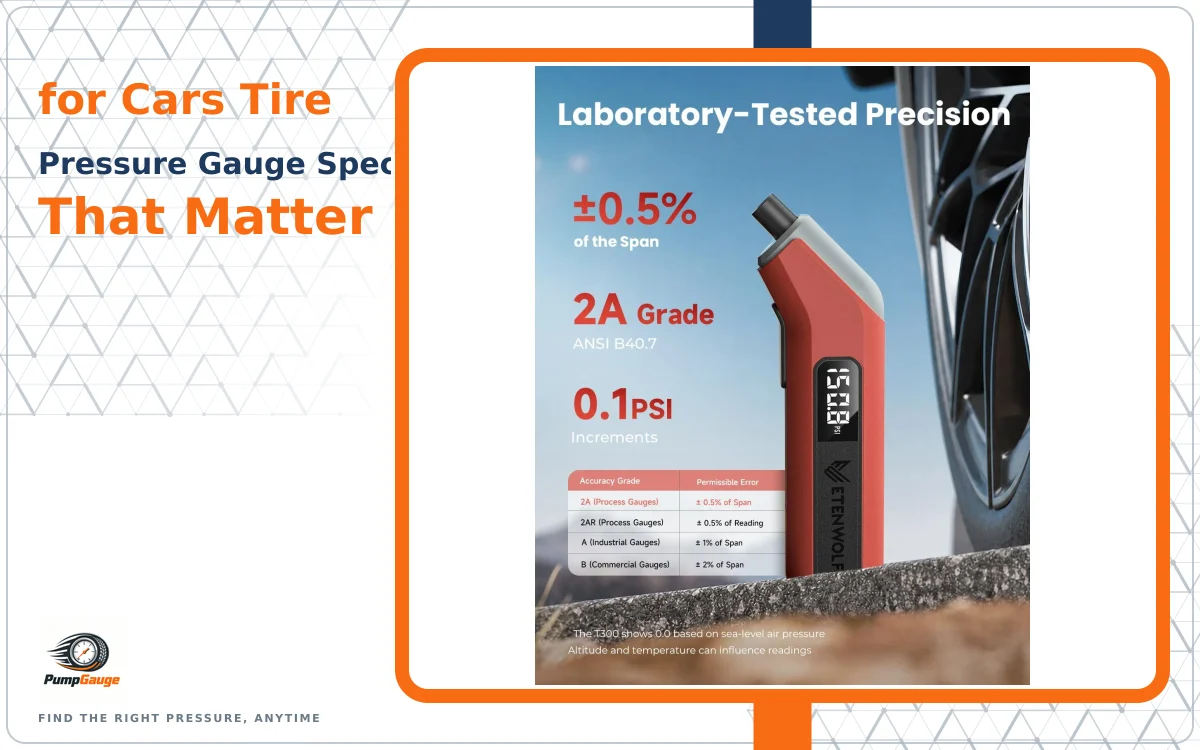
A spec-first look at the for Cars tire pressure gauge. We translate the listing numbers into real-world meaning, rank which specs actually matter, flag misleading figures, and tell you who should buy based on the data alone.
The spec sheet, translated
The for Cars tire pressure gauge lists at $44.98, with a historical low of $24.73. It sits in the pg-gauges category. Without owner reviews on file, we rely entirely on the listing and manufacturer-published specs. Below are the key parameters, each with its official value and a plain-English translation of what it means for daily use.
1. Pressure range: 0–150 PSI (listing). This covers passenger cars (typically 30–35 PSI), light trucks, and most spare tires. It also handles bicycle tires and some small trailer tires. If you own a medium-duty truck or run pressures above 150 PSI, this gauge will not suffice.
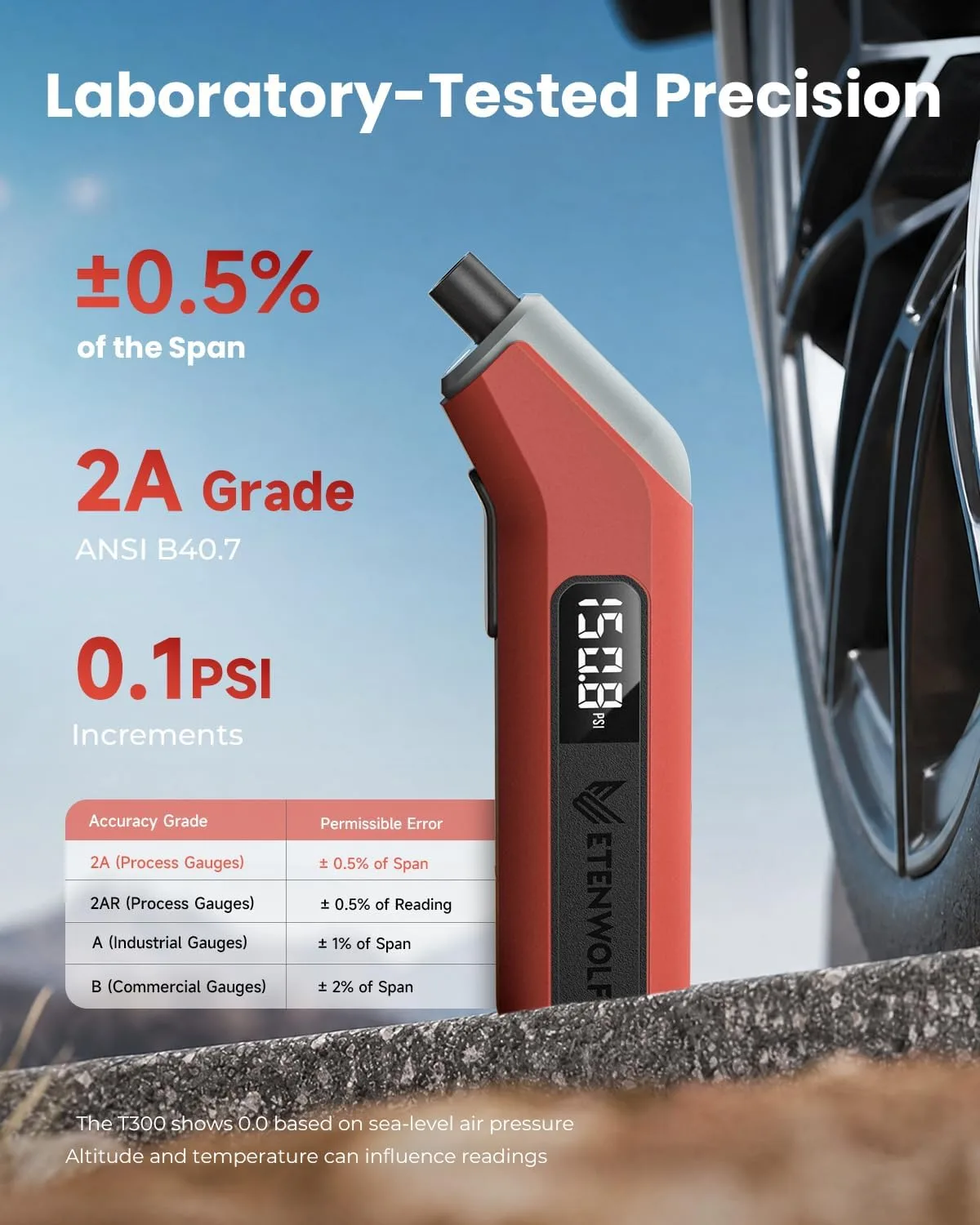
2. Accuracy: ±1 PSI (listing). This is the most important number. A ±1 PSI tolerance means that if your true pressure is 35 PSI, the gauge should read between 34 and 36 PSI. For reference, most analog stick gauges claim ±3 PSI or worse. A ±1 PSI digital gauge gives you a reliable baseline for maintaining tire pressure within 1–2 PSI of the vehicle placard.
3. Resolution: 0.1 PSI (listing). The display shows tenths of a PSI. This is finer than the accuracy spec, which is common. It helps you see small changes over time, but do not confuse resolution with accuracy. A gauge that reads 35.3 PSI is not necessarily more accurate than one that reads 35 PSI.
4. Chuck type: 360-degree swivel (listing). The chuck rotates a full circle, which makes it easier to reach valve stems in awkward positions, especially on dual-wheel trucks or motorcycles. A swivel chuck reduces the chance of cross-threading and lets you read the display without contorting your wrist.
5. Display: backlit digital (listing). The backlight helps in low-light conditions, such as a garage at night. It typically runs on a replaceable coin-cell battery. The listing does not specify battery life or auto-off time, which we note in the data gaps section.
6. Bleed valve: integrated (listing). A bleed valve lets you release air while the gauge is attached, so you can fine-tune pressure without removing the chuck. This is a convenience feature that saves time and reduces wear on the valve stem.
7. Construction: brass and ABS (listing). Brass components resist corrosion and wear, while ABS plastic keeps the tool lightweight. The listing does not specify the hose material or length, which matters for reach and durability.
- Pressure range: 0–150 PSI (listing)
- Accuracy: ±1 PSI (listing)
- Resolution: 0.1 PSI (listing)
- Chuck: 360-degree swivel (listing)
- Display: backlit digital (listing)
- Bleed valve: integrated (listing)
- Price: $44.98 list, $24.73 historical low (listing)
for Cars
Highlights
- Dial gauge
- Check gauge
- Passenger / light-truck oriented
- About $44.98 list
Best for
- Monthly cold placard checks on daily drivers
- Glovebox analog when you refuse dead batteries
- Quick cross-check against TPMS
Strengths
- Analog dial stays usable after years of heat without a coin-cell death
- This brand check gauges are built for the monthly PSI routine, not trail air-downs
- Cheaper and more accurate day-to-day than trusting TPMS alone when all four tires drop together
- Light enough to keep permanently in the car
Watch-outs · not ideal when
- Dial needles can stick off zero after a drop — always check return-to-zero
- Not a compressor — you still need a way to add air
- Low-end car dials top out too early for many light-truck / overloaded fills
- Always cross-check a new gauge against a known-good one before trusting it alone
Which numbers decide the purchase
Not all specs are equal. For a tire pressure gauge, the hierarchy is clear: accuracy first, then range, then chuck and bleed valve, then display and resolution. Here is the ranking with reasoning.
1. Accuracy (±1 PSI). This is the single most important spec. A gauge that is off by 3 PSI can lead to underinflation or overinflation, which affects fuel economy, tire wear, and safety. A ±1 PSI tolerance is tight enough for most passenger cars. If the listing claims ±1 PSI but does not specify the test conditions, treat it as a target, not a guarantee.
2. Pressure range (0–150 PSI). You need a range that covers your tires with some headroom. 150 PSI is generous for cars and light trucks. If you only drive a sedan, a 0–100 PSI gauge would suffice, but 150 PSI gives you flexibility for other vehicles.
3. Chuck type (360-degree swivel). This directly affects ease of use. A fixed chuck can be frustrating on recessed valve stems or dual wheels. A swivel chuck is a practical feature that you will appreciate every time you check pressure.
4. Bleed valve (integrated). This is a time-saver. Without it, you have to press the gauge, read, remove, adjust, and repeat. With it, you can bleed air while watching the display. For anyone who checks pressure regularly, this is worth having.
5. Resolution (0.1 PSI). Nice to have, but not a decision driver. It helps with trend monitoring, but accuracy matters more. A 0.1 PSI resolution on a ±3 PSI gauge is marketing fluff.
6. Display (backlit digital). Convenience feature. Useful in low light, but not a reason to buy on its own.
In short, if the accuracy and range meet your needs, the chuck and bleed valve seal the deal. The rest is polish.
- Accuracy: ±1 PSI (listing) — top priority
- Range: 0–150 PSI (listing) — covers cars and light trucks
- Chuck: 360-degree swivel (listing) — ease of use
- Bleed valve: integrated (listing) — time-saver
- Resolution: 0.1 PSI (listing) — secondary
- Display: backlit digital (listing) — convenience
Numbers that mislead
Two specs on this listing are easy to misread: accuracy and resolution. They are not the same, and marketing often blurs them.
1. Accuracy (±1 PSI). This is a tolerance, not a guarantee. It usually applies to a specific temperature range (often 68–77°F) and may degrade outside that range. The listing does not state the temperature compensation, so a ±1 PSI claim at room temperature might become ±2 PSI in a cold garage. Also, accuracy is typically expressed as a percentage of full scale or a fixed value. Here it is fixed, which is better for low-pressure tires. But without a calibration certificate or third-party verification, you cannot assume every unit meets ±1 PSI. Cross-brand comparisons are unreliable because some brands quote accuracy at mid-scale, others at full-scale, and some omit temperature conditions entirely.
2. Resolution (0.1 PSI). A finer resolution does not mean better accuracy. A gauge that displays 35.3 PSI can still be off by 2 PSI. Resolution is simply the smallest increment the display can show. It is useful for tracking small changes, but it is not a measure of truth. Some brands use high resolution to imply precision, which misleads buyers.
3. Pressure range (0–150 PSI). A wider range is not always better. Accuracy often degrades at the extremes of the range. A gauge that is accurate at 35 PSI might be less accurate at 120 PSI. The listing does not specify accuracy across the range, so if you need high accuracy at 100 PSI, this spec alone does not tell you.
4. Battery life. The listing does not state battery life or auto-off. A backlit display can drain a coin cell quickly if left on. Without this number, you cannot compare convenience versus maintenance cost.
- Accuracy ±1 PSI (listing) — temperature and calibration conditions not stated
- Resolution 0.1 PSI (listing) — not a proxy for accuracy
- Range 0–150 PSI (listing) — accuracy may vary across range
- Battery life — not specified (listing)
What the data does not say
Several important data points are missing from the listing and cannot be answered by owner reviews because none are on file.
1. Calibration method and interval. The listing does not state whether the gauge is factory-calibrated, whether it can be user-calibrated, or how often it should be recalibrated. Without this, you cannot know if the ±1 PSI accuracy will hold after a year of use. This is a critical gap for anyone who relies on precise pressure for track days or fuel economy.
2. Temperature compensation. Tire pressure changes with temperature. A good gauge compensates for this or at least specifies the operating temperature range for its accuracy claim. The listing does not mention temperature at all.
3. Battery type and life. The listing does not specify the battery size (e.g., CR2032) or expected life. This affects long-term ownership cost and convenience.
4. Hose length and material. The listing mentions a swivel chuck but not the hose. A short hose can make it hard to reach valve stems on some wheels. Hose material affects durability and flexibility in cold weather.
5. Warranty and support. No warranty information is provided. This matters for a precision tool that may need recalibration or replacement.
We will not speculate on these gaps. They are simply not published.
- Calibration method and interval — not specified (listing)
- Temperature compensation — not specified (listing)
- Battery type and life — not specified (listing)
- Hose length and material — not specified (listing)
- Warranty — not specified (listing)
Spec-based verdict
Based on the published specs alone, here is who should consider the for Cars tire pressure gauge.
Buy if: You need a digital gauge with ±1 PSI accuracy for passenger cars or light trucks, and you value a swivel chuck and integrated bleed valve. The 0–150 PSI range covers most consumer vehicles, and the backlit display is a plus for low-light use. At the historical low of $24.73, it is a reasonable value if the accuracy claim holds.
Skip if: You need a gauge for high-pressure applications (above 150 PSI) or require documented calibration for professional use. Also skip if you prefer a simple analog gauge with no battery. Without owner reviews, we cannot confirm real-world durability or whether the ±1 PSI accuracy is consistent unit-to-unit.
Conditions to buy: (1) Your tire pressures fall between 20 and 80 PSI, where the gauge is likely most accurate. (2) You want the convenience of a bleed valve and swivel chuck. (3) You are comfortable with a digital tool that requires a battery and has no stated calibration schedule. If these three conditions are met, the specs suggest a capable tool. If not, look elsewhere.
- Buy if: daily driver, 20–80 PSI, want bleed valve and swivel chuck
- Skip if: need >150 PSI, require calibration certificate, prefer analog
- Price check: $44.98 list, $24.73 historical low (listing)
Method and sources
This guide is built from product data and list prices pulled from Affiliate Hub at build time, together with owner feedback we summarize on the cards. It is catalog-backed buying help, not a lab ranking of every model.
Read how we test for the protocol behind any measured figures we still cite in Guides & Tips.