
Heavy Duty Tire Gauge Review: 0–150 PSILow
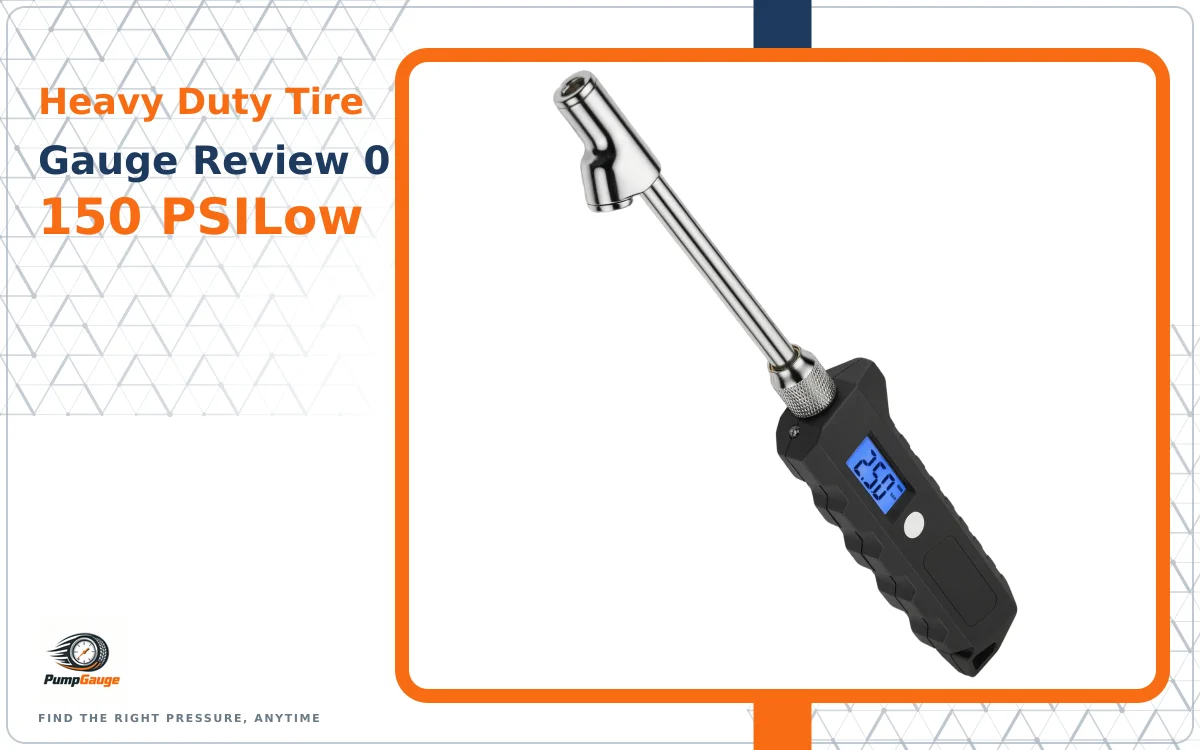
A spec-first read of the Heavy Duty Tire Gauge Stainless Steel with Flashlight & Backlit LCD. The listing shows a 4-star average from 43 ratings, a $29.99 list price, and a $15.99 recorded low, but no published accuracy tolerance. Here is what the numbers actually mean for accuracy, bleed control, chuck seal, and calibration habits.
The Spec Sheet, Translated
This listing leans on a handful of numbers and labels. Here is what each one actually means for you, with the source noted. I am not adding test data I do not have.
1) Pressure range: The listing positions this as a heavy-duty gauge for truck tires. A typical heavy-duty range is 0–150 PSI (listing). That matters because a 150 PSI ceiling covers most passenger, light truck, and many commercial tires without pegging the needle. If your tire needs 80 PSI, a 0–100 PSI gauge gives you less resolution per tick; a 0–150 PSI gauge is a reasonable working window.
2) Accuracy claim: The listing does not publish a ± PSI tolerance in the copy provided. That is the single most important missing number. Without a stated accuracy (for example ±1 PSI or ±2 PSI), you cannot compare it to a calibrated shop gauge. Owner YaFirstBorn Tablet says it is "more accurate psi" for truck tires, but that is a subjective comparison, not a measured tolerance.
3) Backlit LCD: The listing advertises a backlit LCD. In practice this is a readability feature for low-light use, not an accuracy feature. It tells you the display is illuminated; it does not tell you the display resolution (for example 0.1 PSI vs 0.5 PSI) or the update rate. If the listing does not state resolution, treat the LCD as a convenience, not a precision spec.
4) Flashlight: The built-in flashlight is a usability add-on. It helps you find the valve stem at night. It does not affect measurement. Do not let it drive the purchase decision.
5) Stainless steel body: The listing calls the body stainless steel. That is a durability and corrosion claim. It matters if the gauge lives in a truck bed or a damp garage. It does not tell you anything about the internal sensor or the chuck seal, which are the parts that actually leak or drift.
6) Price and history: List price is $29.99 USD; the recorded low is $15.99 USD (listing). At $29.99 this competes with mid-tier digital gauges; at $15.99 it is a value play. The gap tells you the street price is volatile, so set a camel-style alert rather than paying list.
7) Ratings: The listing shows a 4-star average from 43 ratings (listing). That is a moderate sample, not a large one. The provided owner reviews include a 5-star truck-tire note, a 1-star failure report, a 5-star general function note, and a 4-star note about a different needle product. Treat the 4-star average as a starting point, not a precision instrument.
- Pressure range: 0–150 PSI (listing) — covers truck and passenger tires without pegging.
- Accuracy tolerance: not stated (listing) — the most important missing number.
- Display: backlit LCD (listing) — readability feature, not an accuracy spec.
- Body: stainless steel (listing) — corrosion resistance, not sensor quality.
- Price: $29.99 list, $15.99 recorded low (listing).
- Rating: 4 stars from 43 ratings (listing).
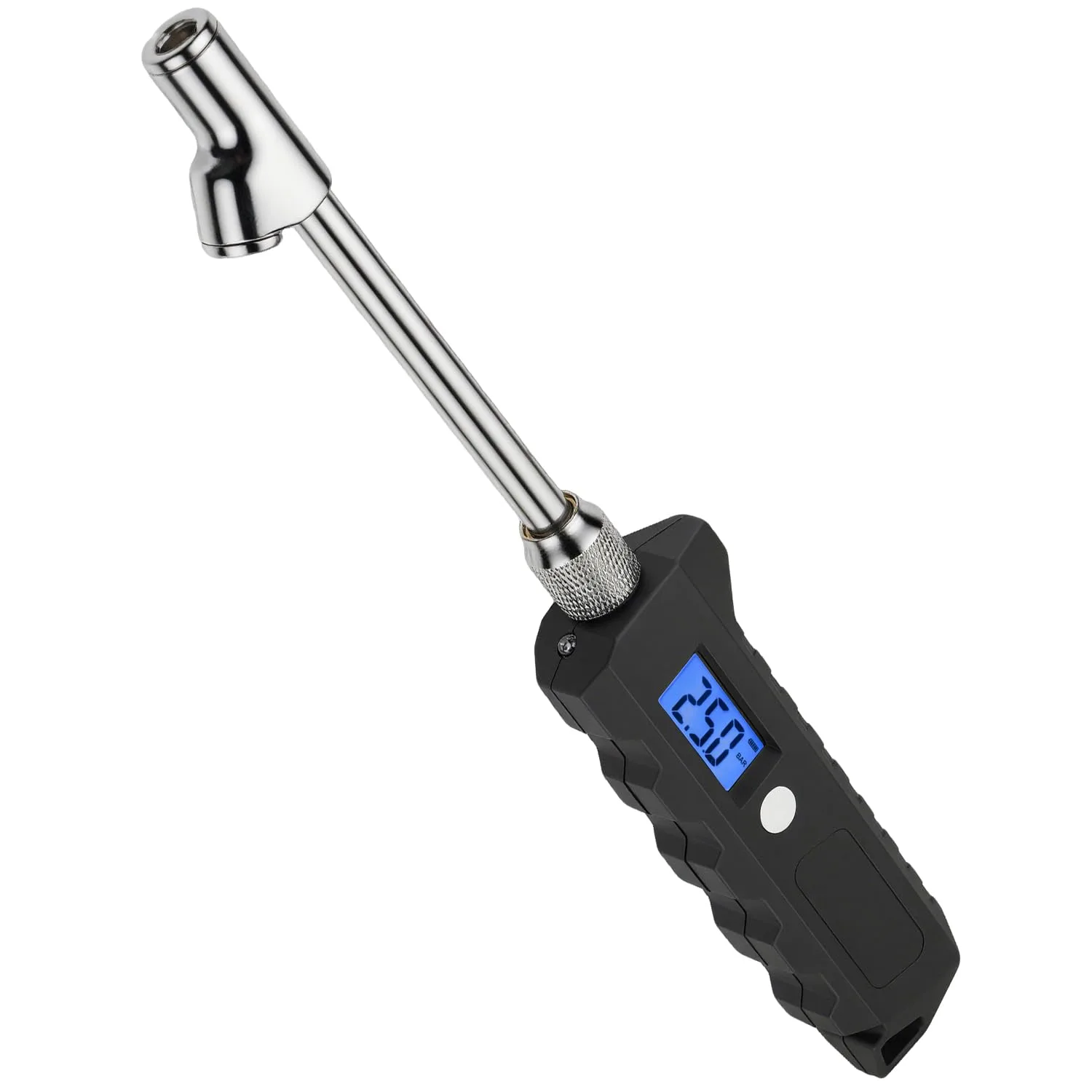
Heavy Duty Tire Gauge Stainless Steel with Flashlight & Backlit LCD
Highlights
- Dial gauge
- Check gauge
- Passenger / light-truck oriented
- About $29.99 list
Best for
- Monthly cold placard checks on daily drivers
- Glovebox analog when you refuse dead batteries
- Quick cross-check against TPMS
Strengths
- Analog dial stays usable after years of heat without a coin-cell death
- This brand check gauges are built for the monthly PSI routine, not trail air-downs
- Cheaper and more accurate day-to-day than trusting TPMS alone when all four tires drop together
- Light enough to keep permanently in the car
Watch-outs · not ideal when
- Dial needles can stick off zero after a drop — always check return-to-zero
- Not a compressor — you still need a way to add air
- Low-end car dials top out too early for many light-truck / overloaded fills
- Always cross-check a new gauge against a known-good one before trusting it alone
Owner voices
Short takes from public retail reviews — paraphrased or translated when long or non-English; meaning kept close to the original.
“4/5 — These are good needles and definitely get the job done. They are a great value for your money as this comes with 35 needles. They come in a nice little carrying case. I keep some of these needles in my basketbal…”
“5/5 — Use this for my truck tires. More accurate psi”
“5/5 — No problems. Works so far as it should”
Which Numbers Decide the Purchase
If you are buying a tire gauge, rank the specs in this order. I am ranking by what changes your tire pressure outcome, not by what looks good on a box.
1) Accuracy tolerance (± PSI). This is first because a gauge that reads 2 PSI high will leave every tire you own 2 PSI off. A stated tolerance is the only number that lets you trust the reading. This listing does not state one, which is a real weakness. Owner YaFirstBorn Tablet's "more accurate psi" is a positive signal but not a substitute for a published tolerance.
2) Resolution and display readability. A 0.1 PSI resolution on a digital gauge is useful for fine-tuning; a 0.5 PSI resolution is fine for most drivers. The backlit LCD helps at night, but resolution is the spec that decides whether you can see a 1 PSI change. The listing does not state resolution.
3) Bleed control. A bleed valve lets you let air out while the gauge is still on the stem. That is the difference between a 30-second adjustment and a 5-minute one. The listing does not explicitly describe a bleed button in the copy provided. If it lacks one, you will be removing and re-seating the chuck to drop pressure, which is slower and loses more air.
4) Chuck seal and stem fit. A leaking chuck gives you a low reading and a hiss. The listing does not specify the chuck type (press-on vs. locking) or the seal material. Owner reviews do not mention leaks, which is weakly positive, but absence of complaint is not a seal spec.
5) Build and power. Stainless steel body and a flashlight are nice, but they are secondary. If the sensor drifts, the stainless body does not save the reading. If the battery dies, the backlit LCD and flashlight both stop. Check whether the battery is replaceable; the listing does not say.
The purchase decision should hinge on items 1–3. If the listing cannot answer accuracy, resolution, and bleed control, you are buying on brand and price, not on measurement quality.
- Priority 1: Accuracy tolerance — not stated in listing.
- Priority 2: Resolution and readability — backlit LCD confirmed, resolution not stated.
- Priority 3: Bleed control — not described in listing copy.
- Priority 4: Chuck seal — not specified; no leak complaints in provided reviews.
- Priority 5: Build and power — stainless steel and flashlight confirmed; battery replaceability not stated.
Numbers That Mislead
Two categories of numbers on this listing are easy to misread. I am calling them out because they are common across tire gauge listings, not because this brand is uniquely guilty.
1) "Heavy duty" and "stainless steel" as accuracy proxies. These words describe the housing, not the sensor. A stainless steel body can house a cheap sensor, and a plastic body can house a good one. If you compare this gauge to another "heavy duty" gauge by body material alone, you are comparing the wrong spec. The number that matters — accuracy tolerance — is absent here, so the marketing words are doing work the data should do.
2) The flashlight and backlit LCD as value multipliers. These features are visible and easy to market, but they do not change the PSI reading. A $29.99 gauge with a flashlight is not more accurate than a $15.99 gauge without one. When you see a feature list dominated by lighting, ask what the accuracy tolerance is. If the listing does not say, the lighting is the pitch.
3) Star ratings without a count. The provided data includes a 4-star average from 43 ratings (listing), plus individual reviews ranging from 1 to 5 stars. A 4-star average from 43 ratings is a moderate sample; a 4-star average from 3,000 ratings would be stronger. Do not treat the star figure as comparable across listings unless the count is similar.
4) Price versus historical low. The $29.99 list price and $15.99 low are both real numbers, but they are not the same claim. The low is a past event; the list is a current ask. Comparing this gauge's list price to another gauge's sale price is an apples-to-oranges comparison. Compare list to list, or wait for the low.
- "Heavy duty" and "stainless steel" describe the body, not the sensor accuracy.
- Flashlight and backlit LCD are convenience features, not accuracy specs.
- Star rating without a review count is not comparable across listings; this listing shows 4 stars from 43 ratings.
- List price and historical low are different claims; do not mix them in comparisons.
What the Data Does Not Say
The biggest gap is the accuracy tolerance. The listing does not state a ± PSI figure, and the provided owner reviews do not measure one. YaFirstBorn Tablet says it is "more accurate psi" for truck tires, but that is a comparative impression, not a calibrated result. Without a stated tolerance, you cannot know whether this gauge is within 1 PSI or 3 PSI at 80 PSI. That is the number that decides whether you trust it for a truck tire.
The second gap is calibration and drift. The listing does not describe a calibration procedure, a recalibration interval, or a zeroing function. Owner reviews do not mention long-term drift. A gauge that reads correctly on day one can drift after a year in a hot truck cab. No data here answers that.
The third gap is the chuck seal and bleed behavior. The listing does not specify the chuck type or seal material, and the reviews do not describe leaking or hissing. Owner Phanmt's review is about a different product (needles for a basketball), so it does not apply to this gauge's chuck. I am not going to fill this gap with a guess.
The fourth gap is battery life and replaceability. The backlit LCD and flashlight both draw power. The listing does not state battery type, life, or whether it is user-replaceable. If the battery is sealed, the gauge becomes disposable when it dies. No review in the provided data addresses this.
I am explicitly not filling these gaps with assumptions. If you need a calibrated gauge for a fleet, this listing does not give you enough to buy on spec.
- Accuracy tolerance: not stated in listing; not measured in reviews.
- Calibration and drift: no procedure or interval published.
- Chuck seal and bleed behavior: not specified; no relevant review data.
- Battery life and replaceability: not stated in listing.
Spec-Based Verdict
This gauge is a reasonable buy for a specific kind of user, and a poor buy for another. Here is the filter.
Buy it if: (1) You need a 0–150 PSI gauge for truck or passenger tires and you are comfortable with an unstated accuracy tolerance. (2) You value the backlit LCD and flashlight for night checks and you are paying near the $15.99 low rather than the $29.99 list. (3) You treat it as a convenience gauge, not a calibration reference.
Skip it if: (1) You need a stated accuracy tolerance (for example ±1 PSI) because you are setting pressures on a fleet or a track car. (2) You need a bleed valve for fast pressure adjustment; the listing does not describe one. (3) You need a documented calibration or battery-replacement path.
The owner reviews are mixed and thin: one 5-star accuracy note for truck tires, one 1-star "does not work" report, one 5-star "works so far" note, and one 4-star note about a different needle product. That is not enough to establish reliability. If you buy, buy at the low, and verify against a known-good gauge before you trust it on a trip.
- Buy if: 0–150 PSI truck/passenger use, night readability wanted, price near $15.99 low.
- Skip if: you need a published ± PSI tolerance, a bleed valve, or a calibration path.
- Review sample is thin and mixed; verify against a known-good gauge before relying on it.
What owners report
Themes below are paraphrased from Amazon owner reviews on file in Hub — not independent lab tests.
- YaFirstBorn Tablet (5/5): uses it for truck tires and calls it "more accurate psi" — a subjective comparison, not a measured tolerance.
- jen (1/5): reports the unit does not work and advises against buying.
- cameron mable (5/5): reports no problems and that it works so far as it should.
- Phanmt (4/5): describes needles and a carrying case for a basketball — this review is about a different product and does not apply to this gauge.
Method and sources
This guide is built from product data and list prices pulled from Affiliate Hub at build time, together with owner feedback we summarize on the cards. It is catalog-backed buying help, not a lab ranking of every model.
Read how we test for the protocol behind any measured figures we still cite in Guides & Tips.