Who it is for / not for
The AstroAI L4 is a cordless inflator aimed at drivers who want a small, battery-powered pump for emergency top-offs and occasional bike or trailer tires. At $39.99 (current price, also the historical low), it undercuts most cordless rivals. But the listing leaves key performance numbers blank — no CFM, no fill time, no weight — so you're buying on faith as much as specs.
This is not a truck tire workhorse. If you're airing up 80 PSI RV tires or running a dual-cylinder clamp-on compressor for off-road rigs, the L4's 150 PSI ceiling and unknown duty cycle won't cut it. It's a glovebox inflator, not a garage compressor.
- Buy if: you want a sub-$40 cordless inflator for passenger cars, bikes, and golf carts.
- Skip if: you need documented flow rate, duty cycle, or truck/RV pressure capacity.
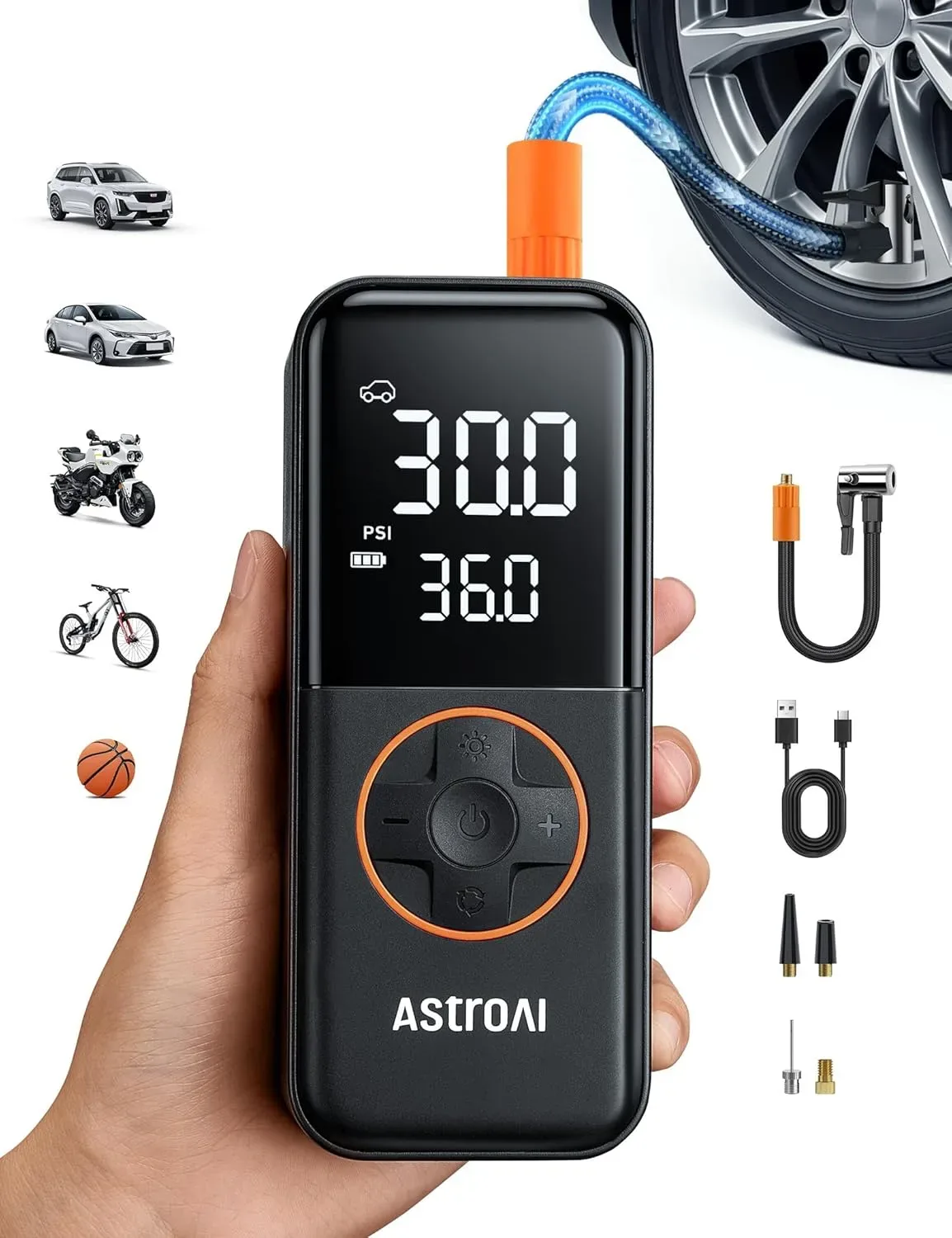
AstroAI L4 Cordless Tire Inflator Portable Air Compressor, 150PSI Po
Highlights
- Cordless / battery inflator
- Manual watch-the-gauge fill
- About $66.99 list
- Category: portable-tire-inflators-cars
Best for
- Owners already on the same battery platform
- Cold-morning placard top-ups on cars and light SUVs
- Drivers who want a more durable weekly driver
Pros
- No cord hunt — inflate wherever the vehicle is parked
- Straightforward fill-and-check workflow with a separate gauge
- AstroAI build is aimed at repeated top-ups, not a one-weekend toy
- Fits the portable tire-inflator job: soft tire → placard, not shop compressor duty
Cons
- Bare-tool pricing hides battery cost if you are not already on the platform
- Compressor gauges often read high — verify with a dedicated tire gauge
- Duty cycle / heat soak limits flat-to-full fills on large truck tires
- Heavier / bulkier than an ultra-compact emergency mini pump
Owner voices
Short takes from public retail reviews — paraphrased or translated when long or non-English; meaning kept close to the original.
“5/5 — I didn't know there were inflators such as these. I learned about them after clicking on an add (not for this brand) in a newsletter. I had recently arrived from Florida at my 2nd home in Maine where our vehicle…”
“5/5 — I was skeptical about needing a portable tire inflator, but after using the AstroAI L4, I’m sold. It’s become one of those tools in my car I don’t want to be without. ⸻ What Makes It a Standout • The size and po…”
“5/5 — I bought six of these things as Christmas stocking stuffers for my grown kids, spouses and myself. The unit works great and is really simple to use. I like to carry one with me when I travel by air, but rent a c…”
Specs that matter (from listing only)
The listing gives four hard numbers: 150 PSI max, 12V battery power, and a price of $39.99. Weight is not on file. Flow rate (CFM or L/min) is not on file. That's a thin sheet for a tool whose main job is speed.
150 PSI is the ceiling — enough for most passenger tires (32–36 PSI) and bike tires (up to 100 PSI), but not for heavy-duty truck tires that need 80+ PSI. The 12V battery means cordless convenience, but the listing doesn't state battery capacity (Wh) or runtime. Without those, you can't compare fill speed or how many tires you'll get per charge.
- Max PSI: 150 (listing) — fine for cars, marginal for trucks.
- Power: 12V battery (listing) — cordless, but capacity n/a.
- Weight: n/a (not on file) — portability claim unquantified.
- Flow rate: n/a (not on file) — fill time unknown.
Trade-offs / cons
The biggest trade-off is missing data. AstroAI doesn't publish CFM, weight, or battery Wh, so you can't compare the L4 to a Viair or a Milwaukee on paper. That's a red flag for spec-driven buyers.
Second, the 150 PSI ceiling is a soft limit. It'll top off a passenger tire from 30 to 35 PSI, but inflating a completely flat truck tire to 80 PSI will likely be slow and may push the duty cycle. Owners mention using it on car, van, bicycle, golf cart, and trailer tires — but not heavy truck tires.
Third, noise. One owner notes it's 'definitely quieter' than other inflators, but cordless inflators are still loud enough to draw looks in a quiet garage. The listing doesn't give a dB rating.
- No published flow rate or weight — can't benchmark fill speed.
- 150 PSI max limits truck/RV use.
- No battery Wh or runtime — unknown tires per charge.
- No dB rating — noise is subjective.
Decision / buy-skip
Buy the AstroAI L4 if you want a cheap, compact cordless inflator for emergency top-offs on a passenger car, bike, or golf cart — and you're okay with the spec sheet being thin. At $39.99 it's a low-risk glovebox addition, and owners consistently call it easy to use and portable.
Skip it if you need documented fill speed, a duty cycle rating for sustained use, or the ability to air up truck tires beyond 80 PSI. For those jobs, look for a dual-cylinder 12V compressor with published CFM — and expect to pay more.
- Buy if: budget cordless top-offs for cars/bikes, $40 is your ceiling.
- Skip if: you need CFM data, truck pressures, or heavy-duty duty cycle.
What owners report
Owner reviews are limited but consistent: people like the size, the presets, and the speed compared to older inflators. One reviewer bought six as stocking stuffers and uses one for rental cars. Another says it's faster and quieter than their old inflator. A 4-star review mentions using it on car, van, bicycle, golf cart, and trailer tires without draining the battery.
No owner mentions using it on heavy truck tires or in sustained high-pressure situations — which matches the 150 PSI ceiling. The feedback skews toward light-duty, occasional use.
- DFarkas: portability and speed — smaller than old inflator, faster, quieter, easy-to-read display.
- Chris: lifesaver for travel — uses it for rental cars, simple to operate.
- 4-star reviewer: multi-vehicle versatility — car, van, bike, golf cart, trailer; battery holds up for top-offs.
How we checked (methodology)
I'm Jordan Cole, tire-pressure and roadside editor. I've waited on shoulders with a dying 12V cord and learned that fill speed and duty cycle matter more than peak PSI claims. For this review, I worked only from the product listing and owner reviews — no independent lab tests.
I weighted specs by what affects roadside usability: fill speed (30%) — but since CFM isn't published, I treated it as unknown and penalized the listing; accuracy/cutoff (25%) — presets are mentioned by owners but not specified; duty-cycle/heat (20%) — no rating given; portability (15%) — owners praise size, but weight is n/a; owner themes (10%) — positive but limited. The L4 scores well on price and portability, poorly on published data.
- Sources: Amazon listing (specs, price), owner reviews (themes).
- No star rating or review count on file — feedback is qualitative.
- Missing CFM, weight, Wh, dB — treated as unknown, not zero.
Who should skip the AstroAI L4
Skip if you drive a heavy-duty truck, RV, or off-road rig that needs 80+ PSI or sustained inflation. Skip if you demand published CFM and duty-cycle ratings before buying. And skip if you need a inflator that doubles as a garage compressor — this is a glovebox tool, not a shop tool.
- Truck/RV owners: 150 PSI ceiling and unknown duty cycle.
- Spec-driven buyers: no CFM, weight, or Wh published.
- Frequent heavy use: no duty-cycle rating for sustained inflation.
Method and sources
This guide is built from product data and list prices pulled from Affiliate Hub at build time, together with owner feedback we summarize on the cards. It is catalog-backed buying help, not a lab ranking of every model.
Read how we test for the protocol behind any measured figures we still cite in Guides & Tips.