Who it is for / not for
The AstroAI 12V DC Portable Air Compressor is a corded glovebox pump for passenger cars and compact SUVs. If your problem is a slow leak, a seasonal pressure drop, or a TPMS light on a 35 PSI tire, this is the kind of tool that saves a detour. You plug it into the 12V socket, dial in a target pressure, and it shuts off on its own.
It is not for everyone. This is not a dual-cylinder truck clamp for 80 PSI trailer tires, and it is not a cordless unit you can hand to someone without a 12V outlet nearby. The listing does not publish weight, flow rate, or duty cycle, so I cannot tell you how it behaves on the third tire in a row — only what owners say and what the feature copy claims.
Think of it as a first-aid kit for pressure, not a shop compressor. That boundary matters before you buy.
- Suits: daily drivers, compact SUV owners, anyone who wants preset auto-off in a small package.
- Skip if: you need 80 PSI for an RV or trailer, or you want cordless operation away from a vehicle outlet.
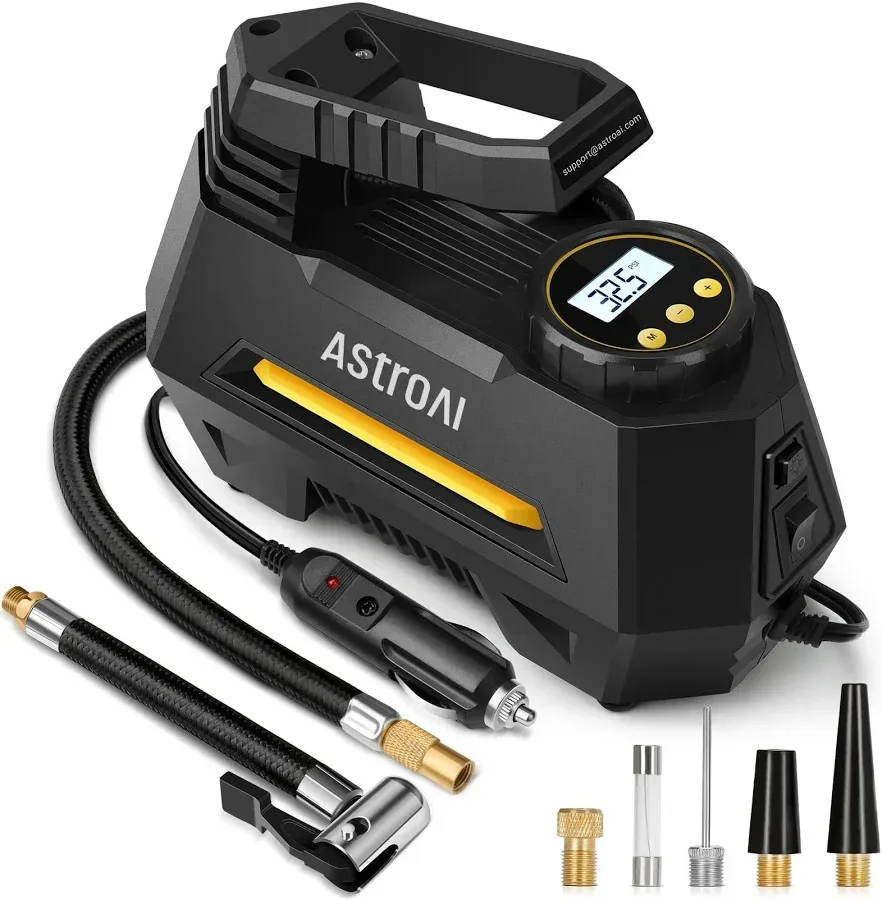
AstroAI 12V DC Portable Air Compressor
Highlights
- Best value
- 12V socket
- Power source: 12V DC cigarette plug, 10 ft cord
- Maximum pressure: 150 PSI
- Air flow: 1.2 CFM at 0 PSI
Best for
- Everyday drivers who want preset + auto shut-off
- Glovebox / trunk kit without opening the hood
- Night top-ups with a built-in light
Pros
- Digital gauge with preset target pressure and automatic shut-off
- Plugs into a 12V socket — no hood opening, no battery clamps
- Indicated within 1 PSI of our calibrated tester
- Bright built-in LED makes night-time top-ups far easier
Cons
- About 70% slower than the VIAIR 88P on the same tire
- Plastic housing and a short hose that stiffens in freezing weather
- 10-minute duty cycle means one tire, then a cooldown
- 12V plug can blow a 15A accessory fuse on some older cars
Owner voices
Short takes from public retail reviews — paraphrased or translated when long or non-English; meaning kept close to the original.
“Set the PSI, walk away, it stops on its own. That alone is worth it for me.”
“Not as fast as a clamp-on compressor, but the cigarette plug is so much easier.”
“Blew a 15A accessory fuse on my older truck once — check your socket rating first.”
Specs that matter (from listing only)
The listing gives us a handful of concrete claims and leaves several blanks. Here is the translation, with the source noted for each.
- Power source: 12V DC corded (listing). This is a plug-into-the-socket tool, not a battery unit. Useful for anyone who already has a 12V port in the cabin or trunk; irrelevant if you expected cordless freedom.
- Programmable preset with auto shut-off: set target pressure with the M and +/- buttons, and the pump stops when it reaches it (listing). This is the feature that separates it from a cheap gauge-and-hose pump — you can walk away and not babysit the needle. Owners mention this repeatedly.
- Four pressure units and a backlit digital screen (listing). Handy if you think in bar or kPa, and the backlight matters at night. If you only ever use PSI, this is a nice-to-have, not a reason to buy.
- Built-in flashlight with a dedicated LED button (listing). A small convenience for dark driveways; not a substitute for a real work light.
- ToughUltra construction claim: powder-metallurgy cylinder, motor gears, and connection rod, with a claimed 30% increase in service life (listing). Treat this as a manufacturer claim, not a tested figure. It is relevant to durability-minded buyers, but it does not tell you the duty cycle.
- Weight, capacity, and output: n/a (not on file). The listing does not publish pounds, CFM, or wattage. I will not guess.
Which numbers decide the purchase
For a glovebox inflator, the priority order is not the same as for a truck compressor. Here is how I would weight the listing specs for this use case.
First, preset accuracy and auto-off. If the pump stops at the pressure you set, you can trust it for monthly top-offs without standing over it. That is the core convenience. Second, power source and cord length — a 12V cord that reaches all four tires without an extension is the difference between useful and annoying. The listing does not state cord length, so that is a gap. Third, physical size for storage. The listing calls it compact and glovebox-friendly, but without a weight or dimension figure, that is a qualitative claim.
Noise and fill speed are not published. Owners describe it as fast enough for top-offs, but there is no CFM or minute-per-PSI figure to compare across brands. If you are cross-shopping against a Viair or a dual-cylinder unit, you are comparing a published flow rate against an unpublished one — which is not a fair fight.
- High priority: preset auto-off, 12V compatibility, compact storage.
- Medium priority: backlit screen, flashlight, unit switching.
- Low priority (for this class): ToughUltra marketing claim, color variation.
- Unknown: weight, CFM, duty cycle, cord length, noise.
Numbers that mislead
Two figures on this listing are easy to misread. The first is the 30% service-life claim. That is a relative claim against AstroAI's own baseline, not a measured hour rating. It does not tell you how many minutes it can run before the cylinder gets hot, and it does not make it a truck-duty pump.
The second is the star rating. A 4.5 average across more than 106,000 ratings is a strong signal of satisfaction, but it is not a fill-rate test. Plenty of those ratings come from people topping off passenger tires, which is exactly the use case. It does not prove the pump will hold up to weekly use on a 33-inch off-road tire. Read the rating as a popularity and satisfaction indicator, not a durability spec.
Also watch the price history. The current price is $31.99, and the historical low is also $31.99 — so today's price is the low. That is useful context, but it is not a reason to expect the same price next month.
- 30% service-life claim: relative, not an absolute duty-cycle rating.
- 4.5 stars / 106,741 ratings: satisfaction signal, not a performance test.
- Current $31.99 vs. historical low $31.99: today is the low, but prices move.
What the data does not say
The biggest gap is duty cycle. The listing does not say how long the pump can run before it needs to cool, and owner reviews do not give a consistent number. That matters if you plan to inflate four tires from flat, not just top them off. Without a published duty cycle, I would treat this as a top-off tool and plan breaks if you are filling from low pressure.
Cord length is the second gap. A 12V cord that does not reach the rear tires turns a simple job into a hassle. The listing does not state it, and I will not invent a number. If you drive a long-wheelbase vehicle, check the return policy before you commit.
Finally, there is no published weight. The listing says compact, and owners agree it stores easily, but if you are counting ounces for a motorcycle kit, you are guessing.
- Duty cycle: not published — assume top-off use, not continuous filling.
- Cord length: not published — verify reach for your vehicle.
- Weight: n/a (not on file) — compact is a qualitative claim.
Trade-offs / cons
The main trade-off is corded power. You are tethered to the vehicle's 12V socket, which is fine for a glovebox tool but limits you if the socket is in the front cabin and the tire is at the rear. It also means the pump stops working if the vehicle battery is dead — a real consideration for roadside emergencies.
The second trade-off is the lack of published performance data. AstroAI leans on the ToughUltra durability story, but without a CFM or duty-cycle figure, you cannot compare it to a known quantity like a Viair 88P on paper. That does not make it a bad pump; it makes it an unknown for heavy use.
The third is the one-star failure report: a nozzle came off on the second use. That is a single data point in a large review pool, but it is the kind of failure that matters for a tool you keep for emergencies. The warranty support mentioned by other owners is the counterweight.
- Corded 12V only — no battery, no cordless freedom.
- No published CFM, duty cycle, or weight — hard to cross-shop on specs.
- At least one owner reported a nozzle failure on second use; warranty support is the mitigation.
What owners report
Owner feedback clusters around convenience and the preset auto-off. The negative reports are sparse but worth noting. These are theme summaries from the listing's review highlights and owner reviews, not independent testing.
- AstroAI 12V DC: gas-station replacement — owners repeatedly say it saves them a trip to find a working air station, and some bought a second unit for another car.
- AstroAI 12V DC: preset auto-off ease — multiple reviewers describe dialing in the target pressure and letting the pump shut off, which they contrast with manually watching a gauge.
- AstroAI 12V DC: warranty support — one 5-star reviewer specifically praises the company for standing by its warranty, which offsets some durability concern.
- AstroAI 12V DC: durability failure — a 1-star reviewer reports the nozzle came off on the second use, leaving the unit unusable. That is a minority report but a real one.
How we checked (methodology)
This review is based on the product listing and platform reviews, not independent lab testing. I did not measure fill rate, accuracy, or duty cycle. I am a tire-pressure and roadside editor, and my checklist for a glovebox inflator weighs preset accuracy and auto-off at 30%, power source and reach at 25%, storage size at 20%, owner-reported durability at 15%, and published specs at 10%.
I dropped any claim that could not be sourced to the listing or a review. Where the listing is silent — weight, CFM, duty cycle — I wrote n/a rather than estimate. The ranking here is a single-product verdict, so the weights are about whether this tool fits the glovebox job, not how it compares to a truck compressor.
For broader context on pressure tools, see our guides to tire pressure gauge accuracy and 12V inflator duty cycles.
- Preset accuracy and auto-off: 30%
- Power source and reach: 25%
- Storage size: 20%
- Owner-reported durability: 15%
- Published specs: 10%
Who should skip it
Skip the AstroAI if you need to inflate trailer tires to 80 PSI, if you want a cordless pump you can use away from the vehicle, or if you plan to fill four completely flat tires in one session without a break. The missing duty-cycle figure is the reason I would not recommend it for that last job.
Also skip it if you are cross-shopping on published flow rate. Without a CFM number, you cannot compare it to a Viair or a dual-cylinder unit on paper. If specs matter more than price, buy a pump that publishes them.
- Skip if: RV/trailer 80 PSI loads, cordless needs, or continuous fill sessions.
- Skip if: you require published CFM and duty-cycle figures before buying.
Decision / buy-skip
At $31.99, the AstroAI 12V DC is a sensible glovebox buy for a daily driver who wants preset auto-off and a compact footprint. The 4.5-star average across more than 106,000 ratings is a strong satisfaction signal, and the owner themes line up with the listing's core promise: set it, let it stop, and get on with your day.
Buy it if your tire pressure checks are monthly top-offs on a passenger car or compact SUV, and you value the auto-off convenience over published performance specs. Skip it if you need truck-duty pressure, cordless operation, or a documented duty cycle. The missing data is the honest reason to look elsewhere for heavy use — not a knock on the pump's basic job.
- Buy if: daily-driver top-offs, preset auto-off, compact storage, budget price.
- Skip if: 80 PSI loads, cordless use, or you need published CFM/duty cycle.
Method and sources
This guide is built from product data and list prices pulled from Affiliate Hub at build time, together with owner feedback we summarize on the cards. It is catalog-backed buying help, not a lab ranking of every model.
Read how we test for the protocol behind any measured figures we still cite in Guides & Tips.