Who it is for — and who should keep shopping
If you air down before sand, rock, or a long washboard road, the ARB E-Z Tire Deflator (ARB505) is the tool that removes the valve core and lets the tire dump pressure fast while a 1-PSI dial shows you exactly where you are. It is not a compressor, not a TPMS sensor, and not a substitute for a proper gauge when you air back up. This review is for buyers comparing deflators, not inflators.
The short answer: it suits drivers who air down regularly and want a repeatable, fast drop to a target PSI without guessing. It does not suit anyone who only checks pressure monthly, or who needs to inflate — that is a different tool and a different guide.
- Suits: off-roaders airing down to 12–22 PSI several times a month.
- Suits: owners who want a mechanical dial that works without batteries.
- Skip if: you need a compressor or an inflator — this only deflates.
- Skip if: you air down once a year and a $10 stick gauge is enough.
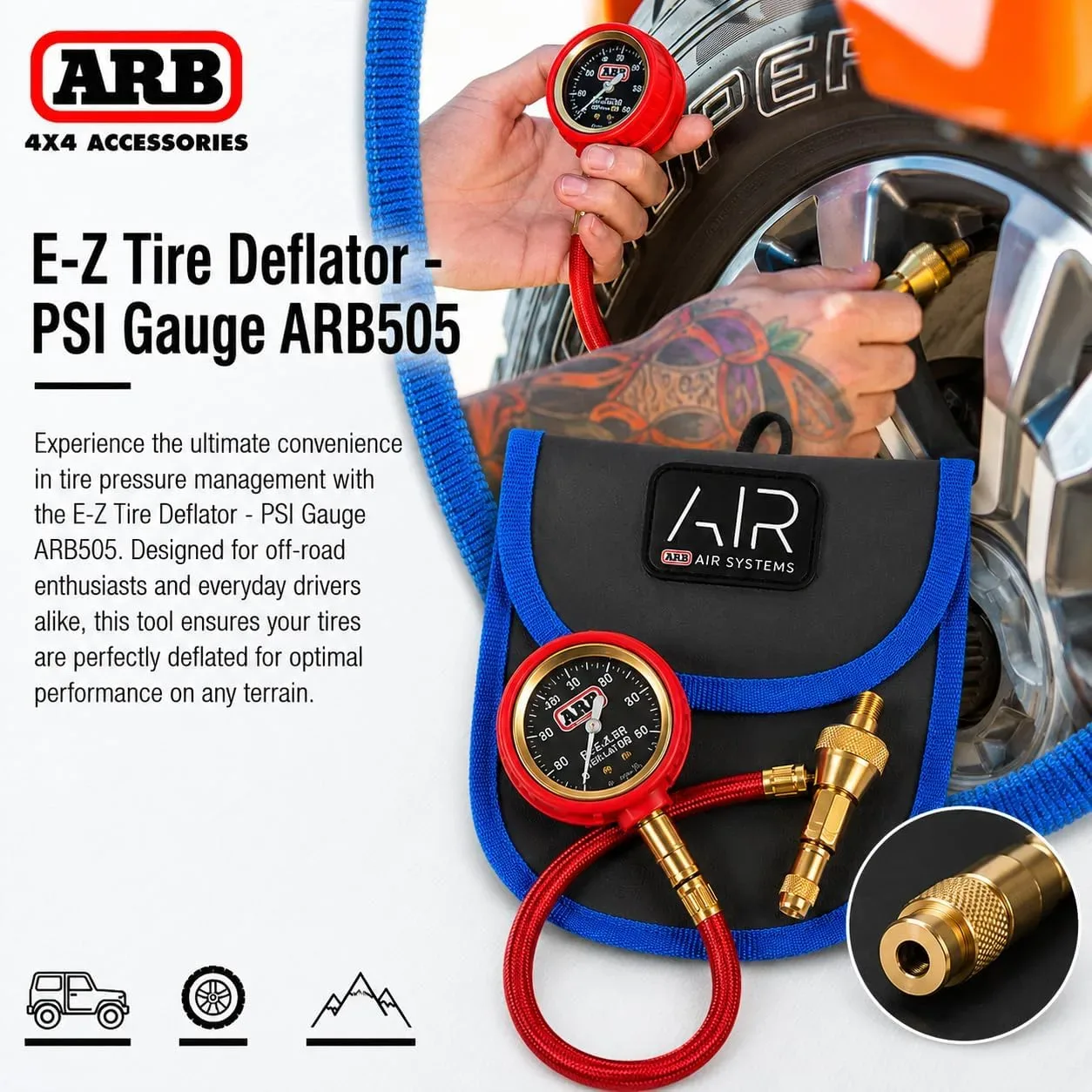
ARB E-Z Tire Deflator - PSI Gauge (ARB505)
Highlights
- Trail tire deflator
- Manual trail control
- On-tool gauge readout
- About $54.95 list
Best for
- Airing down one tire at a time at the trailhead
- Overlanders who already carry onboard or portable air
- Drivers OK watching the gauge while air dumps
Pros
- Purpose-built for controlled air-down — faster than a bleed button on a check gauge
- On-tool gauge keeps PSI visible while you dump or fill
- ARB kit sits in the overland / recovery gear class rather than a glovebox pencil
- Fewer electronics to fail in dust and weather than a full digital manifold
Cons
- Needs a plan to air back up — this is not a compressor
- One-tire tools are slower on a four-corner air-down
- Easy to overshoot target PSI if you walk away from a wide-open dump
- Trail abuse (sand, rocks, tossed in a drawer) wears seals and QDs over time
Owner voices
Short takes from public retail reviews — paraphrased or translated when long or non-English; meaning kept close to the original.
“5/5 — Works very well. I debated what to use for tire deflation for some time, and I did a lot of research. I am god that I went this way. The Currie version is made by the same folks. I compared my ARB to a friend's…”
“5/5 — I do regular offroading and need to air down my tires to about 15-22 PSI depending on the situation. I learned of these tire deflators while at the sand dunes as I watched someone else "air down" in a fraction o…”
“4/5 — I bought a cheaper knock-off version and now that it failed, I figure I might as well spend a little more on the ARB deflator. It’s really quick to air down my tires from 26 psi that I drive on the street to the…”
How we checked this
Figures on this page come from manufacturer listings and owner-review themes on file — not bench fill-rate tests. When a number is missing it stays n/a (not on file). I cover tire-pressure and roadside air tools as an editor using a checklist approach against the catalogue, not a lab visit.
The spec sheet, translated
ARB lists the ARB505 at $54.95 (current and historical low are the same — no discount history to chase). The rating is 4.7 from 3,063 ratings, which is strong but not a lab score. Here are the numbers that actually shape the purchase, each with its source.
Max pressure reading: the dial is marked in 1-PSI increments (listing). That is the resolution, not a max PSI rating — ARB does not publish a ceiling on the listing, so I will not invent one. For a passenger tire at 35 PSI or an off-road tire at 15 PSI, 1-PSI steps are plenty. For a 1-PSI precision claim on a 80-PSI RV tire, I would want a second gauge to confirm.
Construction: brass and stainless body, fully geared solid brass movement, rubber gauge guard, braided hose, full swivel connection (listing). Translation: it is built to live in a dusty recovery bag and get knocked around. The rubber guard is the part that saves the dial when it rolls off a tailgate.
Valve-core removal: the patented design lets you pull the core so air escapes at an amplified rate, then a sliding valve gives a live reading while deflating (listing). This is the feature that separates it from a press-on deflator — you are not guessing when to stop.
Weight and size: listing details say 12 ounces (0.75 lb) and 5 x 5 x 5 inches; normalizedFacts mark weight n/a, so treat 12 oz as the listing figure, not a verified scale reading. Either way it is a glovebox or bag item, not a dash-mounted tool.
- Price: $54.95 (listing; historical low also $54.95).
- Dial resolution: 1 PSI increments (listing).
- Body: brass/stainless, rubber gauge guard, braided hose (listing).
- Weight: 12 oz / 0.75 lb per listing details; normalized weight n/a.
- Rating: 4.7 from 3,063 ratings (platform).
Which numbers decide the purchase
Ranked by what changes the buying decision for a deflator: first, the valve-core removal and live reading — that is the whole reason to spend $55 instead of $15. Second, the 1-PSI dial and brass movement, because accuracy at low pressure is where cheap deflators drift. Third, the build materials and guard, since this tool lives in dirt. Fourth, weight and pouch, which matter only if you are packing light. Price sits last because the spread between a good deflator and a great one is about one tank of gas.
The ARB505 wins on the first two and is merely good on the rest. If you only care about the last two, a lighter plastic deflator will do.
Numbers that mislead
Two figures on this listing are easy to misread. The 1-PSI increment is resolution, not accuracy — a dial can show 1-PSI steps and still be off by 2 PSI. ARB does not publish an accuracy tolerance on the listing, so I would not treat the dial as a calibration reference; use it to hit a target, then confirm with a trusted gauge.
The 12-ounce weight is from the details block, while the normalized spec says n/a. That is a listing inconsistency, not a measured weight. It is close enough for bag planning, but do not quote it as a scale result. Also, the 4.7 rating reflects 3,063 buyers, many of whom are airing down 31-inch tires to 20 PSI — it is not a test of the dial at 80 PSI.
What the data does not say
ARB does not publish a max PSI rating, an accuracy tolerance, or a duty cycle on this listing. Owners report fast deflation from street pressure to trail pressure, but no one in the provided reviews measures the dial against a calibrated gauge. If you need a deflator for a heavy truck at 80 PSI, the listing gives you no ceiling to check against — that is a gap, not a green light.
There is also no published flow rate (CFM or L/min). The speed claims come from owner experience, not a spec sheet. I would treat 'fast' as a theme, not a number.
Trade-offs and cons
The honest cons are few but real. It only deflates — no inflation, no pressure monitoring. The valve-core removal step adds a moment of fiddling compared with a press-on deflator, and if you lose the core, you are stuck. The canvas pouch is a nice touch, but it is not waterproof, just dust and splash protection.
Price is the other trade-off. At $54.95 with no historical discount, you are paying for the ARB name and the brass movement. A knock-off may work for a season; owners report the cheaper versions failing, which is exactly the case this tool is built to avoid.
- Deflate-only — no inflator or gauge function when aired up.
- Valve-core removal is an extra step; spare cores are cheap insurance.
- No published max PSI or accuracy tolerance on the listing.
- Pouch is dust/splash protection, not waterproof.
What owners report
Owner themes line up with the spec story: speed and simplicity. One 5-star reviewer who airs down to 15–22 PSI for off-roading said they learned the tool at the sand dunes and now use it instead of the slow method. A 4-star reviewer came from a failed knock-off and reported dropping from 26 PSI street pressure to 12 PSI trail pressure quickly. Another 5-star owner with 31-inch tires said all four tires went to 20 PSI in under 15 minutes.
The reviews skew toward off-road and beach use, not highway commuting. That matches the page angle — this is a trailhead tool, not a daily-driver pressure checker. No owner in the provided set reports using it on an RV or at 80 PSI, so I would not extrapolate.
- GoodForTheSport: simple and fast — prefers it over digital deflators.
- TNnative: regular off-roader, airs down to 15–22 PSI, calls it easy to use.
- 4-star owner: replaced a failed knock-off, quick drop from 26 to 12 PSI.
- 5-star owner: 31-inch tires to 20 PSI in under 15 minutes for the beach.
How I checked this listing
I am the tire-pressure and roadside editor at PumpGauge, and my checklist for a deflator is simple: does the listing publish the numbers that matter (dial resolution, construction, valve-core design), and do owner themes match those numbers? I do not run lab fill-rate tests, and I did not measure this unit. Everything here is from the ARB listing and platform reviews, with gaps marked n/a rather than filled with guesses.
For related buying frameworks, see our guide to tire pressure gauge accuracy and our off-road air-down checklist.
Who should skip the ARB505
Skip it if you need to inflate — this is a deflator only. Skip it if you air down less than a few times a year; a $10 stick gauge and patience will get you there. Skip it if you need a published max PSI for a heavy truck or RV, because ARB does not list one here. And skip it if you want a digital readout — this is a mechanical dial by design.
Buy it if you air down regularly, want a fast valve-core dump with a live 1-PSI dial, and value a brass movement that survives the recovery bag. At $54.95 with a 4.7 rating from 3,063 buyers, it is the known quantity in a category full of knock-offs.
Method and sources
This guide is built from product data and list prices pulled from Affiliate Hub at build time, together with owner feedback we summarize on the cards. It is catalog-backed buying help, not a lab ranking of every model.
Read how we test for the protocol behind any measured figures we still cite in Guides & Tips.