Who it is for — and who should scroll past
If you tow a travel trailer or drive a Class C and you are tired of nursing a 35 PSI passenger-car inflator up to 80 PSI, the VIAIR 400P Automatic is the kind of tool you are shopping for. It is a 12V compressor with an automatic shutoff, sold as a step up from the cigarette-lighter toys. The listing price is $168.45, and it carries a 4.8-star rating across 1,288 ratings — numbers I will treat as listing claims, not bench results.
This is not a glovebox inflator for a commuter car, and it is not a dual-cylinder truck clamp for 37-inch mud tires. The 400P Automatic sits in the middle: enough for RV and trailer tire pressures, not the fastest way to air up four off-road tires after a trail day. If you need a pocket gauge for monthly pressure checks, this is overkill.
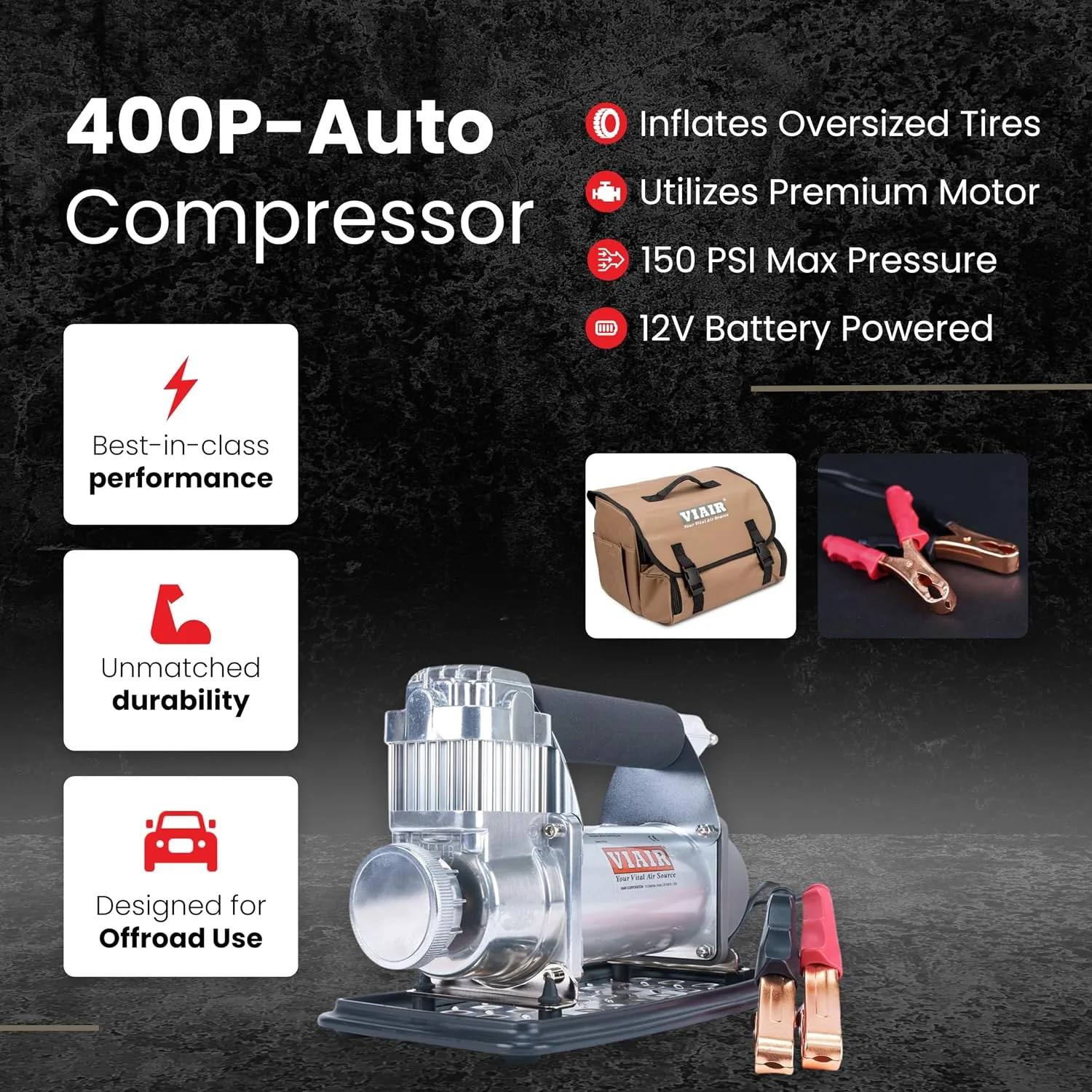
VIAIR 400P Automatic 40045
Highlights
- 12V portable inflator
- Digital preset / auto shut-off
- About $168.45 list
- Category: portable-tire-inflators-rv-trailer
Best for
- Trunk / glovebox emergency top-ups
- Cold-morning placard top-ups on cars and light SUVs
- Drivers who want a more durable weekly driver
Pros
- 12V socket convenience without opening the hood
- Preset + shut-off reduces overshoot vs staring at a bouncing dial
- VIAIR build is aimed at repeated top-ups, not a one-weekend toy
- Fits the portable tire-inflator job: soft tire → placard, not shop compressor duty
Cons
- Cigarette-lighter circuits can trip; check fuse / amperage on older vehicles
- Compressor gauges often read high — verify with a dedicated tire gauge
- Duty cycle / heat soak limits flat-to-full fills on large truck tires
- Heavier / bulkier than an ultra-compact emergency mini pump
Specs that matter — translated from the listing
The listing gives us a handful of numbers worth reading closely. Everything below is from the product page or the model number; where a figure is missing, I say so rather than guess.
- Max working pressure: 150 PSI (listing). That is the ceiling, not a cruising pressure. For most trailer tires at 50–80 PSI, you are well inside the range. For a passenger car at 35 PSI, you are using a fraction of the tool.
- Automatic shutoff: the 'Automatic' in the name refers to a preset pressure cutoff. You dial a target, it stops there. Useful when you are crouched by a trailer wheel and do not want to watch a gauge. The listing does not publish cutoff accuracy, so treat 'automatic' as convenience, not calibration.
- Power: 12V, alligator clips to the battery (listing). This is not a cigarette-lighter compressor. That matters — you need battery access, which is fine on a trailer tongue or tow vehicle but annoying if your battery is buried under a seat.
- Weight and dimensions: n/a (not on file). The listing does not publish a weight figure I can stand behind. I will not invent one. If portability is your top filter, ask the seller before you buy.
- Flow rate: n/a (not on file). VIAIR's model naming does not translate to a CFM number on this listing. Fill time is the number you actually feel, and it is not published here.
Which numbers decide the purchase
Ranked by what changes your ownership experience, not by what looks impressive on a spec sheet:
- 1. Max pressure (150 PSI) — this is the gate. If your trailer or RV tires run above 80 PSI, you need a compressor rated for it. The 400P clears that bar on paper.
- 2. Power source (12V alligator clips) — second because it decides where you can use it. Battery access is non-negotiable. A 12V plug unit is more convenient but usually slower and lower-pressure.
- 3. Automatic shutoff — a quality-of-life feature. Nice on a trailer with six tires; not a reason to buy on its own.
- 4. Flow rate — the number that decides how long you stand there. Missing from the listing, which is a real gap.
- 5. Weight — matters if you move it between vehicles. Also missing.
Numbers that mislead
Two figures on this listing are easy to misread. First, the 150 PSI max: that is a ceiling, not a working pressure. A compressor rated to 150 PSI may still be slow getting from 65 to 80 PSI, and the listing does not give a flow curve. Do not read '150 PSI' as 'fast at 80 PSI.'
Second, the 4.8-star rating across 1,288 ratings. That is a listing aggregate, not a measured fill-rate score. High ratings on inflators often reflect reliability and convenience more than speed. Without owner review text on file, I cannot tell you which themes drive that number — only that the count is large enough to be meaningful.
What the data does not say
The biggest gap is fill time. VIAIR does not publish a CFM or a minutes-per-tire figure on this listing, and I will not fill that hole with a guess. If you are comparing this against a dual-cylinder compressor, you are comparing a known quantity to an unknown one.
Weight is the second gap. For a tool that lives in a trailer storage bay, weight matters less; for a tool you move between a tow vehicle and a garage shelf, it matters more. The listing does not give a number, so I cannot rank it on portability.
Finally, there are no owner reviews on file for this SKU in our data. The 4.8-star rating is a listing figure. I cannot summarize themes I do not have, and I will not invent quotes.
Trade-offs and cons
The alligator-clip power is the main trade-off. It gives you full battery amperage, which is why the 400P can push higher pressures than a 12V-plug unit. But it also means popping the hood every time. On a windy trailhead with a cold engine, that gets old.
The automatic shutoff is convenient, but the listing does not publish accuracy. If you are the kind of owner who wants a gauge you can trust to within 1 PSI, plan to verify with a separate handheld gauge — a habit I recommend anyway.
And the price. At $168.45, this is not an impulse buy. It sits above the basic 12V inflators and below the dual-cylinder truck compressors. You are paying for the pressure ceiling and the automatic cutoff, not for speed you can measure from the listing.
Spec-based verdict: buy if, skip if
Buy the VIAIR 400P Automatic if you tow a trailer or drive an RV with tire pressures in the 50–80 PSI range, you have battery access, and you want an automatic cutoff so you are not babysitting the gauge. It is a sensible middle-tier tool for that job.
Skip it if you need a glovebox inflator for a daily driver — a $30 12V-plug unit will do. Skip it if you are airing down and up 35-inch off-road tires regularly; you want a dual-cylinder compressor with a published flow rate. And skip it if you cannot find a weight figure and portability is your top priority — ask the seller first.
What owners report
No owner review text is on file for this SKU in our data. The listing shows a 4.8-star rating across 1,288 ratings, but without review themes I cannot tell you what owners praise or complain about. I will not paraphrase quotes that are not there. If you want owner sentiment, read the listing reviews directly and look for mentions of fill time on trailer tires and clip durability.
How we checked this review
This review is based on the product listing and the platform rating, not on independent lab testing. I am the tire-pressure and roadside editor at PumpGauge; my checklist starts with pressure ceiling and power source, then looks for published flow and weight. When those are missing, I say so rather than estimate. No fill-rate tests were run for this article.
Method and sources
This guide is built from product data and list prices pulled from Affiliate Hub at build time, together with owner feedback we summarize on the cards. It is catalog-backed buying help, not a lab ranking of every model.
Read how we test for the protocol behind any measured figures we still cite in Guides & Tips.