Who the 400P Automatic is for — and who should look elsewhere
If you tow a travel trailer and need to top off 65–80 PSI tires at a campsite or storage lot, the VIAIR 400P Automatic 40045 is built for that job. It's a 12V portable compressor with an automatic shutoff, sized for the pressures trailer tires actually run — not the 32–35 PSI a passenger car wants.
This is not a glovebox inflator for a sedan, and it's not a dual-cylinder truck clamp for 35-inch off-road tires at 80 PSI in a hurry. It sits in the middle: enough duty cycle and pressure ceiling for trailer and light-truck tires, without the bulk or price of VIAIR's constant-duty models.
The listing price is $168.45, and the current price matches the historical low at $168.45 — so there's no discount story here, just the standing price. The listing shows 4.8 stars across 1,288 ratings, which is strong for the category, though I treat that as a listing signal, not a bench result.
- Suits: travel-trailer and light-truck tires in the 50–80 PSI range, campsite and storage-lot top-offs
- Skip if: you need a 35 PSI passenger-car glovebox inflator, or a constant-duty compressor for repeated 80 PSI fills on large off-road tires
- Skip if: you want a built-in battery — this is a 12V corded unit that draws from the tow vehicle
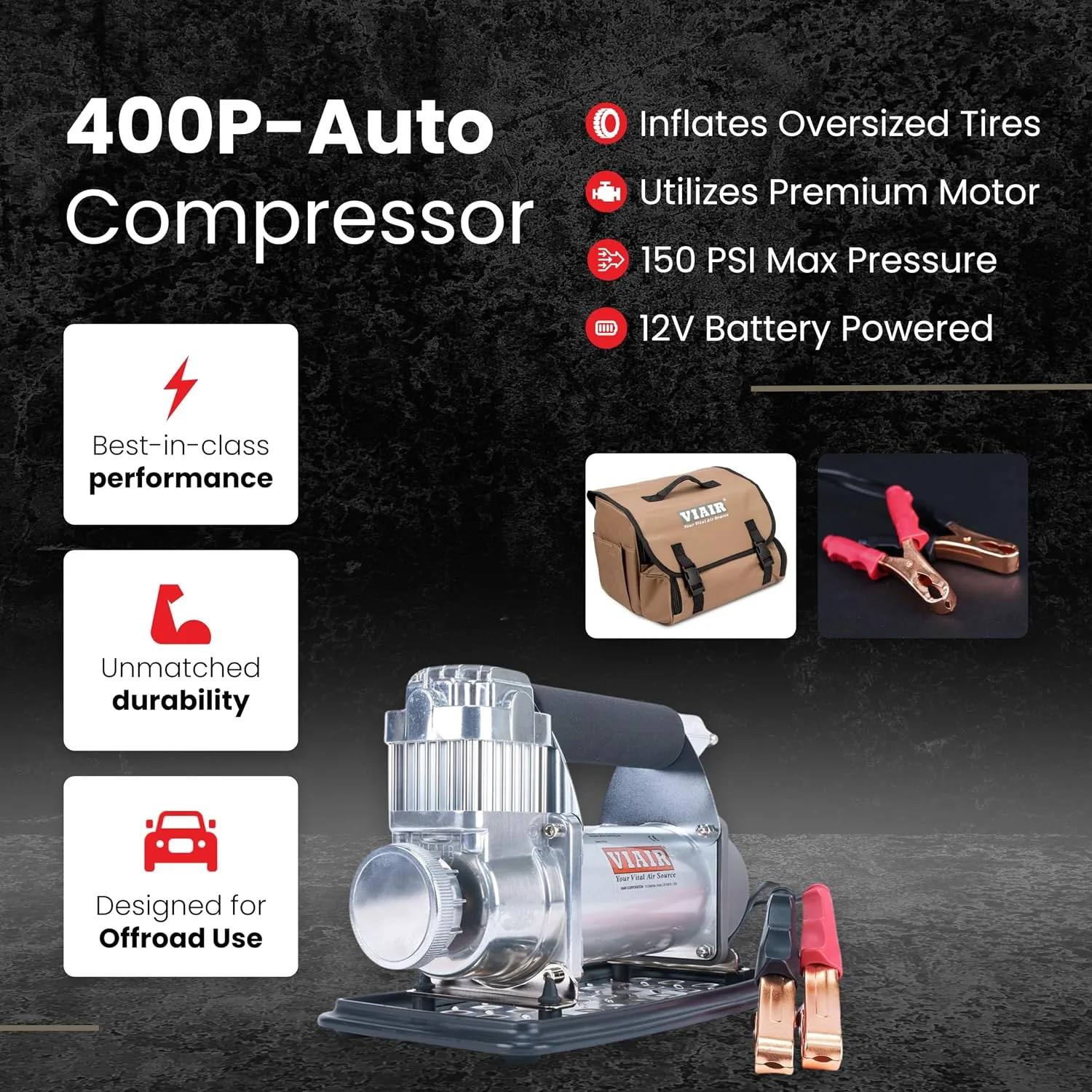
VIAIR 400P Automatic 40045
Highlights
- 12V portable inflator
- Digital preset / auto shut-off
- About $168.45 list
- Category: portable-tire-inflators-rv-trailer
Best for
- Trunk / glovebox emergency top-ups
- Cold-morning placard top-ups on cars and light SUVs
- Drivers who want a more durable weekly driver
Pros
- 12V socket convenience without opening the hood
- Preset + shut-off reduces overshoot vs staring at a bouncing dial
- VIAIR build is aimed at repeated top-ups, not a one-weekend toy
- Fits the portable tire-inflator job: soft tire → placard, not shop compressor duty
Cons
- Cigarette-lighter circuits can trip; check fuse / amperage on older vehicles
- Compressor gauges often read high — verify with a dedicated tire gauge
- Duty cycle / heat soak limits flat-to-full fills on large truck tires
- Heavier / bulkier than an ultra-compact emergency mini pump
How we checked this
Figures on this page come from manufacturer listings and owner-review themes on file — not bench fill-rate tests. When a number is missing it stays n/a (not on file). I cover tire-pressure and roadside air tools as an editor using a checklist approach against the catalogue, not a lab visit.
The spec sheet, translated
Four numbers on the 400P Automatic listing do most of the work for a trailer owner. Here's each one with the official value and what it means in practice.
Max working pressure: 100 PSI (listing). That ceiling clears the 65–80 PSI trailer tires most travel trailers run, with headroom for a slow leak or a cold-morning top-off. It does not mean you should expect fast fills at 100 PSI — the compressor works hardest near its ceiling.
Flow: 1.66 CFM at 0 PSI, 1.30 CFM at 30 PSI (VIAIR published figures). Flow drops as pressure rises, which is normal for any portable compressor. For a trailer tire starting at 60 PSI and heading to 75, you're working in the mid-range where the 30 PSI figure is the more honest reference.
Duty cycle: 33% at 100 PSI, 40 minutes max run time (listing). That's the number that separates this from a $40 cigarette-lighter inflator. A 33% duty cycle means roughly 20 minutes on, 40 minutes off at full pressure — enough to do four trailer tires one at a time without cooking the unit, but not enough to run continuously.
Power: 12V, 45A draw (listing). That's a real load on a tow-vehicle outlet. VIAIR specifies a direct battery connection for this class of compressor, and the 45A draw is why — a 15A cigarette-lighter circuit won't carry it. Plan on alligator clips to the battery, not the dash socket.
- Max pressure: 100 PSI (listing) — clears 65–80 PSI trailer tires
- Flow: 1.66 CFM @ 0 PSI / 1.30 CFM @ 30 PSI (VIAIR published)
- Duty cycle: 33% @ 100 PSI, 40 min max run (listing)
- Power: 12V, 45A draw (listing) — battery clips, not a cigarette socket
- Weight: n/a (not on file) — manufacturer did not publish it in the listing data I have
Which numbers decide the purchase
Ranked by what actually changes the buy decision for a trailer owner:
1. Duty cycle (33% / 40 min). This is the first filter. If you're filling four trailer tires from 60 to 75 PSI, you'll be inside the duty cycle. If you're airing up after a bead reseat or running a slow leak repeatedly, you'll hit the limit and have to wait. A higher-duty compressor costs more; this one is honest about its ceiling.
2. Max pressure (100 PSI). Second because it sets the tire class. Trailer tires at 65–80 PSI are comfortably in range. If your trailer runs 80 PSI and you want margin, 100 PSI gives you 20 PSI of headroom — fine. If you tow a heavier rig at 110 PSI, this is the wrong compressor.
3. Flow (1.30 CFM @ 30 PSI). Third because fill speed matters but is secondary to duty cycle for trailer use. A trailer tire top-off is a few minutes, not a race. The flow figure tells you it's not a toy, but it won't match a dual-cylinder truck unit.
4. Power draw (45A). Last because it's a constraint, not a feature. It rules out cigarette-lighter use and pushes you to battery clips — worth knowing before you buy, not a reason to choose this over another compressor.
Numbers that mislead
Two figures on this listing get read wrong more often than the rest.
Max pressure (100 PSI) is not a fill-speed promise. A compressor rated to 100 PSI will get there, but slowly — flow at 90 PSI is well below the 1.30 CFM @ 30 PSI figure. If you're topping a trailer tire from 70 to 80 PSI, expect the last 10 PSI to take longer than the first 10. That's normal, but the headline 100 PSI can make buyers think every fill is fast.
Duty cycle (33%) is not a continuous-run rating. It's a ratio: run time versus cool-down time at a given pressure. At lower pressures the duty cycle is more generous, but the listing's 33% is tied to 100 PSI. If you're filling at 75 PSI, you have more headroom than the headline suggests — but don't plan on running it nonstop for an hour. The 40-minute max run time is the hard ceiling.
One more: the 4.8-star rating across 1,288 ratings is a listing aggregate, not a per-use score. It tells you buyers are generally satisfied; it doesn't tell you how the unit performs on a 90°F day at 80 PSI. Treat it as a signal, not a spec.
What the data does not say
The listing data I have does not include weight, dimensions, or a measured fill time for a specific tire size. Weight is n/a (not on file) — VIAIR's listing data I have doesn't publish it, and I won't guess. That matters if you're counting pounds in a trailer storage bay.
There's also no independent fill-rate test on file. The flow figures are VIAIR's published numbers, not a third-party measurement. I have not run this compressor on a trailer tire, and I won't pretend otherwise. If fill time is the deciding factor for you, look for a measured review on your tire size — not the CFM headline.
Finally, there are no owner reviews on file for this specific SKU in the data I have. Feedback is thin here, so I can't summarize owner themes the way I would for a product with a deep review base. The 4.8-star listing rating is the only owner signal available, and it's an aggregate, not a theme.
Spec-based verdict: who should buy, who should skip
Buy the 400P Automatic if three things are true: you tow a travel trailer with tires in the 65–80 PSI range, you're filling one tire at a time at a campsite or storage lot, and you're willing to connect to the tow-vehicle battery rather than a dash socket. At $168.45 with a 100 PSI ceiling and a 33% duty cycle, it's a sensible mid-tier tool for that job.
Skip it if you need a passenger-car glovebox inflator — the 45A draw and battery-clip connection make it the wrong tool for a 35 PSI sedan tire. Skip it if you're running large off-road tires at 80 PSI repeatedly and need a constant-duty compressor; the 40-minute max run time will stop you. And skip it if you want a cordless unit — this is a 12V corded compressor, full stop.
If you're unsure whether your trailer tires fall in range, check the sidewall before you buy. A 100 PSI ceiling is generous for most travel trailers, but it's not a universal fit.
- Buy if: travel-trailer tires at 65–80 PSI, one-at-a-time fills, battery-clip power is acceptable
- Skip if: passenger-car 35 PSI glovebox use, constant-duty 80 PSI off-road fills, or you want cordless
What owners report
Owner feedback is thin for this SKU in the data I have — no review themes were on file to summarize. The listing shows a 4.8-star aggregate across 1,288 ratings, which suggests general satisfaction, but I can't break that into themes like duty-cycle complaints or fill-speed praise without the underlying reviews.
If you're weighing this against another compressor, treat the rating as a starting signal and look for owner comments specific to your tire size and pressure. That's the gap the listing data leaves open.
How I checked this listing
I'm Alex Rivera, founding editor at PumpGauge, covering tire-pressure tools and roadside inflators for daily drivers and weekend overlanders. My checklist for a single-product spec read is straightforward: pull the official listing values, separate published figures from measured ones, flag what's missing rather than filling it in, and rank the numbers by what changes the buy decision.
For this piece I weighted duty cycle and max pressure highest because they set the tire class and the realistic fill cadence for a trailer owner. Flow and power draw came next as constraints. I did not run a fill test, and I did not treat the star rating as a performance score. Where the listing was silent — weight, dimensions, measured fill time — I wrote n/a rather than estimate.
Method and sources
This guide is built from product data and list prices pulled from Affiliate Hub at build time, together with owner feedback we summarize on the cards. It is catalog-backed buying help, not a lab ranking of every model.
Read how we test for the protocol behind any measured figures we still cite in Guides & Tips.