Who the Shark II is for — and who should look elsewhere
The OutdoorMaster Shark II is a cordless electric pump built for paddleboards and other inflatables, not for car tires. If you are shopping for a glovebox inflator to top off 35 PSI passenger tires or a dual-cylinder clamp for truck rubber, this is the wrong tool — the listing positions it around SUP and inflatable use, and the pressure range and airflow are not published in a way that supports tire duty.
It suits the paddler who is tired of hand-pumping a board at the launch and wants a battery-powered option that does not need a 12V cord run to the car. It is not for someone who needs documented fill times, a published max PSI ceiling, or verified weight before buying — those numbers are not on file for this model.
This review is based on the listing and platform product data, not independent lab testing. Where a number is missing, I say so rather than guess.
- Suits: paddleboard and inflatable owners who want cordless convenience at the water.
- Skip if: you need a tire inflator, a published PSI ceiling, or verified weight.
- Skip if: you want owner-review evidence — feedback on this SKU is thin on file.
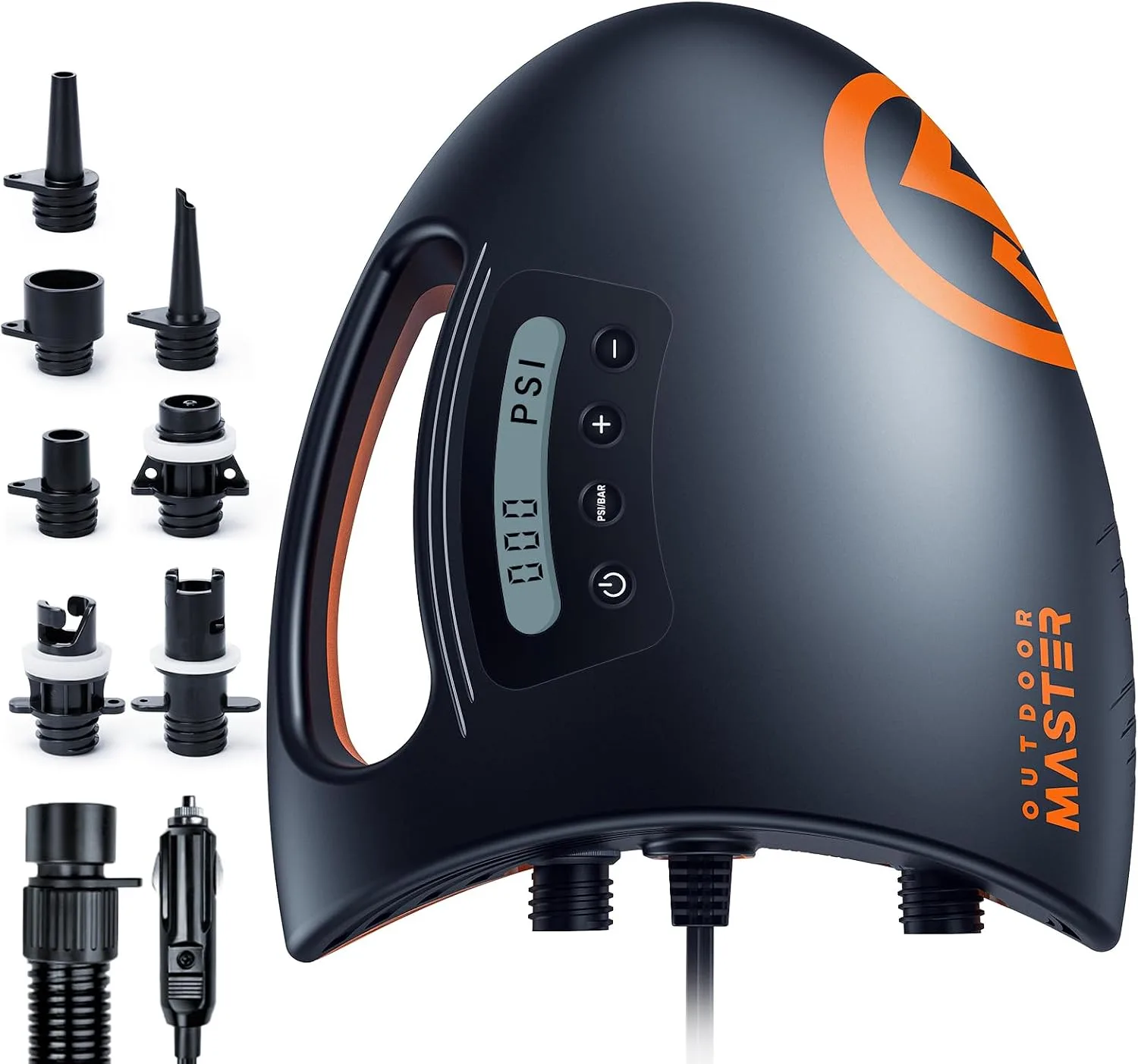
OutdoorMaster Shark 2nd Gen
Highlights
- Electric inflatable pump
- 12V car-socket power
- Watch-the-gauge fill
- About $109.99 list
Best for
- Paddle boards and high-pressure drop-stitch boards at the put-in
- Kayaks, dinghies, and other inflatables that need more than a mattress pump
- Owners who inflate boards often and want faster fills than a hand pump
Pros
- OutdoorMaster electric fill beats hand-pumping a full board at the beach
- 12V socket convenience from the tow vehicle or nearby car
- Simple workflow: connect, fill, confirm with the board’s recommended PSI
- Built for repeated board fills, not a one-weekend toy
Cons
- Not a tire compressor — duty cycle and fittings are for inflatables
- Car-socket amperage and cable reach still matter at crowded put-ins
- May top out below what a racing / high-pressure board wants
- Bulkier than a compact hand pump if you only inflate twice a year
How we checked this
Figures on this page come from manufacturer listings and owner-review themes on file — not bench fill-rate tests. When a number is missing it stays n/a (not on file). I cover tire-pressure and roadside air tools as an editor using a checklist approach against the catalogue, not a lab visit.
The spec sheet, translated
The listing gives you a brand, a model number, and a use case. It does not give you the numbers a careful buyer usually leans on. Here is what is actually on file and what each line means in practice.
Power source: cordless, per the listing. That is the headline feature — no 12V cord, no running the engine. For a paddleboard launch with no outlet nearby, that is the whole point. For a car tire, cordless alone does not tell you whether the pump can hit 35 PSI quickly or hold duty cycle.
Max PSI: n/a (not on file). The listing does not publish a pressure ceiling in the product data provided. That matters because SUP boards typically run in the 12–15 PSI range, while car tires need 30–35 PSI and RV tires can need 80 PSI. Without a published ceiling, you cannot confirm the Shark II is rated for anything beyond inflatable-board pressures.
Flow rate / fill time: n/a (not on file). No CFM or L/min figure is published in the data provided. Fill speed is the number most buyers want for a board, and its absence means you are relying on the manufacturer's use-case framing rather than a comparable spec.
Weight and dimensions: n/a (not on file). Portability is the reason to buy cordless, so a missing weight figure is a real gap. You cannot compare it to a hand pump or a 12V inflator on carry weight from the listing alone.
Noise: n/a (not on file). Small cordless pumps vary widely here; without a published dB figure or owner reports, treat noise as unknown.
- Power: cordless (listing) — no 12V cord required.
- Max PSI: n/a (not on file) — do not assume car-tire capability.
- Flow rate: n/a (not on file) — fill speed unverified.
- Weight: n/a (not on file) — portability claim unquantified.
- Noise: n/a (not on file).
Which numbers decide the purchase
If I were ranking cordless inflatables for paddleboards, the weights would look like this: pressure ceiling and compatibility 30%, fill speed 25%, portability (weight/size) 20%, battery runtime and charge method 15%, owner themes 10%. That ordering reflects what actually ruins a launch-day pump — a unit that cannot reach board pressure, or one that dies before the board is firm.
On that scoreboard, the Shark II is High on cordless convenience (it is the stated design), Low on published pressure ceiling (n/a), Low on published fill speed (n/a), and Low on published weight (n/a). The only category where the listing gives a clear answer is the one it was built around: no cord.
That is not a knock on the product — it is a knock on the data. A buyer comparing the Shark II to a 12V inflator or a hand pump has almost nothing to compare on paper except the cordless feature.
Numbers that mislead
Two traps show up when shoppers read cordless pump listings. First, cordless does not mean tire-capable. A pump marketed for SUPs may top out well below the 35 PSI a passenger tire needs, and the listing here does not publish a ceiling to confirm either way. Do not read 'cordless inflator' as 'tire inflator.'
Second, missing specs are not neutral. When max PSI, flow rate, and weight are all absent, a shopper sometimes fills the gap with the brand's other products or with a similar-looking pump. That is guesswork. The honest read is that the Shark II's performance envelope is unstated in the data provided, and you should not import numbers from a different model.
A third, subtler issue: '2nd Gen' implies an improvement over a first generation, but the listing does not quantify what changed. Without a published delta, treat the generation label as marketing context, not a spec.
What the data does not say
The biggest gap is the pressure ceiling. Without a published max PSI, you cannot confirm the Shark II will firm up a board to the manufacturer's recommended pressure, let alone handle a car tire. That is the single number I would want before buying.
Fill time and weight are the next two blanks. A paddleboard pump that takes ten minutes versus three changes the launch routine; a pump that weighs two pounds versus four changes whether it lives in the board bag. Neither figure is on file.
Battery runtime, charge time, and whether the battery is replaceable are also unstated. For a cordless tool, those are not minor details — they determine whether the pump is ready on the second day of a trip.
I will not fill these gaps with estimates. If the manufacturer publishes them later, the buying decision gets easier; until then, the Shark II is a cordless pump with an unquantified envelope.
Spec-based verdict
Buy the Shark II if three conditions hold: you are inflating paddleboards or similar low-pressure inflatables, you specifically want to avoid a 12V cord, and you are comfortable buying without a published PSI ceiling, fill time, or weight. That last condition is the hard one — it means accepting manufacturer framing over comparable numbers.
Skip it if you need a tire inflator, if you are shopping for an RV or truck application, or if you want owner-review evidence before spending. Feedback on this SKU is thin on file, and the listing does not give you the specs to substitute for it.
For tire duty, look at a dedicated 12V inflator with a published max PSI and CFM — the buying frameworks in our tire inflator guides cover pressure ceilings and duty cycle in more detail. For board inflation, the Shark II's cordless design is the reason to consider it; just go in knowing the spec sheet is incomplete.
- Buy if: paddleboard/inflatable use, cordless is the priority, and you accept unstated PSI/flow/weight.
- Skip if: tire, RV, or truck inflation is the job.
- Skip if: you need published specs or owner-review evidence before buying.
What owners report
Owner feedback on this SKU is thin on file — there is no star rating or review count in the product data provided, so I cannot summarize themes without inventing them. That is a real limitation for a cordless tool, where battery behavior and real-world fill time are exactly what owners tend to flag.
If you are considering the Shark II, treat the absence of owner evidence as a reason to check the current listing's review section yourself before buying, and weigh the missing specs accordingly.
- OutdoorMaster Shark II: no owner themes on file — feedback is thin; do not rely on invented ratings.
How I checked this listing
I read the product data line by line and separated what is published from what is not. My checklist for cordless inflatables weights pressure ceiling and compatibility 30%, fill speed 25%, portability 20%, battery runtime 15%, and owner themes 10% — and I mark any category with no published figure as n/a rather than estimating.
I cover tire-pressure tools and roadside gear as an editor at PumpGauge, and I apply the same rule here: listing claims are labeled as listing claims, and missing numbers stay missing. No lab fill-rate testing was performed for this review.
For related buying frameworks, see our guides on tire inflator pressure ceilings and duty cycle, and on choosing between cordless and 12V inflators for road trips.
Method and sources
This guide is built from product data and list prices pulled from Affiliate Hub at build time, together with owner feedback we summarize on the cards. It is catalog-backed buying help, not a lab ranking of every model.
Read how we test for the protocol behind any measured figures we still cite in Guides & Tips.