The spec sheet, translated
Two devices share one plastic shell here: a 2000A lithium jump starter and a tire inflator. That pairing is the whole pitch, and it's also why the spec sheet reads like two listings stapled together. If you're shopping for a dedicated inflator or a dedicated jump box, this page is not that comparison — it's a translation of what NOCO publishes for the AX65, one number at a time.
Start with the 2000A peak jump rating. From the listing, that's a peak cranking figure, not a continuous current, and NOCO markets it for gas engines up to roughly 8.0L and diesels to about 6.5L. In plain terms: it's sized for a dead battery on a full-size truck or SUV, not a motorcycle-only gadget. Treat the number as a ceiling, not a guarantee — cold mornings and a deeply drained battery both eat into it.
The air compressor is the second headline, and the listing is thinner here than I'd like. NOCO doesn't publish a max PSI or a flow rate (CFM/L/min) in the product data I have on file, so I can't hand you a fill-time estimate or tell you whether it'll top off an 80 PSI trailer tire. That's a real gap, not a footnote — more on it below.
Power comes from an internal lithium battery, so this is cordless by design; there's no 12V cigarette-lighter cord to tangle. Weight is n/a (not on file), which matters because a jump-and-air combo lives or dies by whether you'll actually carry it. And the listing price sits at 232.13 USD, with no historical low on file to compare against.
- 2000A peak jump rating — listing figure, sized for gas up to ~8.0L / diesel ~6.5L
- Built-in air compressor — max PSI and flow n/a (not on file)
- Cordless lithium power — no 12V cord
- Weight n/a (not on file)
- List price 232.13 USD; historical low n/a
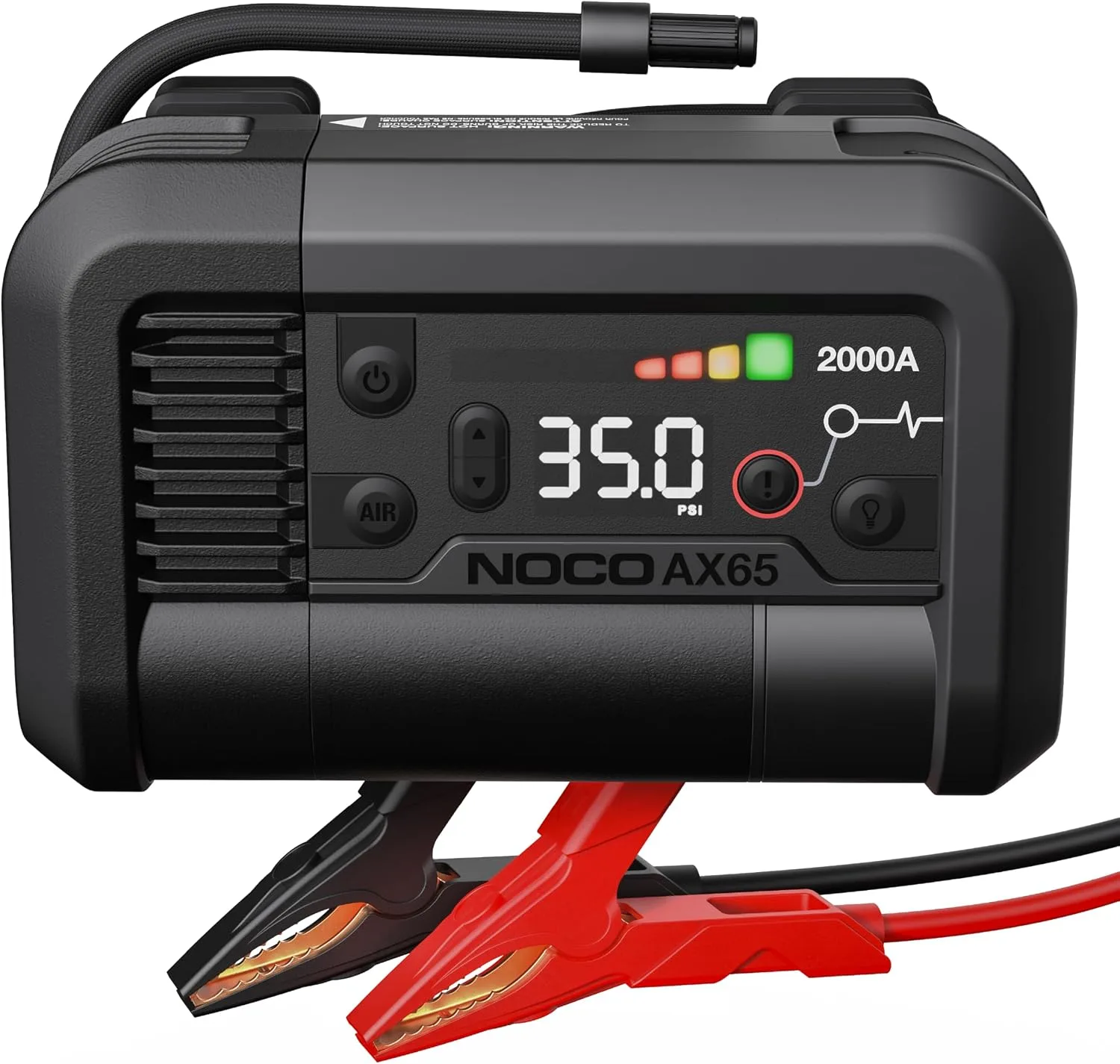
NOCO Boost Air AX65 2000A Jump Starter with Air Compressor
Highlights
- Jump starter + built-in air compressor
- 2000A-class peak claim
- Clamp-on emergency start
- About $232.13 list
Best for
- Dead-battery jump starts in a driveway or parking lot
- Owners who want one box for a jump and a soft-tire top-up
- Drivers who want a higher-amp pack for larger engines
Pros
- One carry case covers both a no-crank morning and a soft tire
- NOCO packs are aimed at roadside self-rescue, not shop chargers
- Higher peak-amp class covers more gas / light-diesel starts
- Beats waiting on a tow for a battery that still takes a jump
Cons
- Built-in compressors are usually light-duty vs a dedicated tire inflator
- Packs need periodic recharge; a dead jump box helps nobody
- Peak-amp marketing is not the same as sustained cranking in deep cold
- Bulk and weight vs a slim pure jump pack if you never use the air feature
How we checked this
Figures on this page come from manufacturer listings and owner-review themes on file — not bench fill-rate tests. When a number is missing it stays n/a (not on file). I cover tire-pressure and roadside air tools as an editor using a checklist approach against the catalogue, not a lab visit.
Which numbers decide the purchase
If I'm ranking these specs by what actually changes your life on a shoulder at 11 p.m., jump capacity comes first. A jump box that can't crank your engine is a paperweight, and the 2000A peak rating is the one figure that tells you this unit is aimed at trucks and big SUVs rather than compacts.
Second is the air side — but only if the published numbers exist, and here they mostly don't. For a combo unit, PSI ceiling and flow rate are what separate a tool that fills a 35 PSI passenger tire in a couple of minutes from one that wheezes for ten. Without those figures from the listing, the compressor is a promise, not a spec.
Third is portability, which I'd weight heavily for a glovebox item. Weight is n/a on file, so I can't score it — but a two-in-one brick is inherently heavier than either half alone, and that's the trade you're accepting. Price lands last: 232.13 USD buys convenience (one device, one charge), and whether that's worth it depends on how often you'd otherwise carry two.
- 1. Jump capacity — decides whether it starts your engine at all
- 2. Compressor PSI/flow — decides fill speed, but unpublished here
- 3. Portability/weight — decides whether it stays in the car
- 4. Price — 232.13 USD for one-device convenience
Numbers that mislead
The 2000A figure is the big one. Peak amps on a jump starter are measured in a burst, and they don't translate cleanly across brands — one company's "2000A" can behave like another's 1500A depending on how the test is run and at what temperature. Use it to sort units into size classes (compact vs. truck-capable), not to declare a winner.
The second trap is the missing compressor spec. A combo unit's air performance is often assumed to match a standalone inflator at a similar price, and that assumption has no basis here. With no published PSI or CFM, you cannot compare the AX65's air side to a Viair or a dedicated 12V pump — full stop.
One more: the 4.1 rating (712 ratings) tells you buyers are broadly satisfied, not that the compressor is fast. Star averages blend jump reliability, air performance, build feel, and app quirks into one number, so they're a smell test, not a spec.
- 2000A peak ≠ continuous cranking amps — don't cross-shop it as an equal
- No published PSI/CFM means no fair comparison to standalone inflators
- 4.1 stars (712 ratings) is a blend, not a fill-speed score
What the data does not say
The honest gap is the compressor. NOCO's listing, as captured in my product data, gives no max PSI, no flow rate, and no duty-cycle guidance. That means I can't tell you how long it takes to move a tire from 28 to 35 PSI, whether it'll handle an 80 PSI trailer tire, or how hot the head gets on a second fill. Anyone who quotes you a fill time for this unit is guessing or repeating marketing.
Weight is the other blank — n/a (not on file). For a device whose entire value is being in the trunk when you need it, that's an annoying omission. I won't fill it with a guess.
And on owner feedback: I have a rating but no review themes on file for this SKU, so I'm treating the feedback picture as thin. I can't tell you whether owners complain about noise, heat, or hose length, because I don't have that evidence in front of me.
- Compressor PSI, flow, and duty cycle: n/a (not on file)
- Weight: n/a (not on file)
- Owner review themes: none on file — feedback treated as thin
Spec-based verdict
Buy the AX65 if you want one device that covers both a dead battery and a low tire, and your vehicle is a truck or large SUV that justifies the 2000A class. The jump side is clearly specified for that job, and consolidation is the real product here.
Skip it if tire inflation is your primary need. Without published PSI or flow, you're buying the compressor on faith, and a dedicated inflator with a stated CFM and a known duty cycle is the safer call for repeated fills — especially for RV or trailer pressures.
Also skip if you're weight-sensitive or shopping for a compact car. The 2000A headroom is overkill for a sedan, and with weight unpublished you can't confirm it'll disappear into a small glovebox. At 232.13 USD, this is a convenience purchase — make sure the convenience is one you'll actually use.
- Buy if: truck/SUV owner who wants jump + air in one brick
- Skip if: inflation is the main job and you need published PSI/CFM
- Skip if: compact-car driver or weight-sensitive buyer
What owners report
Owner feedback on this SKU is thin in my data — there's a 4.1 average across 712 ratings, but no review themes on file to summarize. I won't invent quotes or paraphrase reviews I don't have.
What I can say: a 4.1 average on a combo unit usually reflects mixed feelings about one half of the pair, but which half is exactly what the missing themes would tell you. Until that evidence exists, treat the rating as a general satisfaction signal only.
- Rating on file: 4.1 (712 ratings) — body only, no themes available
- No owner quotes or paraphrases used — evidence not on file
How I checked these specs
I'm a tire-pressure and roadside editor, and my checklist for combo units is simple: pull every published figure from the listing, mark the blanks as n/a, and refuse to fill gaps with marketing language. For the AX65 that meant separating the 2000A peak jump rating from any continuous-current claim, and flagging the compressor's missing PSI and flow as a genuine unknown rather than a soft number.
I weighted jump capacity highest because it's the spec that decides whether the device works at all, then compressor performance (unpublished), then portability (unpublished weight), then price. No lab testing was done for this piece — everything here traces to the product listing and the rating on file. If you're weighing this against a standalone pump, my guide to choosing a roadside tire inflator covers the PSI and duty-cycle numbers that matter.
Who should skip the AX65
Skip it if you already own a reliable jump box and just need air — you'd be paying for redundancy. Skip it if you tow a trailer or run an RV and need confirmed high-pressure fills, because the compressor spec isn't published. And skip it if you want a glovebox-sized inflator for a sedan; the 2000A class is more tool than that job needs.
If you're set on a combo, the AX65 is a reasonable spec sheet for truck owners. Just go in knowing the air side is the unproven half. For the jump-starter side specifically, see our breakdown of peak versus cranking amps before you compare brands.
Method and sources
This guide is built from product data and list prices pulled from Affiliate Hub at build time, together with owner feedback we summarize on the cards. It is catalog-backed buying help, not a lab ranking of every model.
Read how we test for the protocol behind any measured figures we still cite in Guides & Tips.