
Milton 10-160 PSI Re-Calibratable Gauge Review
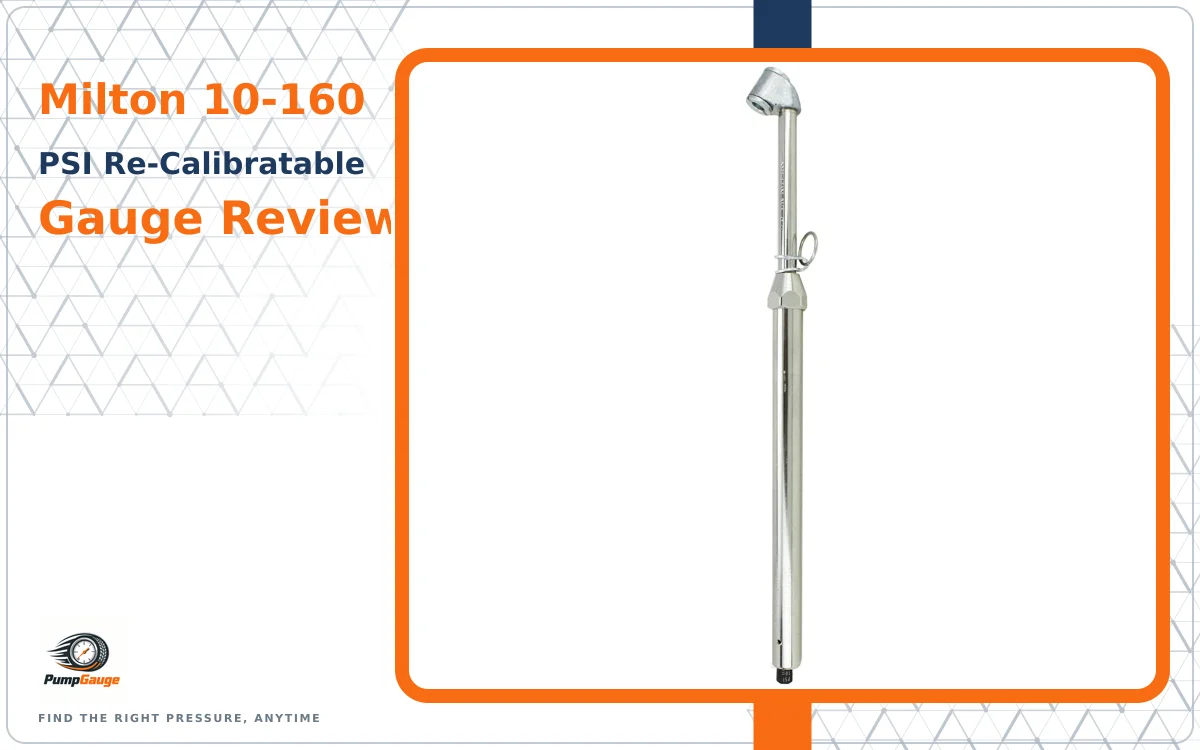
A field-recalibratable 10-160 PSI service gauge with a dual-head chuck, laser-inscribed scale, and a 4.6-star average across 45 ratings.
Milton Re-Calibratable 10-160 PSI gauge at a glance
The Milton Re-Calibratable Tire Pressure Service Gauge (10-160 PSI) is a mechanical service gauge built around one idea: you can correct its reading in the field instead of sending it out or replacing it. It carries a 4.6-star average across 45 ratings and lists at $21.21, which is also its historical low.
The spec sheet is aimed at shop and fleet work rather than a glovebox spare. The 10-160 PSI range is marked in 2 PSI increments on a laser-inscribed aluminum scale bar, the body is chrome-plated brass with seamless tube construction, and the dual-head chuck is meant to fit most tire valve types. Milton includes a clip-on calibration tool and a hang loop, and the gauge is made in the USA with US and global components.

Milton Re-Calibratable Tire Pressure Service Gauge (10-160 PSI)
Highlights
- Dial gauge
- Check gauge
- Multi-PSI scale in product name
- About $21.21 list
Best for
- Monthly cold placard checks on daily drivers
- Glovebox analog when you refuse dead batteries
- Quick cross-check against TPMS
Strengths
- Analog dial stays usable after years of heat without a coin-cell death
- Milton check gauges are built for the monthly PSI routine, not trail air-downs
- Cheaper and more accurate day-to-day than trusting TPMS alone when all four tires drop together
- Light enough to keep permanently in the car
Watch-outs · not ideal when
- Dial needles can stick off zero after a drop — always check return-to-zero
- Not a compressor — you still need a way to add air
- Large RV / high-range faces are awkward for everyday 32–35 PSI car work
- Always cross-check a new gauge against a known-good one before trusting it alone
Owner voices
Short takes from public retail reviews — paraphrased or translated when long or non-English; meaning kept close to the original.
“5/5 — I have all sorts of tire pressure gauges. Pencil, digital, analog, all in one, plastic, metal. All are hard to read, or don't read the same as the next one. I am towing an RV now and needed to be spot on. SO, it…”
“4/5 — The electronic ones are probably more accurate but inflating tires is not rocket science and Milton gauges work for ever, without batteries, after being run over and left in the rain. The advantage of this one,…”
“5/5 — Compared the product to Master Gauge at two tire shops. Margin of error was incredibly low. Off by only 0.1 psi! Incredible quality product for precision reading.”
Accuracy and the Quick Click calibration system
The headline feature is Milton's patent-pending Quick Click calibration technology, which lets the gauge be adjusted in the field to keep its reading honest. That matters most if you already trust a reference — a TPMS display, a shop master gauge, or a second gauge you have verified.
Owner feedback supports the accuracy claim rather than just repeating it. One 5-star reviewer compared the gauge against a master gauge at two tire shops and reported being off by only 0.1 PSI. Another 5-star owner, towing an RV, wrote that other gauges were hard to read or did not agree with each other, and specifically valued being able to calibrate this one against a truck pressure reading and a TireMinder reading. A 4-star reviewer made the practical case for mechanical gauges: they work without batteries and survive being run over and left in the rain.
Bleed control, chuck seal, and reach
The dual-head chuck is the part that decides whether a gauge is pleasant or infuriating on real wheels. Milton lists a large-bore dual head, a dual-head air chuck, a dual-head straight foot air chuck, and a bent extended dual-head straight foot air chuck across the product data — the bent extended head is the one that reaches past a brake or suspension component on recessed and dual-wheel applications.
One verified 5-star owner, HouseDoc, put it plainly: the gauge works great on a dually pickup, and the inside dual is hard to check but this gauge does the job. That is the reach-and-seal problem in one sentence. The 13 x 1.2 x 0.7 inch body and 8.8 ounce weight also mean it hangs on the included loop without dragging on the valve stem while you press.
Readability: the honest trade-off
This is where the gauge earns its 4.6 rather than a perfect score. The scale is black with laser-inscribed markings, and one 2-star owner said the scale cannot be read when the light is not bright — while still calling it well built, easy to use, and consistent with other Milton gauges. That is a fair criticism of a black-on-black scale, and it is the main thing to weigh before buying.
The counterweight is precision: 10-160 PSI in 2 PSI increments is a finer scale than most consumer gauges offer, and the laser inscription will not rub off the way printed markings can. If you check tires in a dim garage, plan on a light or accept that you will be squinting at the low end of the range.
Calibration habits that keep it accurate
A recalibratable gauge is only as good as the reference you calibrate it against, so treat the clip-on tool as part of a routine rather than a one-time fix. Verify against a known-good master gauge or a TPMS reading you trust, adjust with the Quick Click system, then re-check. Repeat after the gauge takes a hit, sits in a hot truck, or starts disagreeing with your other gauges.
The durability story is the reason this routine is worth the effort. Chrome-plated brass, seamless tube construction, and corrosion resistance are listed specifically for demanding service environments, and owners describe these gauges as working forever without batteries. At $21.21 — the current price and the historical low — the cost of keeping one calibrated is far below replacing a gauge every time it drifts.
Who should buy the Milton Re-Calibratable 10-160 PSI gauge
Buy it if you run duals, tow an RV or trailer, or otherwise need a gauge that reads the same as your reference and can be corrected when it does not. The dual-head chuck, bent extended head options, 2 PSI increments, and field calibration cover the accuracy, reach, and seal problems that make cheap gauges frustrating.
Skip it if you only check passenger tires in a well-lit garage and want a backlit digital readout — the 2-star readability complaint is real, and the 10-160 PSI range is more headroom than a 35 PSI car tire needs. For everyone else, the 4.6-star average across 45 ratings and the $21.21 price make this an easy recommendation to keep in the service kit.
Method and sources
This guide is built from product data and list prices pulled from Affiliate Hub at build time, together with owner feedback we summarize on the cards. It is catalog-backed buying help, not a lab ranking of every model.
Read how we test for the protocol behind any measured figures we still cite in Guides & Tips.