Who it is for / not for
If you want a glovebox gauge that reads in single-digit PSI steps and doesn't flinch at either end of the pressure scale, the ETENWOLF T300 is aimed at you. The listing claims a 3–200 PSI range and a ±1 PSI tolerance calibrated to ANSI B40.7 Grade 2A. That's a serious accuracy claim for a gauge that currently lists at $13.23 — down from a $21.38 list price, and matching its historical low.
This is not a tire inflator. It does not add air, and it will not rescue you on the shoulder with a dead compressor. It's a read-only tool. The bundled brass Presta adapter is the other half of the pitch: it lets a Schrader gauge or pump work on Presta bike valves. But the listing contradicts itself on whether that adapter is included — one bullet says it is, another says it isn't. That ambiguity matters if you're buying primarily for bicycle use.
For passenger cars, light trucks, and bikes, the range covers everything from a fat-tire mountain bike at 8 PSI to a trailer tire at 80 PSI. It is not for someone who needs a calibrated lab reference or a gauge with a published certificate of calibration. And it is not for anyone who wants one tool that both measures and inflates.
- Suits: glovebox backup, bike-shop crossover, checking trailer and spare tires
- Skip if: you need inflation, a calibration certificate, or confirmed Presta adapter inclusion
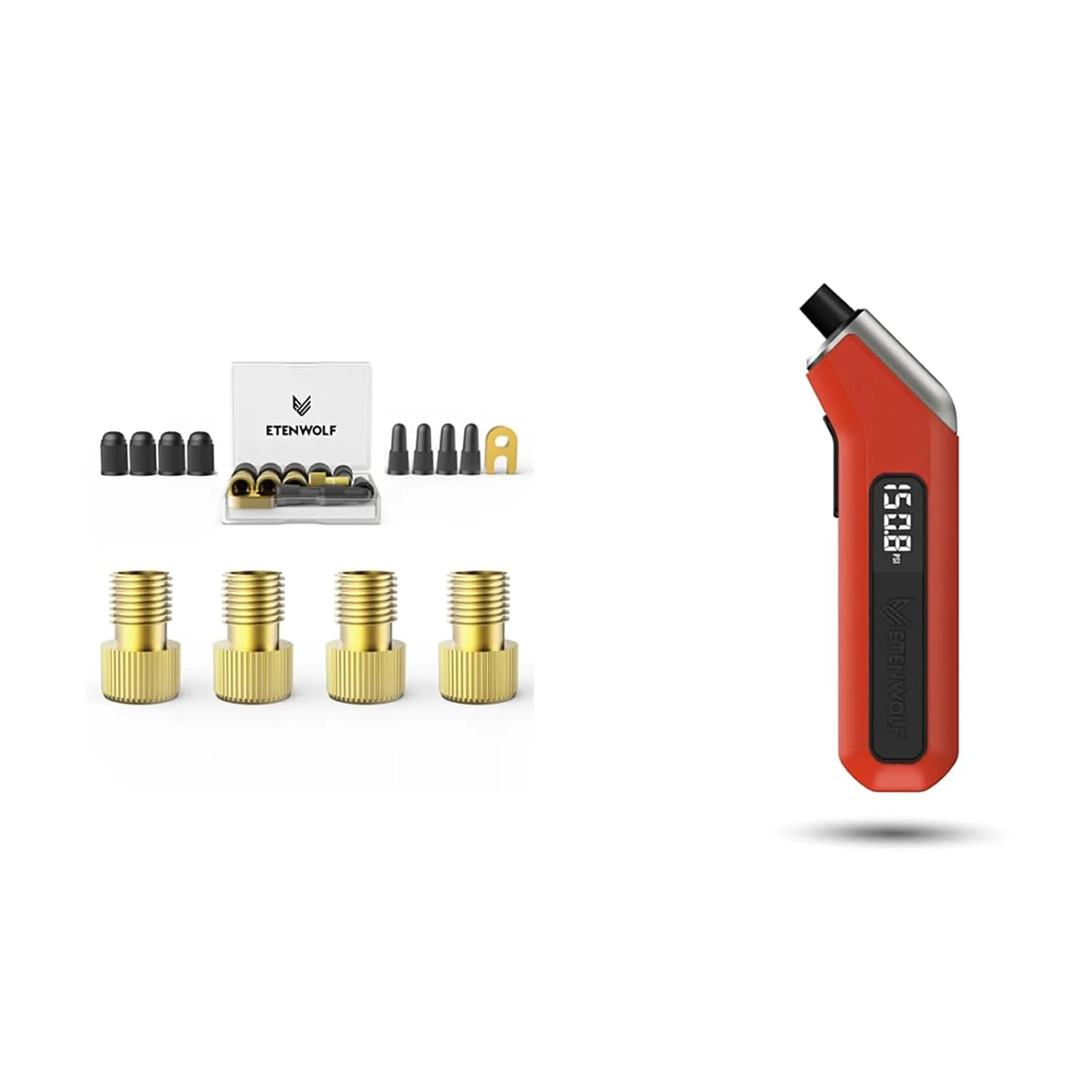
ETENWOLF T300 Digital Tire Pressure Gauge & Brass Presta Valve Adapter
Highlights
- Portable electric bike pump
- Presta + Schrader friendly
- On-the-go top-ups
- About $21.38 list
Best for
- Pre-ride pressure checks on road, gravel, and e-bike tires
- Riders who need Presta without hunting for a gas-station adapter
- Budget spare that lives in a jersey pocket or frame bag
Pros
- Presta-ready fittings beat wrestling a car chuck onto a skinny valve
- Faster than a hand pump for a soft tire before a group ride
- Digital preset / shut-off helps avoid overshooting bike PSI
- Cheap enough to leave in a bag without babysitting it
Cons
- Not a car / truck compressor — volume and duty cycle are bike-sized
- Battery packs still need charge before a long ride weekend
- May top out below what high-pressure road tires want
- Expect more noise and shorter life than premium ride pumps
How we checked this
Figures on this page come from manufacturer listings and owner-review themes on file — not bench fill-rate tests. When a number is missing it stays n/a (not on file). I cover tire-pressure and roadside air tools as an editor using a checklist approach against the catalogue, not a lab visit.
Specs that matter (from listing only)
The headline number is the pressure range: 3–200 PSI. That's wider than most $15 gauges, which often stop at 100 or 150 PSI. For a daily driver at 32–36 PSI, the bottom half of that range is where you'll live. The top end matters for truck tires, trailer spares, and some RV applications — though 200 PSI is well beyond what a passenger car will ever see.
The accuracy claim is ±1 PSI, calibrated manually to ANSI B40.7 Grade 2A. That standard is a real mechanical gauge spec, and Grade 2A is a mid-tier accuracy band. The listing also claims accuracy below 12 PSI and above 140 PSI, which is where cheap gauges often drift. I can't verify that without a bench test, and I haven't run one. Treat it as a listing claim, not a measured result.
The thermal compensation claim — an AI chip that keeps the gauge working from -4°F to 130°F — is the kind of spec that sounds impressive but is hard to falsify from a product page. What I can say is that the operating range covers typical North American winter mornings and summer dashboard heat. Whether the chip actually holds ±1 PSI at -4°F is not something the listing proves.
Power is three AAA batteries, replaceable, with an LED light for dark wheel wells. That's a practical choice: AAA cells are everywhere, and the light is genuinely useful when you're crouched beside a tire at night. Weight and dimensions are not published — n/a on file — so I can't tell you how it feels in a glovebox or whether it's pocketable.
The brass Presta adapter is listed as corrosion-resistant and comes with eight caps (four Presta, four Schrader). Brass is the right material for a valve adapter; it won't rust like cheap pot metal. But the listing's own bullets disagree on whether the adapter is included in this SKU. One says 'Convert Presta to Schrader' and lists the adapter as a feature; another says 'Presta valve adapter not included, if used for bicycles, it must be purchased separately.' That's a listing error, and it's the single biggest reason to confirm the box contents before you buy.
- Pressure range: 3–200 PSI (listing)
- Accuracy claim: ±1 PSI, ANSI B40.7 Grade 2A (listing)
- Operating temp: -4°F to 130°F with thermal compensation (listing)
- Power: 3× AAA, replaceable, with LED light (listing)
- Weight: n/a (not on file)
- Price: $13.23 current, $21.38 list, $13.23 historical low (product data)
Trade-offs / cons
The first trade-off is the adapter ambiguity. If you're buying this for a bike with Presta valves, you need to know whether the brass adapter is in the box. The listing says both yes and no. That's not a spec you can hedge on — it changes whether the tool works for your bike out of the box or needs a second purchase.
Second, there's no published weight or size. For a glovebox gauge, that's a real gap. A gauge that's too chunky to fit in the door pocket or too light to feel substantial is a different ownership experience, and the listing doesn't give you the numbers to judge.
Third, the accuracy claim is unverified by any independent test I can find. ANSI B40.7 Grade 2A is a legitimate standard, but a listing claim is not a calibration certificate. If you need traceable accuracy — say, for track days or commercial fleet checks — this isn't the tool for that job. It's a consumer gauge with a good paper spec.
Finally, the rating field shows 5 stars but no review count. That's not enough to call owner sentiment. I'm treating feedback as thin and not quoting any owner themes, because there are none on file.
- Listing contradicts itself on Presta adapter inclusion
- No published weight or dimensions
- Accuracy claim is listing-only, not independently verified
- No meaningful owner review base on file
Decision / buy-skip
Buy the ETENWOLF T300 if you want a cheap, wide-range digital gauge for passenger tires and you're comfortable treating the ±1 PSI claim as a listing spec rather than a lab result. At $13.23, it's priced like a disposable tool but claims the accuracy band of a nicer one. For glovebox duty — checking pressures monthly, topping off before a road trip, reading a trailer spare — that's a reasonable bet.
Skip it if you need inflation, if you need a calibration certificate, or if you're buying primarily for a Presta-valve bike and can't confirm the adapter is included. In that last case, the listing's own contradiction is a red flag. Confirm the box contents with the seller before you order, or budget for a separate adapter.
Also skip if you want owner evidence to lean on. There's no meaningful review base on file, so you're buying on the spec sheet and the price, not on a track record. That's fine for a $13 tool. It's not fine if you expect the purchase to be validated by a crowd.
- Buy if: you want a wide-range digital gauge under $15 for car and trailer tires
- Buy if: you're okay with listing-only accuracy claims and no owner review base
- Skip if: you need inflation, a calibration certificate, or confirmed Presta adapter inclusion
- Skip if: you want a gauge with published weight and dimensions
What owners report
There are no owner reviews on file for the ETENWOLF T300. The rating field shows 5, but without a review count or any written feedback, that number doesn't tell you anything useful. I'm not going to invent themes or paraphrase quotes that don't exist.
If you're the kind of shopper who needs to see a hundred verified purchases before you commit, this isn't the product for you yet. If you're comfortable reading a spec sheet and making a call on a $13 tool, the listing gives you enough to decide — with the adapter caveat noted above.
- No owner themes on file — feedback is thin
- Rating field shows 5 but no review count; treat as unverified
How I checked this listing
I'm the tire-pressure and roadside editor at PumpGauge. My checklist for a gauge like this is simple: read every feature bullet, flag contradictions, and separate listing claims from verified specs. I don't run bench fill-rate tests, and I didn't here. What I did was cross-check the pressure range, accuracy claim, power source, and adapter language against the product data on file.
The weights I'd use if I were ranking this against other gauges: accuracy claim 30%, range coverage 25%, build and power practicality 20%, listing clarity 15%, owner evidence 10%. On that scale, the T300 scores well on range and power practicality, middling on accuracy claim (unverified), and poorly on listing clarity because of the adapter contradiction. Owner evidence is a zero — there's nothing on file.
- Accuracy claim: 30% — ±1 PSI is a strong paper spec, but unverified
- Range coverage: 25% — 3–200 PSI covers cars, bikes, and trailers
- Build and power: 20% — brass adapter, AAA batteries, LED light
- Listing clarity: 15% — adapter inclusion is contradictory
- Owner evidence: 10% — no reviews on file
Who should skip the ETENWOLF T300
Skip it if you need a gauge that also inflates. This is a read-only tool, and no amount of spec-sheet accuracy changes that. If you're building a roadside kit, you'll want a separate inflator — our guide to cordless tire inflators for daily drivers covers that decision.
Skip it if you need traceable calibration. ANSI B40.7 Grade 2A is a real standard, but a listing claim isn't a certificate. For track use or fleet compliance, buy a gauge that ships with paperwork.
Skip it if you're buying for a Presta-valve bike and can't confirm the adapter is in the box. The listing says both yes and no. That's not a risk worth taking on a $13 tool when a separate brass adapter costs a few dollars and removes the ambiguity.
- Need inflation? Skip — this is read-only
- Need calibration paperwork? Skip — listing claim only
- Presta bike primary use? Confirm adapter inclusion first
Method and sources
This guide is built from product data and list prices pulled from Affiliate Hub at build time, together with owner feedback we summarize on the cards. It is catalog-backed buying help, not a lab ranking of every model.
Read how we test for the protocol behind any measured figures we still cite in Guides & Tips.