Who it is for — and who should scroll past
If you tow a travel trailer, fifth wheel, or drive a motorhome and want to watch tire pressure and temperature from the cab, the EEZTire E518-6AT is the kind of kit you are shopping for. Six valve-cap sensors and a dash display, listed at $250. That is the buying decision in one line: do you need continuous monitoring on six wheel positions, or do you just need to top off a tire once a month?
This is not a glovebox inflator, not a handheld gauge, and not a fix for a tire that is already leaking. It reports; it does not inflate. If your actual problem is a slow leak you have been ignoring, a TPMS will tell you it is happening — it will not solve it. And if you drive a passenger car with four wheels, you are paying for two sensors you will never mount.
- Suits: trailer and motorhome owners with six wheel positions who want in-cab pressure and temperature alerts.
- Skip if: you need a four-sensor kit, an inflator, or a handheld gauge — this does none of those jobs.
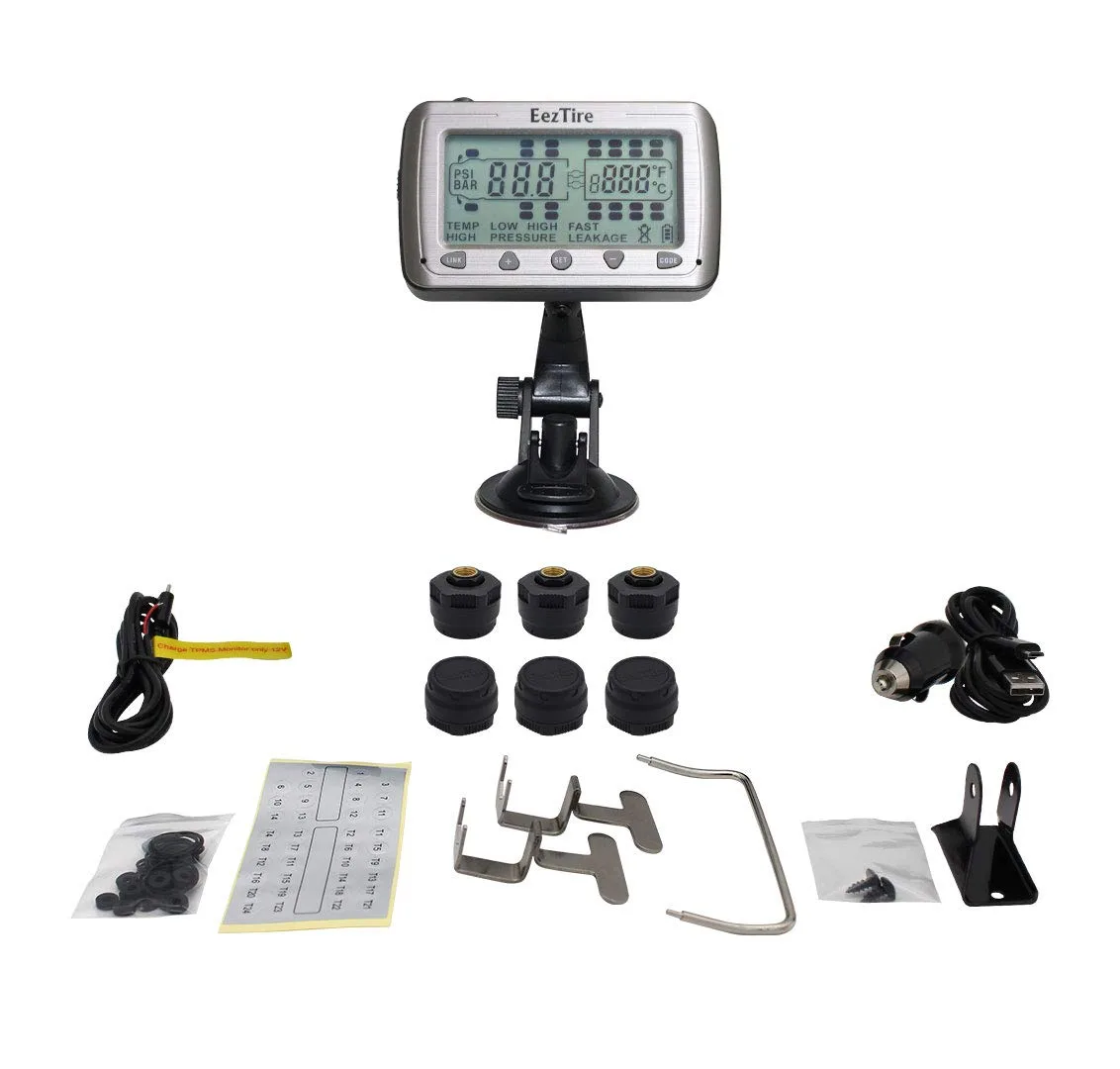
EEZ RV Products EEZTire-TPMS E518-6AT Sensors Tire Pressure Monitoring System
Highlights
- Dial gauge
- Check gauge
- Passenger / light-truck oriented
- About $250 list
Best for
- Monthly cold placard checks on daily drivers
- Glovebox analog when you refuse dead batteries
- Quick cross-check against TPMS
Pros
- Analog dial stays usable after years of heat without a coin-cell death
- EEZ RV Products check gauges are built for the monthly PSI routine, not trail air-downs
- Cheaper and more accurate day-to-day than trusting TPMS alone when all four tires drop together
- Light enough to keep permanently in the car
Cons
- Dial needles can stick off zero after a drop — always check return-to-zero
- Not a compressor — you still need a way to add air
- Low-end car dials top out too early for many light-truck / overloaded fills
- Always cross-check a new gauge against a known-good one before trusting it alone
How we checked this
Figures on this page come from manufacturer listings and owner-review themes on file — not bench fill-rate tests. When a number is missing it stays n/a (not on file). I cover tire-pressure and roadside air tools as an editor using a checklist approach against the catalogue, not a lab visit.
The spec sheet, translated
The listing is thin on hard numbers, which is itself a data point. Here is what is published, what it means in practice, and where I have to write n/a.
Six sensors (listing). That is the headline spec. Six valve-cap sensors cover a dual-axle trailer plus a spare, or a motorhome with a tag axle. If you have four wheel positions, two sensors sit in the box — not a dealbreaker, but you are paying for capacity you will not use.
Valve-cap mounting (listing). The sensors screw onto the valve stem in place of the cap. That means no dismounting tires to install them, which is the main reason buyers pick this style over band-mounted internal sensors. The trade-off is exposed hardware at the valve — worth knowing if you routinely brush curbs or squeeze into tight campsites.
Pressure and temperature monitoring (listing). The display reports both. Temperature matters more than most shoppers realize: a trailer tire running hot is often the first sign of underinflation or a dragging brake, and pressure alone will not always flag it.
Weight, capacity, output: n/a (not on file). The listing snapshot does not publish sensor weight, display dimensions, or battery life. I am not going to guess at those numbers. If they matter to your install — and display size matters on a crowded dash — check the manufacturer page before you buy.
Price: $250 list (product data). Historical low: n/a (not on file). Rating: 3.7 from 3 ratings (product data). That is a very small sample — treat it as a signal, not a verdict.
- Six valve-cap sensors — covers dual-axle trailer or tag-axle motorhome (listing).
- Pressure + temperature display — temperature is the underrated readout (listing).
- Weight, display size, battery life — n/a (not on file).
- Price $250; historical low n/a; rating 3.7 from 3 ratings (product data).
Which numbers actually decide the purchase
Ranked by what should move your wallet, not by what the spec sheet lists first.
One: sensor count. Six is the whole point. If you have six wheel positions, this kit fits the job without buying add-ons. If you have four, a four-sensor kit is cheaper and simpler — the E518-6AT is the wrong shape for your rig.
Two: valve-cap vs. internal mounting. Valve-cap is a DIY install; internal sensors mean pulling tires. For a weekend overlander or a trailer owner who does their own maintenance, valve-cap wins on install cost alone. For someone who wants a set-and-forget install, internal is the better architecture — this is not that.
Three: temperature readout. Pressure-only systems miss heat-driven failures. The listing confirms temperature monitoring, and that is a real functional difference, not a marketing line.
Four: price and rating. At $250 with a 3.7 from three ratings, you are buying on spec and brand reputation, not on a deep evidence base. That is an honest description of where this SKU sits.
Numbers that mislead
Two figures on this listing are easy to over-read.
The 3.7-star rating. Three ratings is not a sample — it is an anecdote. A single unhappy buyer can drag a three-rating average down by a full star. I would not treat 3.7 as evidence of a defective product, and I would not treat a 4.8 from the same sample size as proof of excellence either. The rating is thin; say so and move on.
The $250 list price. There is no historical low on file, so you cannot tell whether $250 is the normal street price or a temporary number. Before you commit, check whether the kit is sold as a six-sensor package or whether sensors are priced separately — the listing snapshot does not break that down, and a per-sensor price changes the math fast.
Also worth flagging: 'six-sensor' does not mean 'six-tire vehicle.' A dual-axle trailer has four tires plus a spare — six sensors covers that. A three-axle trailer has six tires and no spare coverage. Count your wheel positions before you buy, not after.
What the data does not say
The biggest gap is battery life and replacement cost for the sensors. Valve-cap sensors are sealed units; when the battery dies, you replace the sensor, not the battery. The listing snapshot does not publish sensor battery life or replacement sensor price. That is a real ownership cost, and it is missing. I am not going to fill it with a guess.
Second gap: display power and mounting. Is it 12V corded, battery, or solar? The listing does not say in the snapshot I have. On a crowded dash, that detail decides whether the install is clean or a wire mess.
Third gap: alert behavior. Does it alarm on pressure drop only, or temperature too? The listing confirms temperature monitoring but not the alarm logic. If you are buying this specifically for heat alerts on a trailer, confirm that before checkout.
None of these gaps are dealbreakers on their own. Together, they mean this is a buy-on-spec purchase, not a buy-on-evidence purchase.
What owners report
There are no owner reviews on file for this SKU in the data I have. The rating is 3.7 from 3 ratings, and that is the entire evidence base. I am not going to invent themes, quotes, or star breakdowns to fill this section.
If you want owner feedback before buying, the honest move is to read the reviews on the retail listing directly — and weight them by sample size. Three ratings tells you almost nothing. Thirty tells you something. Three hundred tells you a lot.
- EEZTire E518-6AT: no owner review themes on file — feedback is thin (3 ratings, 3.7 average).
How I checked this listing
I am the tire-pressure and roadside editor at PumpGauge. My checklist for a TPMS review is simple: confirm sensor count and mounting style from the listing, confirm what the display actually reports, and flag every number the manufacturer did not publish rather than filling it in.
For this SKU, I weighted sensor count and mounting style highest, temperature monitoring second, and price/rating third — because a TPMS that does not fit your wheel count is the wrong product no matter how good the display is. I did not bench-test this unit, and I am not going to claim I did. Everything above is from the listing and the product data on file.
If you are still sizing your setup, the related guides on tire pressure gauge accuracy and trailer tire care are worth a read before you commit to a six-sensor kit.
Who should skip it
Skip the E518-6AT if you drive a four-wheel passenger car or a single-axle trailer — you are paying for two sensors you will never mount, and a four-sensor kit will do the same job for less.
Skip it if you want an inflator built in. This is a monitor, not a compressor. If your real need is topping off tires at the trailhead, a cordless inflator is the tool — the TPMS just tells you when to use it.
Skip it if you need published battery life and replacement-sensor pricing before you buy. Those numbers are not in the listing snapshot, and if that uncertainty bothers you, wait for a spec sheet or a deeper review sample.
Spec-based verdict
Buy the EEZTire E518-6AT if three things are true: you have six wheel positions to monitor, you want valve-cap DIY installation, and you value temperature readout alongside pressure. At $250, that is a reasonable spec match for a trailer or motorhome owner who does their own maintenance.
Do not buy it if you have four wheels, if you need an inflator, or if you require published battery and replacement-cost data before committing. The 3.7-from-3-ratings evidence base is thin — this is a buy-on-spec decision, and you should make it with your eyes open.
One last practical note: count your valve stems before you order. Six sensors on a four-tire trailer means two spares in a drawer, and six sensors on a three-axle trailer means no spare coverage. The spec sheet does not do that math for you.
Method and sources
This guide is built from product data and list prices pulled from Affiliate Hub at build time, together with owner feedback we summarize on the cards. It is catalog-backed buying help, not a lab ranking of every model.
Read how we test for the protocol behind any measured figures we still cite in Guides & Tips.