Who it is for — and who should scroll past
If you want a cheap, pocketable digital gauge for monthly pressure checks on a car, SUV, or motorcycle, the AstroAI 150 PSI is built for exactly that job. It reads in 0.1 PSI increments, claims ±1 PSI factory calibration, and costs $6.58 right now (list $12.99). For a glovebox tool you'll use a few times a month, that's a sensible spend.
This is not a tire inflator, and it is not a substitute for a dual-cylinder truck compressor or a clamp-on chuck for an RV at 80 PSI. It also won't help you set pressures on a SUP or a road bike at 100+ PSI with any confidence — the 0–150 PSI range covers those numbers on paper, but the resolution and nozzle design are aimed at Schrader valves on vehicles. If you need to add air, not just read it, skip this and look at a 12V inflator.
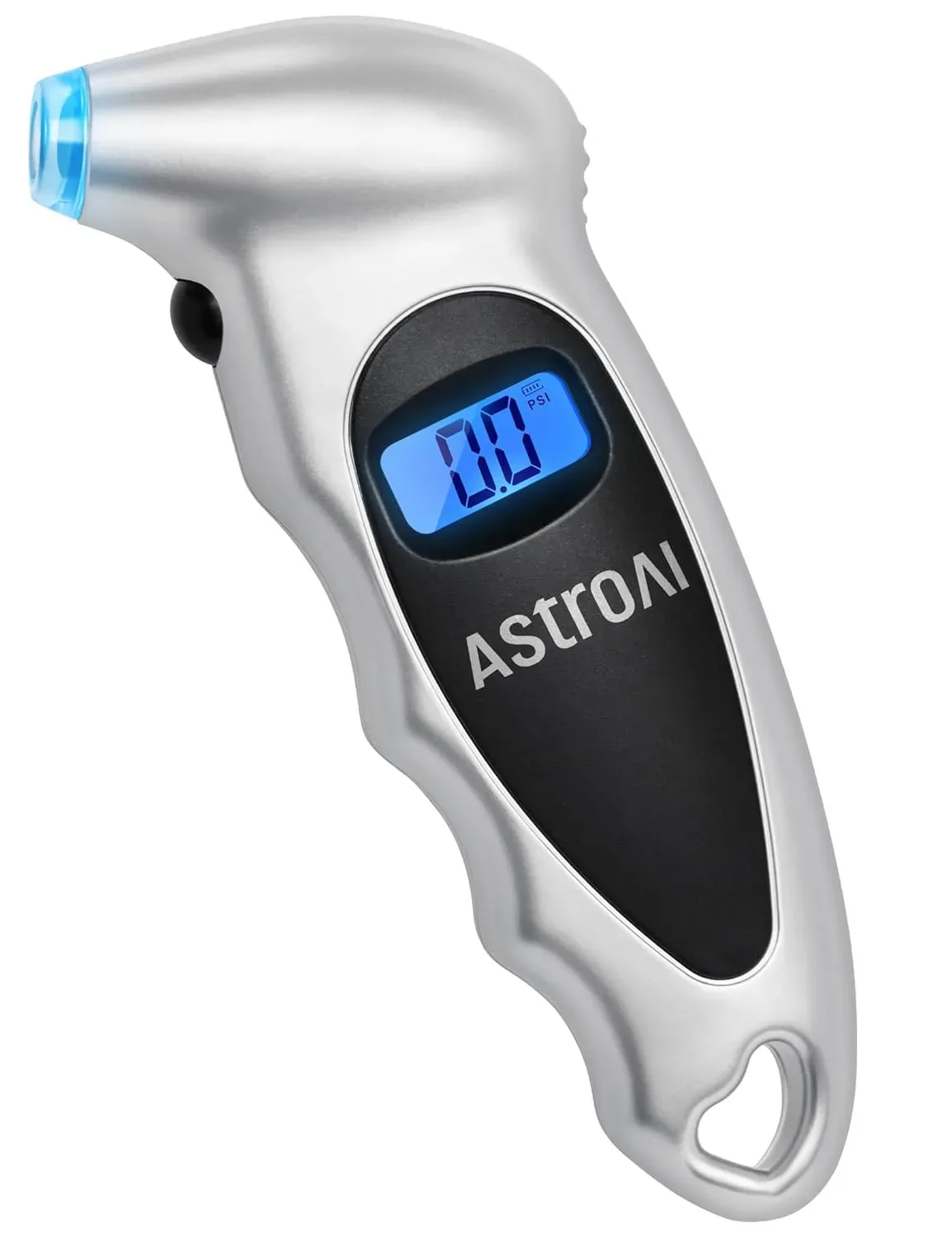
AstroAI Digital Tire Pressure Gauge 150PSI
Highlights
- Digital readout
- Check gauge
- Passenger / light-truck oriented
- About $12.99 list
Best for
- Monthly cold placard checks on daily drivers
- Night checks and drivers who want a lit/hold reading
- Quick cross-check against TPMS
Pros
- Easy-to-read digits beat guessing between dial hash marks for many owners
- AstroAI check gauges are built for the monthly PSI routine, not trail air-downs
- Cheaper and more accurate day-to-day than trusting TPMS alone when all four tires drop together
- Light enough to keep permanently in the car
Cons
- Electronics and seals still dislike glovebox heat and drops long-term
- Not a compressor — you still need a way to add air
- Low-end car dials top out too early for many light-truck / overloaded fills
- Always cross-check a new gauge against a known-good one before trusting it alone
Owner voices
Short takes from public retail reviews — paraphrased or translated when long or non-English; meaning kept close to the original.
“5/5 — AstroAI Digital Tire Pressure Gauge – A Must-Have Tool for Accurate Tire Maintenance As a car owner, keeping track of my vehicle's tire pressure is essential for ensuring safety, efficiency, and optimal performa…”
“5/5 — Leggero , managgevole e con ua presa ergonomica che aiuta. Utile sia per le valvole da auto che sono perpendicolari al cercio sia per quella della moto ( che sono a 90° gradi rispetto al cercio - nella mia almen…”
“4/5 — I'd give this AstroAI digital tire pressure gauge a solid 4 stars and it's a practical, reliable tool that belongs in every vehicle, truck, and RV glove box or gear bag. The 0.1 PSI increment accuracy calibrated…”
How we checked this
Figures on this page come from manufacturer listings and owner-review themes on file — not bench fill-rate tests. When a number is missing it stays n/a (not on file). I cover tire-pressure and roadside air tools as an editor using a checklist approach against the catalogue, not a lab visit.
The spec sheet, translated
Here are the five numbers that actually shape how this gauge behaves in your hand. All values are from the Amazon listing unless noted; I have not independently bench-tested accuracy or fill speed.
**0–150 PSI range (listing).** Covers passenger cars (typically 30–36 PSI), SUVs, motorcycles, and spare tires often set to 60 PSI. It is more range than most drivers need, which is fine — the useful part is that it doesn't top out at 100 PSI like some cheap pencil gauges.
**±1 PSI accuracy claim (listing).** The listing says factory-calibrated to ±1 PSI and references ANSI B40.7. That's a reasonable claim for a digital gauge at this price, but treat it as a manufacturer spec, not a verified measurement. For monthly checks, ±1 PSI is close enough to catch a tire that's drifted 4–5 PSI low.
**0.1 PSI resolution (owner review, 4/5).** One reviewer notes the gauge reads in 0.1 PSI increments. That's finer than you need for a car tire, but it makes repeat readings feel consistent — you can tell whether a tire moved from 33.2 to 32.8 PSI.
**Four units — PSI, Bar, Kgf/cm², KPA (listing).** One button cycles through them. Useful if you also check a motorcycle or a European vehicle with a bar-based door sticker; otherwise you'll leave it on PSI and never touch it.
**2.4 oz / 0.15 lb (listing details).** Light enough to disappear in a glovebox or jacket pocket. Note: the normalized product data lists weight as n/a, but the listing's Item Weight field says 2.4 ounces — I'm using the listing figure and flagging the mismatch rather than guessing.
**2×AAA batteries, 30-second auto-off (listing).** The gauge ships with batteries and powers down after 30 seconds idle. That's a small thing that matters: a dead gauge in a roadside moment is worse than no gauge.
Which numbers decide the purchase
If I rank the specs by how much they affect daily usefulness: accuracy claim first, then valve fit and nozzle light, then range, then resolution, then units.
Accuracy is the whole point of a gauge. A ±1 PSI claim is credible for this class, but the listing is the only source — no independent test is on file. Valve fit comes second because a gauge that's hard to seat on a Schrader stem leaks air and gives you a bad reading. Owners mention the ergonomic head works on both perpendicular car valves and 90-degree motorcycle valves, which is a real usability point.
Range and resolution matter less than the marketing suggests. A 0–150 PSI range is more than a passenger car needs, and 0.1 PSI resolution is finer than the door-jamb sticker asks for. They're nice-to-haves, not deal-breakers.
Numbers that mislead
Two figures on this listing are easy to over-read. First, the ±1 PSI accuracy claim: it's a factory calibration statement, not a guarantee that your unit will match a certified master gauge after a year in a hot glovebox. Digital gauges can drift, and the listing doesn't publish a recalibration interval. If you're setting pressures for track days or towing at max load, a ±1 PSI claim without a calibration certificate is a starting point, not a precision instrument.
Second, the 0–150 PSI range. It's tempting to read that as 'works for everything up to 150 PSI,' but the nozzle and resolution are tuned for vehicle tires. At 100+ PSI on a road bike or a small SUP, the same gauge may read fine on paper while being awkward to seat and slower to settle. Range is not the same as fitness for a specific valve and pressure band.
What the data does not say
The listing doesn't publish a battery life figure in hours or number of checks — only that auto-off extends it. It also doesn't state an operating temperature range, which matters if you leave it in a car through a Midwest winter or a Phoenix summer. And there's no published drop rating, despite the 'rugged body survives drops' line; that's marketing language, not a spec.
The biggest gap is independent accuracy verification. The 4.4-star rating across 72,528 reviews is a strong signal that most buyers get usable readings, but star averages can't tell you whether a unit that's a year old still holds ±1 PSI. I would not fill that gap with a guess.
Trade-offs and cons
The main trade-off is precision versus price. At $6.58, you're getting a plastic-bodied ABS gauge with a factory calibration claim and no published recalibration path. That's fine for monthly checks; it's not fine if you need a gauge you can trust for competition or heavy towing where a 2 PSI error changes load distribution.
The nozzle light and backlit display are genuinely useful in a dark garage, but they also mean batteries. The listing includes 2×AAA and auto-off, yet there's no low-battery indicator mentioned. A gauge that dies quietly in the glovebox is a common failure mode for this category.
One owner (1/5) reported a unit that only worked intermittently when tested on their car. That's a single data point against tens of thousands of positive ratings, but it's worth noting that QA on a $6.58 tool won't match a $40 professional gauge.
- Pros: ±1 PSI claim, 0.1 PSI resolution, backlit display and nozzle light, four units, 2.4 oz, $6.58 current price.
- Cons: no published recalibration interval, no operating temperature range, no low-battery indicator, plastic body, one reported intermittent unit.
How I checked the specs
I'm Alex Rivera, founding editor at PumpGauge, and I cover tire-pressure tools and roadside gear. This review is based on the Amazon listing, the product data on file, and owner review themes — not an independent lab test. I did not measure fill speed, accuracy against a master gauge, or battery life.
My checklist for a digital gauge like this: does the accuracy claim come with a standard reference (here, ANSI B40.7), does the valve fit work on both car and motorcycle stems, and does the listing disclose the gaps a buyer would care about (temperature range, recalibration, battery indicator). Where the listing is silent, I've said so rather than filling it in.
What owners report
The review themes skew toward accuracy and ease of use, with a smaller cluster around valve fit on motorcycles. The 4.4-star average across 72,528 ratings is consistent with a tool that does its job for most buyers, though the reviews are not a substitute for a calibration check.
One theme worth flagging: several owners describe this as a glovebox or gear-bag tool for cars, trucks, and RVs — not a precision instrument for track or towing use. That matches how I'd position it.
- Jorge & Carolina M (5/5): accuracy and ease of use — describes it as a must-have for routine tire maintenance.
- Italian reviewer (5/5): ergonomic head fits both perpendicular car valves and 90-degree motorcycle valves.
- 4/5 reviewer: cites 0.1 PSI increments and ANSI B40.7 calibration as the reason for a solid rating.
- 1/5 reviewer: reports a unit that only worked intermittently on their car — a single QA data point.
Who should skip it
Skip the AstroAI if you need a gauge for competition tires, heavy towing at max load, or any situation where a 1–2 PSI error has real consequences. Skip it if you want a gauge with a published recalibration service or a metal body that survives being stepped on. And skip it if you're actually shopping for an inflator — this reads pressure, it doesn't add air.
Buy it if you want a cheap, light, backlit gauge for monthly checks on a car, SUV, or motorcycle, and you're comfortable treating the ±1 PSI claim as a manufacturer spec rather than a certified measurement. At $6.58, it's a low-risk glovebox addition.
Method and sources
This guide is built from product data and list prices pulled from Affiliate Hub at build time, together with owner feedback we summarize on the cards. It is catalog-backed buying help, not a lab ranking of every model.
Read how we test for the protocol behind any measured figures we still cite in Guides & Tips.