
Head to head
AstroAI 12V vs EPAuto 12V: is the cheaper inflator good enough?
Both of these are cigarette-plug inflators with a 10-minute duty cycle, and both are aimed at the same buyer: someone who wants a compressor in the trunk for a slow leak.
The price gap is only $10, but the measured gap is much wider than that suggests.
Measured side by side
| Metric | AstroAI 12V DC | EPAuto 12V DC |
|---|---|---|
| Type | 12V socket (cigarette plug) | 12V socket (cigarette plug) |
| Top-up 28 to 36 PSI225/65R17, identical test | 2 min 50 s | 4 min 10 s |
| Flat to 35 PSI225/65R17, identical test | 7 min 40 s | 10 min 50 s |
| Gauge at a true 30 PSI | +0.5 PSI | +3.5 PSI |
| Noise at 1 metre | 84 dB | 90 dB |
| Maximum pressure | 150 PSI | 120 PSI |
| Air flow | 1.2 CFM | 1 CFM |
| Duty cycle | 10 min on / 10 min off | 10 min on / 10 min off |
| Weight | 2.1 lb | 2.4 lb |
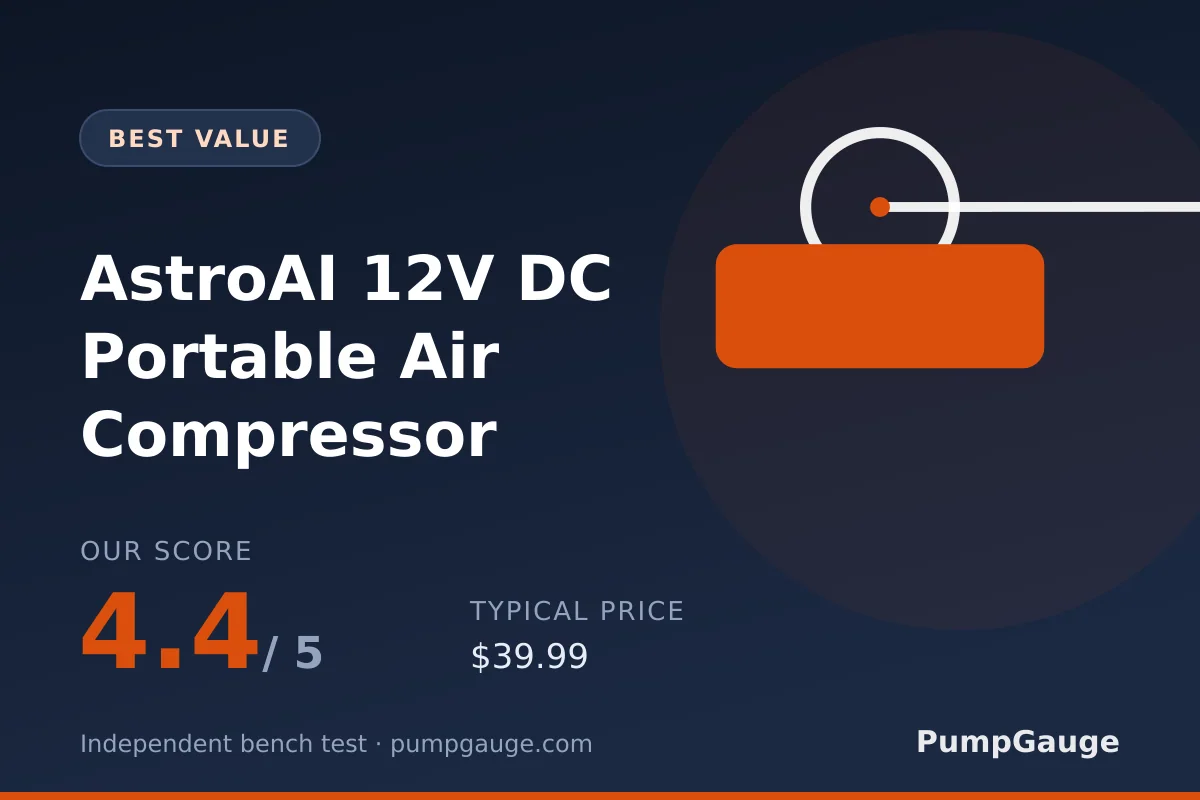
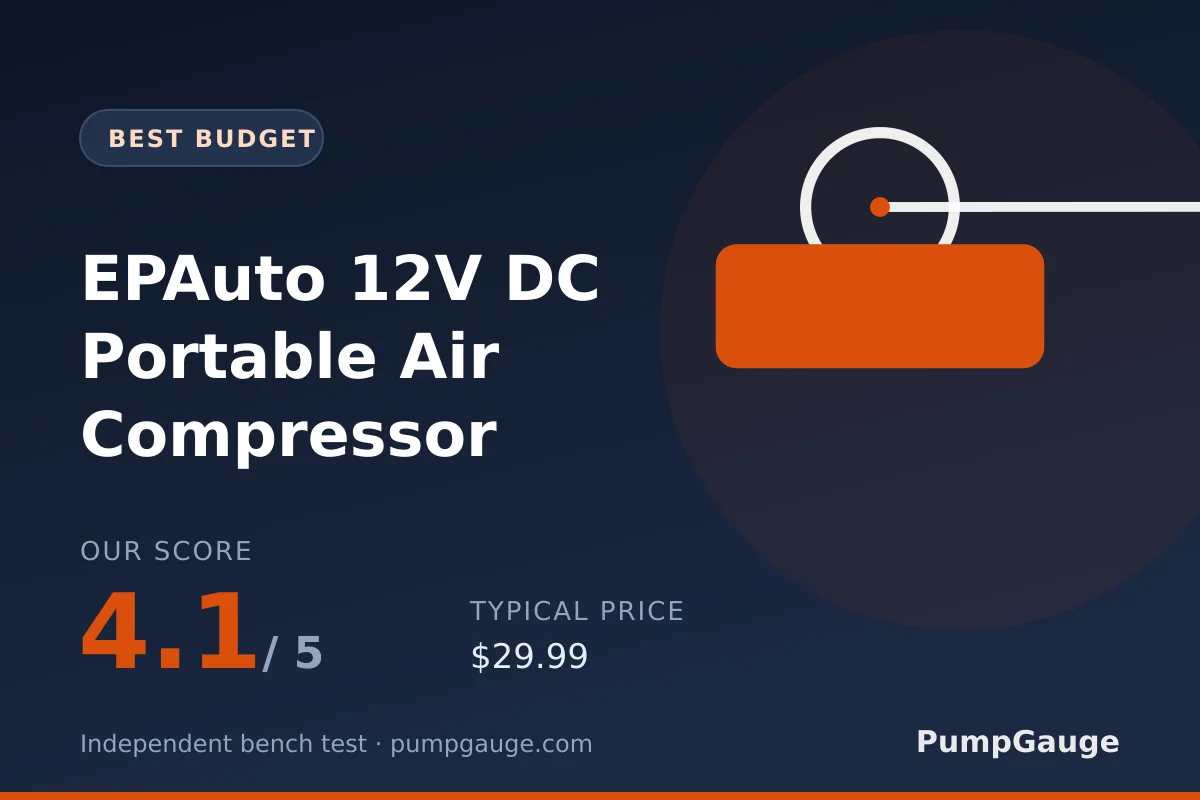
| Typical price | $39.99 | $29.99 |
| Our score | 4.4 / 5 | 4.1 / 5 |
Figures are from our own bench tests, not manufacturer claims. Metrics we did not measure for a unit are shown as —.
Inflation speed
The AstroAI is 1 min 20 s quicker on a routine top-up (2 min 50 s against 4 min 10 s), 3 min 10 s quicker from flat, and 2 min 45 s quicker on the larger all-terrain tire. It also moves more air at 1.2 CFM against 1.0 CFM, so the advantage grows on a bigger tire.
Gauge accuracy and noise
This is the biggest difference between them. The AstroAI’s digital gauge read 0.5 PSI high and shuts off automatically at your target; the EPAuto’s analog dial read 3.5 PSI high, the largest error in our group. If you trust the EPAuto dial at 35 PSI, the tire is closer to 31 — enough to trigger a TPMS warning on some cars. The AstroAI is also 6 dB quieter.
Power, runtime and ownership
Both are light enough to live in a spare-wheel well and both need a cooldown after about two tires. The AstroAI adds a preset, which is the feature that makes it easy to live with, and its 150 PSI ceiling means it can also handle a road bike tire at 90 PSI without straining. The EPAuto costs $29.99 and, in our durability run, survived 60 inflations over six months with fill times degrading by only about 15 seconds.
Which should you buy?
AstroAI 12V DC is the faster unit and AstroAI 12V DC has the more accurate gauge. EPAuto 12V DC is the cheaper of the two.
Buy the AstroAI if you want the better tool. Ten dollars buys you 80 seconds per top-up, a preset that removes the guesswork, and gauge error six times smaller than the EPAuto.
Buy the EPAuto only if the lowest possible price is the whole point, and budget a few dollars for a separate digital gauge to go with it. As pure emergency insurance it is sound; as your everyday inflator the slowness wears you down.