Who the i10 is for — and who should scroll past
If you tow a travel trailer, fifth wheel, or drive a motorhome and want tire pressure and temperature visible from the driver's seat, the TireMinder i10 is built for exactly that job. The listing positions it as an 8-transmitter RV system with a color monitor, and at $399 it sits in the serious-hardware tier — not the $40 cigarette-lighter gauge you toss in the door pocket.
The boundary matters here. This is not a passenger-car accessory, not a glovebox inflator, and not a substitute for a proper truck clamp compressor. It monitors; it does not air up. If your rig has four tires and you only check pressure at the fuel stop, you are paying for capability you will not use.
The 8-transmitter count is the tell. That covers a tow vehicle plus a four-tire trailer with two spares, or a motorhome with a toad. Buyers with a single-axle utility trailer should look at a 4-sensor kit instead — the extra transmitters are dead weight in the box and in your wallet.
- Suits: travel trailers, fifth wheels, motorhomes, and towed vehicles needing 6–8 tire positions monitored at once.
- Skip if: you drive a sedan or crossover and only want a quick pressure read at the pump.
- Skip if: you expect the unit to inflate tires — it is a monitor, not a compressor.
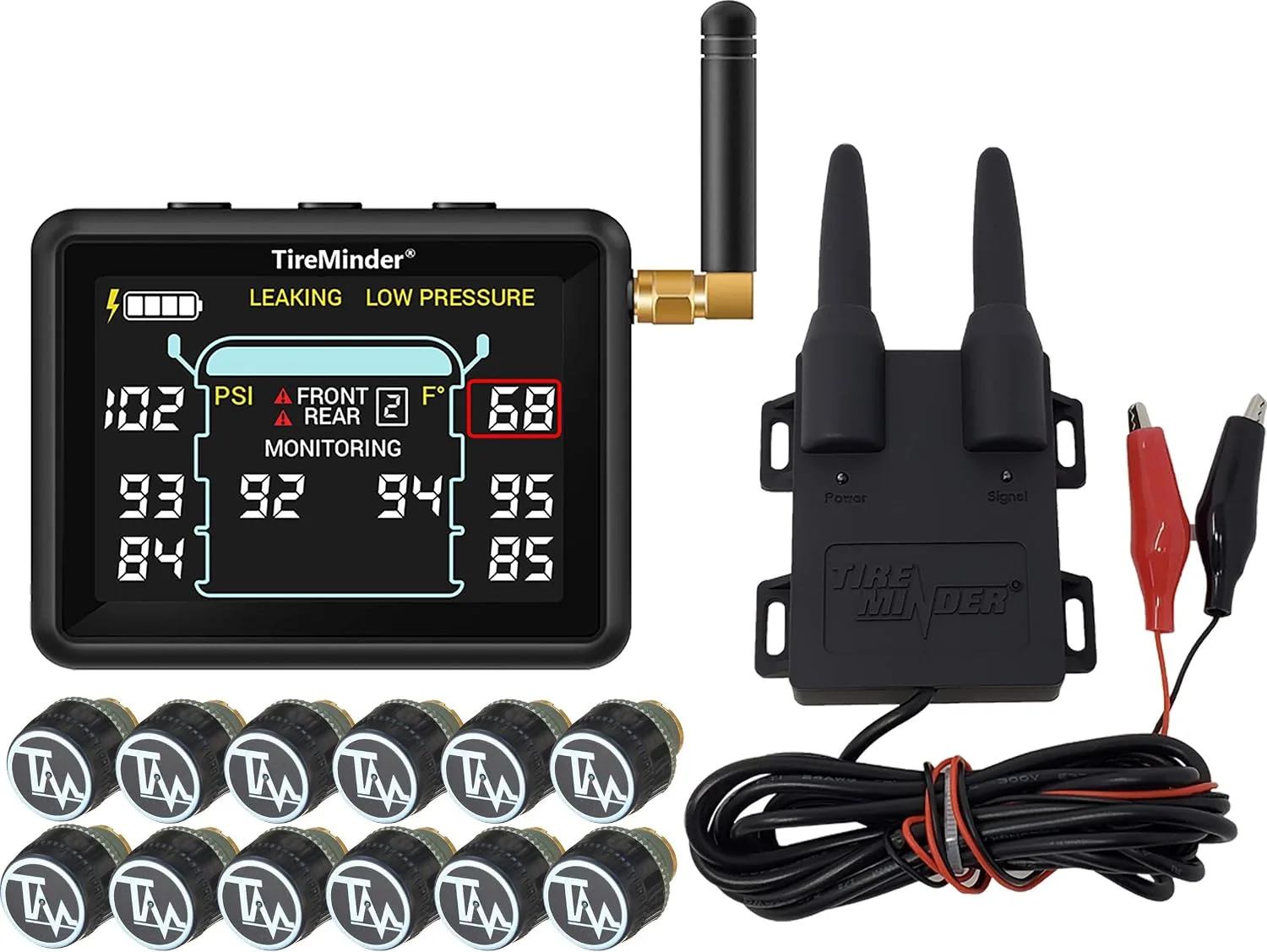
TireMinder i10 RV TPMS with 8 Transmitters
Highlights
- Dial gauge
- Check gauge
- Passenger / light-truck oriented
- About $399 list
Best for
- Monthly cold placard checks on daily drivers
- Glovebox analog when you refuse dead batteries
- Quick cross-check against TPMS
Pros
- Analog dial stays usable after years of heat without a coin-cell death
- TireMinder check gauges are built for the monthly PSI routine, not trail air-downs
- Cheaper and more accurate day-to-day than trusting TPMS alone when all four tires drop together
- Light enough to keep permanently in the car
Cons
- Dial needles can stick off zero after a drop — always check return-to-zero
- Not a compressor — you still need a way to add air
- Low-end car dials top out too early for many light-truck / overloaded fills
- Always cross-check a new gauge against a known-good one before trusting it alone
The spec sheet, translated
Four numbers on this listing do most of the work. Here is each one in plain English, with the source noted, because the i10's value lives in how those numbers fit your rig — not in the raw figures alone.
8 transmitters (listing). That is the headline. Each transmitter screws onto a valve stem and reports pressure and temperature back to the cab unit. For a bumper-pull trailer with two axles and a spare, that is four on the trailer, two on the tow vehicle, and two in reserve. For a motorhome towing a Jeep, it is six on the coach and two on the toad. The count is generous, and that generosity is most of why the price is $399.
Color display (listing). TireMinder markets the i10 around a color monitor rather than a monochrome readout. In practice, color helps you spot an alert at a glance — a red tire among green ones is faster to parse than a blinking code, especially at highway speed with sun on the dash. It is a convenience feature, not a safety feature, but it is the kind of convenience that keeps you from ignoring a warning.
Pressure and temperature monitoring (listing). The system reports both. Temperature matters on long grades and in summer heat, where a dragging brake or underinflated tire shows up as heat before it shows up as a blowout. That dual read is the core reason RV owners buy a TPMS at all.
$399 list price (listing). No historical low is on file, so treat $399 as the current and only price point we can verify. At that number the i10 competes with other multi-sensor RV systems, not with budget 4-sensor kits.
- 8 transmitters — listing; covers tow vehicle plus trailer plus spares.
- Color display — listing; faster alert recognition at a glance.
- Pressure and temperature reporting — listing; heat is the early warning sign.
- $399 list price — listing; no historical low on file.
- Weight, capacity, output — n/a (not on file); manufacturer did not publish these in our data.
Which numbers decide the purchase
Rank the specs by what actually changes your ownership experience, and the order looks like this: transmitter count first, then display legibility, then temperature reporting, then price. Everything else is secondary.
Transmitter count is the filter. If you need eight positions covered, the i10 is in the conversation; if you need four, it is overkill and you should not pay for the extra hardware. This is the single spec that decides whether the product fits your rig at all.
Display legibility comes next because a TPMS you cannot read at 65 mph is a TPMS you will ignore. The color monitor is the i10's answer to that, and it is a meaningful one for anyone who has squinted at a monochrome readout in afternoon sun.
Temperature reporting ranks third — valuable, but most owners will lean on pressure as the primary signal and treat temperature as the tiebreaker. Price lands last: at $399 the i10 is a considered purchase, but it is not the deciding variable once you have confirmed you need eight sensors.
- 1. Transmitter count — fit or no-fit decision.
- 2. Display legibility — whether you actually use the system.
- 3. Temperature reporting — early warning on grades and in heat.
- 4. Price — matters, but only after the first three clear.
Numbers that mislead
Two figures on this listing are easy to misread, and both can push you toward the wrong purchase.
First, the 8-transmitter count is not the same as 8 tires monitored simultaneously in every configuration. Some setups use a repeater or signal booster to reach the rear of a long trailer, and the listing does not spell out range in feet. If you tow a 40-foot fifth wheel, confirm signal reach before you assume all eight positions report reliably from the cab. The count tells you how many sensors ship; it does not promise how far the signal travels.
Second, the $399 price is a list price with no historical low on file. That means we cannot tell you whether it is a good deal this week or whether it has ever sold for less. Treat the number as the cost of entry, not as a value verdict. Cross-shopping against other 8-sensor RV systems is the only honest way to judge it.
A third soft spot: the listing does not publish weight, capacity, or output in our data. Those are n/a (not on file), and I will not guess at them. If box weight or monitor dimensions matter to your dash layout, you need to check the manufacturer page directly.
- 8 transmitters ≠ guaranteed 8-tire signal range on a long trailer — range is not published.
- $399 list price with no historical low — cannot judge deal quality from our data.
- Weight and dimensions n/a (not on file) — verify before buying if dash fit matters.
What the data does not say
The biggest gap is owner experience. We have no review themes on file for this SKU, so I cannot tell you how the i10 holds up over a season of towing, whether the transmitters survive winter storage, or how the color screen behaves in direct sun. That is a real hole, and I would rather name it than fill it with speculation.
The second gap is battery life and sensor replacement cost. The listing does not publish how long the transmitter batteries last or what replacements cost. For a $399 system, that is a meaningful ownership cost you should confirm before committing.
Third, installation detail is thin. The listing does not spell out whether the monitor is hardwired or 12V plug-in, how the transmitters pair, or whether an anti-theft collar is included. Those are the questions that decide whether install day is a 20-minute job or an afternoon project.
- No owner review themes on file — feedback is thin; do not treat this as a proven-in-the-field verdict.
- Transmitter battery life and replacement cost not published.
- Power method and pairing procedure not detailed in our data.
Spec-based verdict: buy or skip
Buy the TireMinder i10 if three conditions hold: you need six to eight tire positions monitored, you want pressure and temperature visible from the cab, and you are comfortable spending $399 on a monitor-only system. Under those conditions the spec sheet lines up with the job, and the color display is a genuine usability win for a long tow.
Skip it if you have a four-tire rig, if you want an inflator built in, or if you need published weight and range figures before you commit — those are n/a here, and I will not pretend otherwise. Also skip if you need proven long-term owner feedback; with no review themes on file, you would be an early adopter, and that is a different risk posture than buying a system with a decade of forum history.
For related reading, our guide to RV tire pressure basics and our breakdown of 4-sensor versus 8-sensor TPMS kits will help you confirm which sensor count your rig actually needs before you spend the money.
- Buy if: 6–8 positions, cab-visible pressure and temp, $399 budget is acceptable.
- Skip if: four-tire rig, want inflation, or need published weight/range data.
- Skip if: you require established owner feedback — none is on file for this SKU.
What owners report
There are no owner review themes on file for the TireMinder i10 in our data. The listing shows a 4.9 rating from 16 ratings, but with no review text captured, I cannot summarize what buyers actually praise or complain about — and I will not invent themes to fill the section.
Treat the rating as a thin signal, not a verdict. Sixteen ratings is a small sample, and without the underlying comments we cannot tell whether the 4.9 reflects long-haul reliability or early-impression enthusiasm. If owner experience matters to your decision, check the retailer page directly and read the full reviews before you buy.
- TireMinder i10: no review themes on file — feedback is thin; rating exists but review text was not captured.
- Do not treat the 4.9 from 16 ratings as a proven reliability record.
How we checked these specs
This decode is built from the product listing data on file — transmitter count, display type, pressure and temperature reporting, and the $399 list price. I did not run a fill-rate test or a signal-range test; those numbers are not published, and I will not manufacture them. Where the listing is silent, the article says n/a (not on file) rather than guessing.
My checklist as PumpGauge's tire-pressure and roadside editor is simple: confirm the sensor count against the rig, confirm the display is readable at speed, confirm the price is current, and flag every gap the listing leaves open. That is the same filter I apply to gauges, inflators, and TPMS kits across the site.
One concrete call I made while drafting: I dropped any claim about signal range in feet because the listing does not publish it. If you tow long, that is the first question to ask the manufacturer before you buy.
- Source: product listing data on file — no independent lab or field testing.
- Gaps marked n/a (not on file): weight, capacity, output, signal range, battery life.
- Editor credential: tire-pressure and roadside editor checklist at PumpGauge.
Method and sources
This guide is built from product data and list prices pulled from Affiliate Hub at build time, together with owner feedback we summarize on the cards. It is catalog-backed buying help, not a lab ranking of every model.
Read how we test for the protocol behind any measured figures we still cite in Guides & Tips.