
Slime Dual Head Dial Tire Gauge: 10-160 PSI Review
A gauge specialist's review of the Slime Dual Head Dial Tire Gauge (10-160 psi), covering accuracy, bleed control, chuck seal, readability, and calibration habits based on product data and owner reviews.
Overview
The Slime Dual Head Dial Tire Gauge (10-160 psi) is a dial gauge with a dual head and bleeder valve, designed for reaching through wheel wells on 4x4s, SUVs, and RVs. It has a 228mm braided air hose, a shock-resistant rubber housing, and reads in psi, kPa, and bar. It fits Schrader valve stems. The current price is $15.98, with a list price of $39.99 and a historical low of $15.98. It holds a 4.3-star rating from 277 ratings.
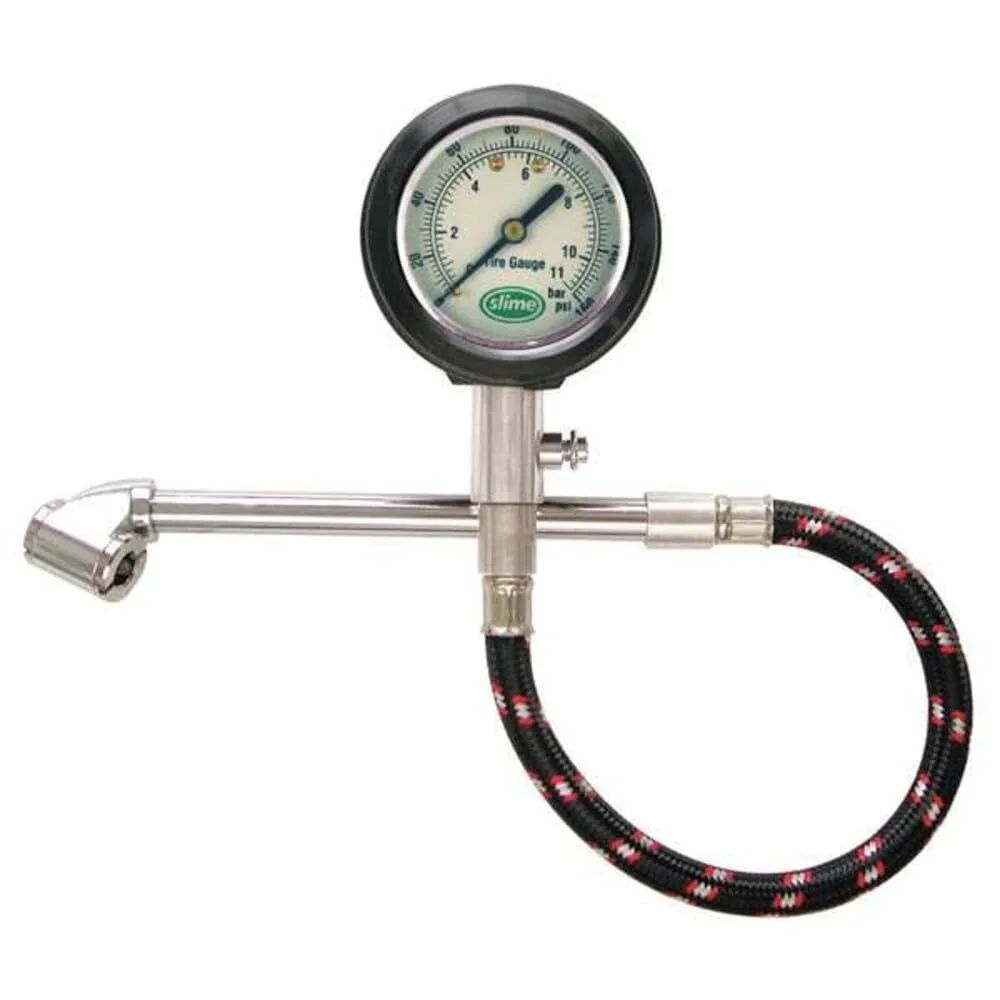
Slime Dual Head Dial Tire Gauge (10-160 psi)
Highlights
- Dial gauge
- 10–160 PSI
- Dual head (standard + dual wheels)
- Bleed / hold release
Best for
- RV and dually owners who need the reverse head
- Drivers who want bleed-down without removing the chuck
- Glovebox analog when battery gauges die
Strengths
- Dual chuck reaches inner dual tires without fighting the hose as hard
- Needle holds the reading until you hit the release — easier than reading on-stem
- Bleed valve lets you drop overfills while watching the dial
- Wide 10–160 PSI scale covers cars through many light-truck / RV fills
Watch-outs · not ideal when
- Some units arrive with a strong chemical odor that fades after days
- Hose bend and tight fittings can fight positioning on tight stems
- Still calibrate against a second gauge — dials drift if dropped
- Bulkier than a pencil gauge for everyday car-only use
Owner voices
Short takes from public retail reviews — paraphrased or translated when long or non-English; meaning kept close to the original.
“Solid seal on the stem, and the hold/bleed release means I can read the dial after I pull it off — handy on duals.”
“Great for the inner dual tire. Accuracy is fine once I check it against my other gauges.”
“Bleed without removing the gauge makes topping down to placard PSI quick. Reads close to my TPMS.”
Accuracy and calibration
Dial gauges like this one can vary, so calibration is a habit worth keeping. One owner review noted that after comparing with other gauges, this one read 4 PSI higher in the 90 PSI range. Another owner recommended calibrating any gauge you buy with others you own. These are individual experiences, but they highlight the importance of checking your gauge against a known reference, especially if you rely on precise pressures for towing or heavy loads.
Bleed control and chuck seal
The bleeder valve next to the gauge lets you release air to fine-tune pressure. An owner found the release handy: after taking a reading, the needle remains at that reading until you push the release, which can be easier than reading while connected. The same release allows you to let air out of an over-inflated tire. The dual head is designed to get a solid fit on the valve stem, and one owner said it is easy to get a solid fit. Another owner noted the angle of the head makes it easier to use on inner tires of a dually than some other gauges.
Readability and build
The dial face is easy to read, and the shock-resistant rubber housing protects it. The 228mm braided air hose provides reach, and the long body helps you access valve stems without hassle. One owner described it as well constructed and easy to use. However, another owner mentioned a strong chemical odor that persisted for about a week after unboxing, though it eventually went away.
Who it's for
This gauge is aimed at owners of 4x4s, SUVs, and RVs who need to check tire pressure regularly, especially on vehicles with dual wheels where reaching the inner tire can be tricky. The 10-160 psi range covers most passenger and light truck tires, and the bleeder valve helps you dial in pressure. If you maintain proper pressure, you can improve gas mileage by around 3.3%, and under-inflated tires can lower gas mileage by 0.4% for every 1 psi drop across all four tires.
Method and sources
This guide is built from product data and list prices pulled from Affiliate Hub at build time, together with owner feedback we summarize on the cards. It is catalog-backed buying help, not a lab ranking of every model.
Read how we test for the protocol behind any measured figures we still cite in Guides & Tips.