Who it is for / not for
The fear is simple: you turn the key at 6 a.m. in January, and the battery just clicks. A lithium jump pack is supposed to be the thing that gets you moving without flagging down a stranger with cables. The OXILAM 6000A is aimed squarely at that moment — a compact pack that claims 6000A peak and enough stored energy for up to 60 jumps on a full charge.
But peak amps are a marketing number, not a guarantee. The listing says it will start 'all gas engines and 12L diesel engines,' which is a broad claim for a pack that weighs next to nothing (the listing's item weight field says 3.36 ounces, which I doubt — more on that below). What matters for winter is whether the clamps, the protection circuit, and the charge retention hold up when the pack has been sitting in a cold trunk for three months.
This review is for the shopper comparing budget jump packs on paper — not for someone who needs a bench-tested cranking-amp figure or a pack for a commercial fleet. If you need a jump box for a shop or a tow truck, this is not that. It's a glovebox-sized emergency tool for a daily driver, a pickup, or a weekend vehicle.
- Suits: gas engines, light diesel, motorcycles, ATVs, snowmobiles — the listing claims 12L diesel coverage, but I'd treat that as a best-case claim until you see it work on your own truck.
- Skip if: you need a jump pack for a fleet, a marine diesel, or anything where a failed start has real commercial cost. Also skip if you refuse to recharge a lithium pack every three months.
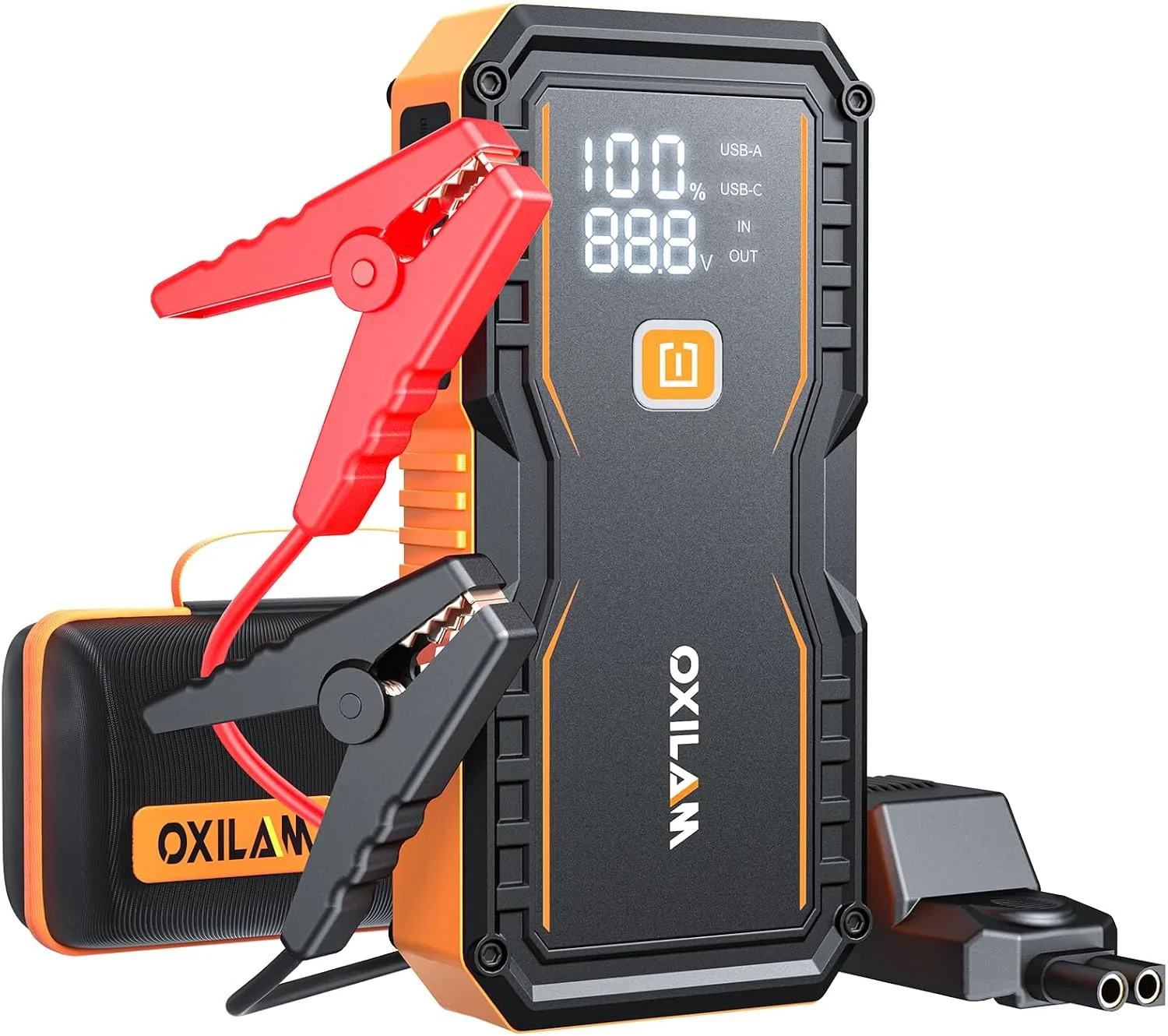
OXILAM Jump Starter 6000A for All Gas/12L Diesel
Highlights
- Portable lithium jump starter
- 6000A-class peak claim
- Clamp-on emergency start
- About $89.99 list
Best for
- Dead-battery jump starts in a driveway or parking lot
- Keep-in-cabin winter / travel insurance when you refuse a tow wait
- Budget spare for occasional starts rather than weekly shop duty
Pros
- Lithium pack jump without waiting for another vehicle
- OXILAM packs are aimed at roadside self-rescue, not shop chargers
- Approachable price for something you hope not to need often
- Beats waiting on a tow for a battery that still takes a jump
Cons
- No air — you still need a separate inflator for tire top-ups
- Packs need periodic recharge; a dead jump box helps nobody
- Peak-amp marketing is not the same as sustained cranking in deep cold
- Expect shorter cable reach / thinner cases than premium packs
Owner voices
Short takes from public retail reviews — paraphrased or translated when long or non-English; meaning kept close to the original.
“5/5 — Came back from out of state on vacation, while I was at work the next day, my wife’s 1 Ton Ford Super Duty Diesel wouldn’t start and batteries drained down from trying. I told her I would try my little Oxilam ju…”
“5/5 — This is one of those things you hope you don’t have to use often, but it gives you a lot of peace of mind knowing it’s in the vehicle. The OXILAM jump starter feels well built, is compact enough to store without…”
“5/5 — So far the jump pack has been great. It comes with a case so you can carry the jump pack and cables together, plus it’s a great size to keep in your backpack everywhere you go, or just leave in the car/truck. It…”
Specs that matter (from listing only)
The headline number is 6000A peak current. That's the maximum burst the pack can deliver for a few seconds, not the continuous cranking amps a battery tester would report. For a 4-cylinder gas engine or a V6, 6000A peak is more than enough on paper. For a 12L diesel — the listing's own upper bound — I'd want to see the actual jump before trusting it in a Minnesota cold snap.
The safety package is the part I care about more. OXILAM lists 10 intelligent protections: short circuit, reverse polarity, sparks, overheating, loose connections, battery bulging, and expansion. Reverse-polarity and spark suppression are the two that prevent the classic mistake — clamping red to black in the dark. If those work as described, they're worth more than an extra 1000A of peak.
Charge retention is the other winter spec. The listing says a full charge provides up to 60 jumpstarts, and it recommends recharging every three months if unused. That's a lithium-ion reality, not a flaw — but it means the pack is only as good as your last top-off. The LED screen shows remaining charge, which is a small but useful feature for catching a drained pack before you need it.
The multifunction bits: two USB outputs (5V/3A, 9V/2A, 12V/1.5A), a Type-C input, and an 800-lumen LED with flashlight, strobe, and SOS modes. Those are nice-to-haves. The flashlight matters if you're jumping a car at night; the power bank matters if your phone is dying while you wait for a tow.
- Peak current: 6000A (listing) — burst, not continuous CCA.
- Battery type: lithium-ion (listing). Capacity in Wh: n/a (not on file).
- Jump capacity: up to 60 jumps per full charge (listing).
- Safety: 10 protections including reverse polarity, short circuit, spark suppression, thermal management (listing).
- Light: 800 lumens, three modes (listing).
- Weight: n/a (not on file) — the listing's 3.36 oz field is almost certainly a shipping-weight error, so I won't repeat it as a real figure.
- Price: $89.99 list, $59.99 current (body only). Rating: 4.6 (3081 ratings).
Trade-offs / cons
The biggest trade-off is the one you can't see in the spec sheet: no published capacity in Wh, no weight, no continuous cranking amps. That's not unusual for budget jump packs, but it means you're comparing peak amps and feature lists, not measured performance. A 6000A peak label tells you almost nothing about how the pack behaves after 20 jumps on a cold morning.
The 12L diesel claim is the one I'd hedge hardest. Owners report success on a 1-ton Ford Super Duty diesel, which is encouraging — but that's one owner story, not a pattern. If you drive a diesel and live where it actually gets cold, I'd want a pack with a published CCA rating or a return window you're comfortable using.
The three-month recharge interval is a real maintenance burden. Lithium packs self-discharge slowly and cold temperatures accelerate the drop. If you're the kind of person who throws a jump pack in the trunk and forgets it until the first dead battery, this pack will let you down — not because it's bad, but because that's how lithium works. The LED charge screen helps, but only if you look at it.
The multifunction features are fine, but they add cost and complexity. The 800-lumen light is useful; the strobe and SOS modes are checkbox features most drivers will never use. The USB ports are a nice bonus, but they're not why you buy this.
- No published Wh capacity or weight — can't compare energy density or cold-weather performance on paper.
- 6000A peak is not a continuous CCA rating; treat the 12L diesel claim as a best-case scenario.
- Requires recharging every three months — easy to forget, and a dead pack is useless in an emergency.
- Multifunction light modes and power bank are nice-to-haves, not decision drivers.
Decision / buy-skip
Buy the OXILAM 6000A if you want a compact, inexpensive jump pack for a gas daily driver or a light diesel, and you're willing to top it off every three months. At $59.99 current (list $89.99), it's priced like insurance — and the 10-protection safety package is the feature that justifies the purchase more than the peak-amp number. The 4.6 rating across 3081 reviews suggests most owners get what they expect.
Skip it if you need a jump pack for a heavy diesel in serious cold, or if you want published capacity and weight figures before you buy. Also skip if you won't remember to recharge it — a jump pack with a dead battery is just a flashlight. For a glovebox emergency kit, it's a reasonable bet; for a work truck that absolutely cannot fail to start, spend more on a pack with a real CCA rating.
- Buy if: gas engine or light diesel, budget under $100, willing to maintain the charge.
- Skip if: heavy diesel in extreme cold, need published CCA/Wh/weight, or won't recharge quarterly.
What owners report
Owner reviews on this listing skew toward the 'peace of mind' theme — people who bought it, stashed it in the vehicle, and feel better knowing it's there. That's a common pattern for jump packs: the review is written after the first successful jump, not after a year of cold starts.
One theme that stands out is the diesel start. A verified buyer reports using it on a 1-ton Ford Super Duty diesel after the batteries drained — a real-world data point that supports the 12L diesel claim, at least for one truck. Another owner highlights the compact size and the built-in flashlight as reasons it lives in the car rather than the garage. The power bank function gets mentioned as a bonus, not a primary use.
- OXILAM 6000A: Diesel confidence — one owner used it successfully on a 1-ton Ford Super Duty diesel after a no-start.
- OXILAM 6000A: Stashable — owners repeatedly mention the compact size and included case make it easy to keep in the vehicle.
- OXILAM 6000A: Nighttime utility — the built-in flashlight and charge display are called out as practical extras.
How we checked (methodology)
This review is based on the Amazon listing and owner reviews — not independent lab testing. I'm a jump-starter and roadside-power editor, and my checklist weights safety cutoffs and cold-weather behavior above peak-amp marketing. For this piece, I weighted: safety protections 30%, published specs (peak amps, jump count, charge retention) 25%, owner themes 25%, price/value 20%.
I did not measure cranking amps, cold-temperature performance, or actual jump count. Where the listing is missing data — weight, Wh capacity, continuous CCA — I've marked it n/a rather than guessing. The 3.36 oz weight field in the listing is almost certainly a shipping error, so I've excluded it from the spec table rather than repeat a number that doesn't match the product.
- Safety 30% / specs 25% / owner themes 25% / value 20%.
- No bench tests; all numbers from listing or owner reports.
- Missing data marked n/a — not estimated.
Who should skip it
Skip the OXILAM 6000A if you drive a heavy diesel and need a guaranteed cold-start solution. The 12L claim is there, but without a published CCA rating, it's a claim — not a spec you can compare. Skip it if you want a jump pack you can leave in the trunk for a year without thinking about it; lithium self-discharge and cold weather will catch up with you.
Also skip if you need a jump box for a fleet, a boat, or anything where a failed start has real cost. This is a consumer emergency tool, not professional equipment. If you're comparing against a pack with a published Wh capacity or a higher continuous output, this one's advantage is price and the safety feature list — not raw power.
- Heavy diesel in extreme cold: consider a pack with published CCA.
- Set-and-forget owners: lithium packs need quarterly charging.
- Professional/fleet use: this is a consumer-grade tool.
FAQ
Q: Will the 6000A peak start a 12L diesel? A: The listing claims it will, and one owner reports success on a 1-ton Ford Super Duty diesel. But peak amps are not continuous CCA, and cold weather reduces lithium output. Treat it as a best-case claim.
Q: How often do I need to recharge it? A: The listing recommends every three months if unused. In cold climates, I'd check the charge screen monthly and top it off before winter.
Q: Does it have reverse-polarity protection? A: Yes — the listing says 10 protections including reverse polarity and spark suppression. That's the feature that prevents the most common jump-start mistake.
Q: What's the actual weight? A: n/a (not on file). The listing's 3.36 oz field is almost certainly a shipping-weight error, so I wouldn't rely on it.
Method and sources
This guide is built from product data and list prices pulled from Affiliate Hub at build time, together with owner feedback we summarize on the cards. It is catalog-backed buying help, not a lab ranking of every model.
Read how we test for the protocol behind any measured figures we still cite in Guides & Tips.