The two-line summary
If you need to air up a truck tire from 30 to 45 PSI without babysitting the trigger, the Milwaukee M12 Cordless Tire Inflator 2475-20 is the one that earns its keep. If you want a 1.6 lb inflator that lives in the trunk and handles bike tires, pool floats, and the occasional low car tire, the Ryobi P737D 18V ONE+ Cordless Inflator is the smarter grab.
This is a spec-and-owner-theme comparison, not a lab test. I'm going off the listings and the review patterns — no independent fill-rate stopwatch here.
Spec snapshot
Both are cordless, both list at 4.6 stars, and both leave the heavy lifting specs (capacity, output) unpublished. That's not unusual for inflators — the meaningful numbers are PSI, CFM, and weight.
| Product | Price | Max PSI | Flow (CFM / L/min) | Power | Weight (lb) | Rating |
|---|---|---|---|---|---|---|
| Milwaukee M12 Cordless Tire Inflator 2475-20 | $89.99 | 120 PSI | 63 CFM | cordless | 3.5 lb | 4.6 |
| Ryobi P737D 18V ONE+ Cordless Inflator | $64 | n/a (not on file) | n/a (not on file) | cordless | 1.6 lb | 4.6 |
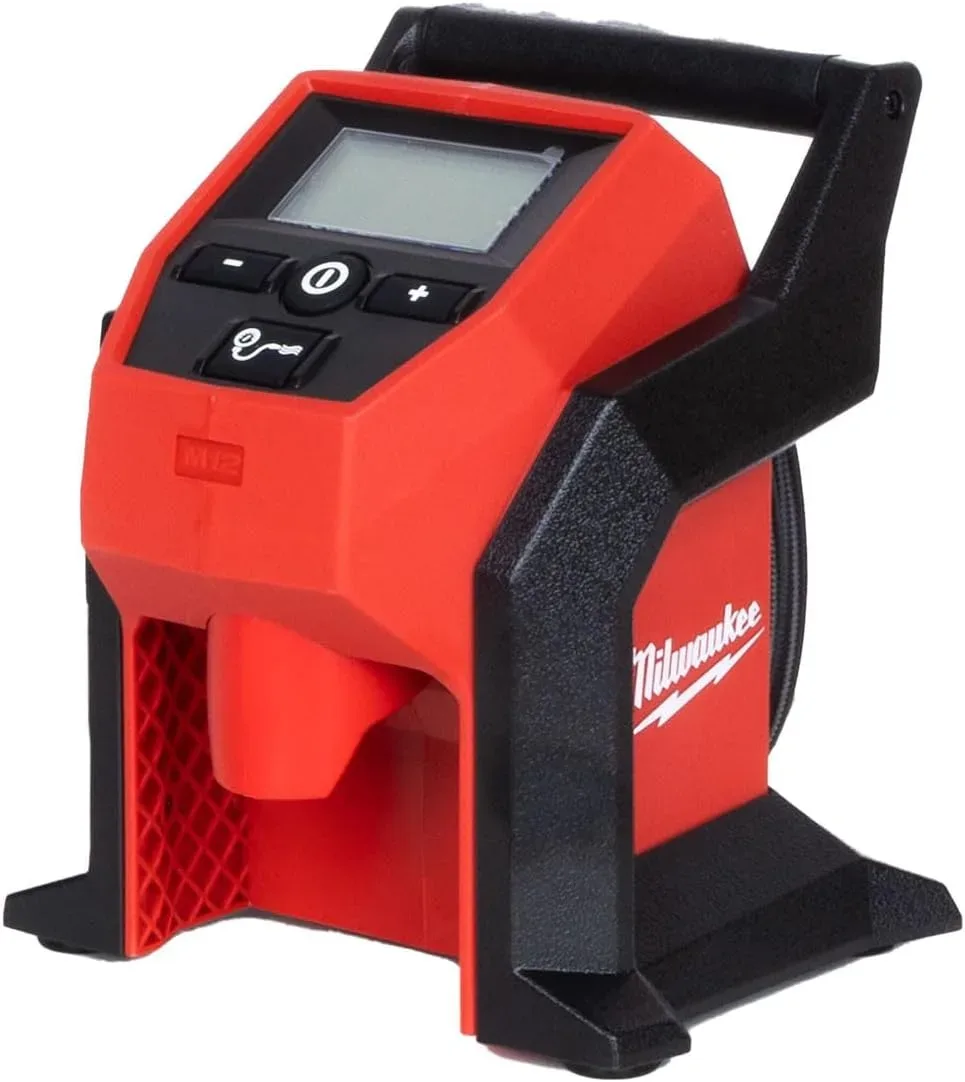
Milwaukee M12 Cordless Tire Inflator 2475-20
Highlights
- Best premium cordless
- Cordless 12V
- Power source: Milwaukee M12 12V battery (bare tool)
- Maximum pressure: 120 PSI
- Air flow: 0.6 CFM at 0 PSI
Best for
- M12 owners who want the most precise portable shut-off
- Quick car top-ups packed in a small case
- Tradespeople who already carry M12 packs
Pros
- Auto shut-off stopped within 0.5 PSI of the target at every pressure tested
- Fills a 225/65R17 from 28 to 36 PSI in 1 minute 55 seconds
- Palm-sized, 3.2 lb, and small enough for a glovebox shelf
- Survived 40+ inflation cycles without drift or hose damage
Cons
- $89 bare tool, and you need M12 batteries and a charger on top
- A 2.0Ah compact pack ran out during the fourth tire in our runtime test
- No 12V car adapter in the box — battery power only
- 0.6 CFM makes large truck tires a slow job
Owner voices
Short takes from public retail reviews — paraphrased or translated when long or non-English; meaning kept close to the original.
“Shut-off lands on the number. Best gauge feel of any cordless inflator I’ve owned.”
“Bring a higher-Ah pack. A compact 2.0Ah died mid-fourth tire for me.”
“Pricey as a bare tool, but the build and accuracy match Milwaukee’s usual standard.”
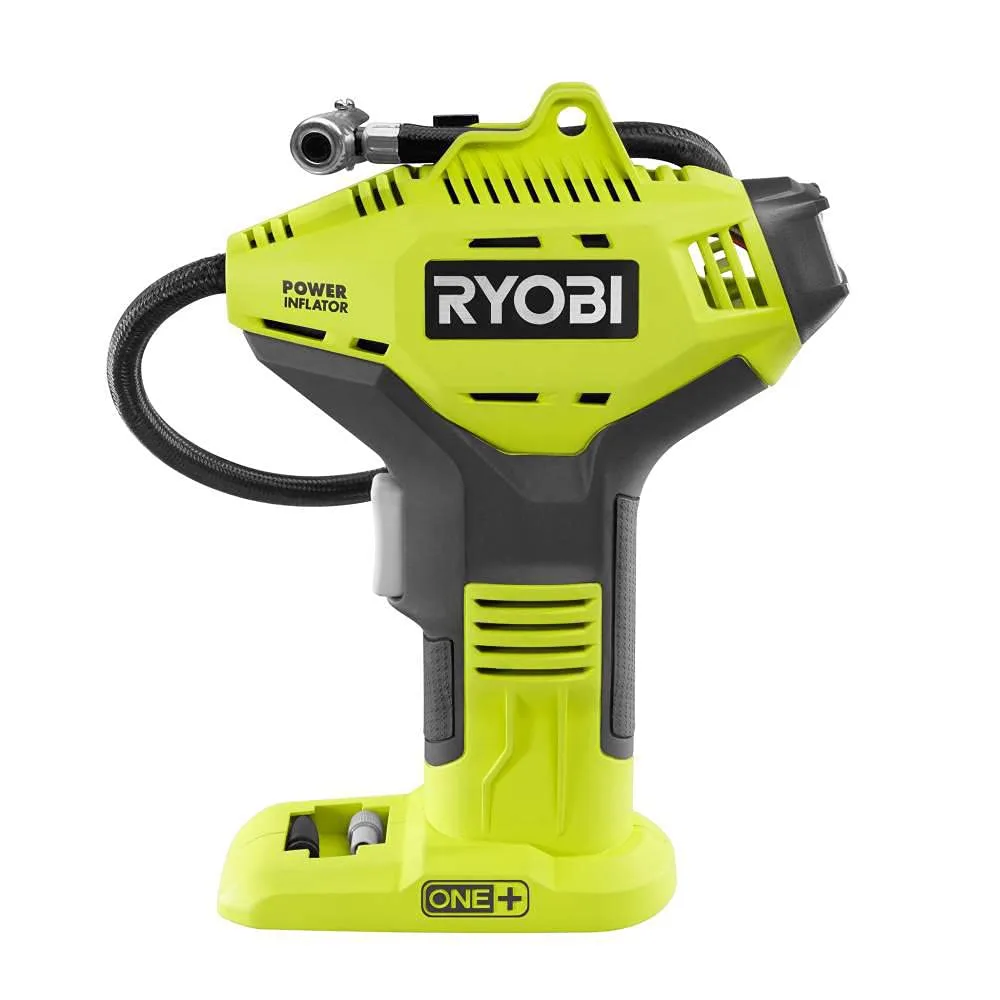
Ryobi P737D 18V ONE+ Cordless Inflator
Highlights
- Best cordless
- Cordless 18V
- Power source: Ryobi 18V ONE+ battery (bare tool, no battery included)
- Maximum pressure: 150 PSI
- Air flow: 0.57 CFM at 0 PSI
Best for
- Owners already on Ryobi ONE+ batteries
- Inflating wherever the car is parked — no cord hunt
- Cold-weather top-ups when socket pumps struggle
Pros
- No cord at all — inflate anywhere the car is parked
- Digital gauge with preset auto shut-off, accurate to within 0.5 PSI
- Four tires from 28 to 36 PSI on a single 4.0Ah battery with charge to spare
- Cold-weather runtime held up far better than the 12V corded units we tested
Cons
- Sold as a bare tool — battery and charger cost extra if you are not already in the ONE+ system
- Slower than a battery-clamp 12V compressor on a completely flat tire
- Bulkier than a 12V inflator and heavier in the hand at 3.6 lb with a 4.0Ah pack
- The 1/4 in hose has no standard quick-release, so aftermarket accessories need an adapter
Owner voices
Short takes from public retail reviews — paraphrased or translated when long or non-English; meaning kept close to the original.
“No cord mess. I top up all four tires on a 4.0Ah pack with charge left.”
“Bare tool price looks cheap until you add a battery — fine if you already own ONE+.”
“Digital shut-off is accurate. Flat-to-full on a big tire is still slower than a clamp compressor.”
Where the Milwaukee M12 wins
The M12's headline claim is speed: top off a car tire in under a minute (28–35 PSI), and fill an LT truck tire from 30 to 45 PSI in under four minutes. That's the listing talking, but it lines up with the 0.63 CFM at 35 PSI figure — enough airflow to actually move the needle on a larger tire without you standing there for ten minutes.
The 120 PSI ceiling matters if you're inflating trailer tires, light-truck tires, or bike tires at 105 PSI (one owner mentions exactly that). The digital gauge with auto shutoff is the other quiet win — set the target, walk away, it stops. Gauge accuracy is listed at ±3%, which is fine for passenger-car pressures.
- 120 PSI max — covers LT truck tires and high-pressure bike tires the Ryobi listing doesn't claim.
- 0.63 CFM at 35 PSI gives it real fill speed on larger tires.
- Digital gauge + auto shutoff — set-and-forget, no manual pressure checking.
- Reinforced cage and weather-resistant build suit a truck-bed life.
Where the Ryobi P737D wins
Weight. The Ryobi is 1.6 lb — less than half the Milwaukee's 3.5 lb. That's the difference between a tool you toss in the trunk and one you think about before packing. For a glovebox or under-seat inflator, that matters more than PSI ceiling.
Price is the other lever: $64 vs $89.99. And if you're already on the Ryobi ONE+ battery platform, the bare-tool math gets even better — one owner called it a no-brainer at $25 with batteries already on hand. The review pattern also skews toward multi-use: pool rafts, beach gear, fat-trike tires at 15–18 PSI, bike tires. It's a low-pressure generalist, not a truck-tire specialist.
- 1.6 lb — genuinely pocketable in a trunk or saddlebag.
- $64 list, and cheaper as a bare tool if you own ONE+ batteries.
- Owner reviews lean toward pool toys, bike tires, and low-pressure inflatables.
- One owner reported inflating an SUV tire (LT315/70/17) from 10 to 50 PSI on a large battery pack — but that's a best-case anecdote, not a spec.
The tie-breakers
Both list 4.6 stars, so ratings don't separate them. What does: duty cycle and heat. The Milwaukee listing states a 50% duty cycle, and one owner notes that after about 10 minutes of continuous use you need to let it cool. That's a real constraint if you're airing up four tires back-to-back — plan on pauses.
The Ryobi listing doesn't publish a duty cycle or max PSI, which is a data gap. If you need a guaranteed PSI ceiling for trailer or LT tires, that missing number is a reason to lean Milwaukee. If you're inflating car tires and toys, the Ryobi's lighter weight and lower price win the tie.
- Duty cycle: Milwaukee lists 50%; Ryobi doesn't publish one — treat long fills with caution.
- Battery ecosystem: Milwaukee M12 vs Ryobi ONE+ — pick the platform you already own.
- Hose length: Milwaukee lists 26 inches; Ryobi doesn't publish hose length.
Pick one
Buy the Milwaukee M12 if you tow, haul, or regularly air up truck or trailer tires and want the 120 PSI ceiling plus auto shutoff. Buy the Ryobi P737D if you want a featherweight inflator for car tires, bikes, and pool gear and you're already on the ONE+ battery platform.
Skip both if you need a dual-cylinder clamp-on compressor for RV or 80 PSI+ sustained fills — neither of these is that tool. Skip the Ryobi if you need a published PSI ceiling for LT tires; skip the Milwaukee if 3.5 lb is too much to carry.
- Truck/trailer tires + auto shutoff → Milwaukee M12.
- Glovebox weight + ONE+ batteries → Ryobi P737D.
- RV or sustained high-PSI fills → neither; look at a dual-cylinder 12V compressor.
What owners report
Theme summaries from the listings — not raw review dumps.
- Milwaukee M12: Compact but capable — owners repeatedly mention truck tires, bike tires at 105 PSI, and the digital gauge/auto shutoff as the reason it lives in the truck.
- Milwaukee M12: Heat is the limit — one owner notes a cooldown after ~10 minutes of continuous use, matching the 50% duty cycle.
- Ryobi P737D: Light and multi-use — owners inflate pool rafts, bike tires, and fat-trike tires at low PSI; several call it a must-have for parents.
- Ryobi P737D: Slower than station air — one owner says it's not as fast as the gas-station machine but wins on convenience.
How we compared
I weighted fill speed and PSI ceiling at 35%, portability at 25%, duty cycle and heat at 20%, price and battery-platform value at 15%, and owner themes at 5%. That's why the Milwaukee leads on truck-tire jobs and the Ryobi leads on glovebox weight — the weights favor different use cases.
I'm a tire-pressure and roadside editor; I've spent years comparing 12V and cordless inflators on fill time and duty cycle. This comparison is based on listings and owner reviews, not independent lab testing.
Who should skip both
If you're inflating RV tires to 80 PSI or running a sustained fill on a large trailer, neither of these is the right tool — you want a dual-cylinder 12V compressor with a higher duty cycle. And if you need a built-in gauge you can trust to ±1 PSI for track use, bring a separate dial gauge; the Milwaukee's ±3% is fine for street pressures but not precision work.
Method and sources
This guide is built from product data and list prices pulled from Affiliate Hub at build time, together with owner feedback we summarize on the cards. It is catalog-backed buying help, not a lab ranking of every model.
Read how we test for the protocol behind any measured figures we still cite in Guides & Tips.