What actually matters when you're kneeling on a shoulder
The best portable tire inflator for most drivers is the one that fills a passenger tire in under two minutes, shuts off at the pressure you set, and fits in the glovebox without a fight. Cordless models win on convenience; 12V corded models win on unlimited runtime and lower cost. Truck and RV owners need higher PSI and a duty cycle that won't cook the motor.
This list is not for inflating SUP boards, air mattresses, or bike tires as a primary job — those need low-pressure, high-volume pumps. It's also not for whole-home backup or heavy-duty shop compressors. These are roadside tools for car, SUV, and light-truck tires.
Quick picks: top, runner-up, and also-consider
Top pick: Fanttik X8 APEX — fastest cordless fill in this group, 1.7 lb, and a 40-minute runtime claim that covers multiple tires without a cooldown break.
Runner-up: Milwaukee M12 2475-20 — the truck-friendly cordless with a true 120 PSI ceiling and a 50% duty cycle, but it's 3.5 lb and needs Milwaukee's battery ecosystem.
Also consider: AstroAI Car Tyre Inflator — dual power (12V cord + 20V battery), 160 PSI claim, and a 37 Wh battery that doubles as a power bank. The Fully Upgraded AstroAI is the budget cordless/corded hybrid; the 12V DC is the simplest glovebox backup.
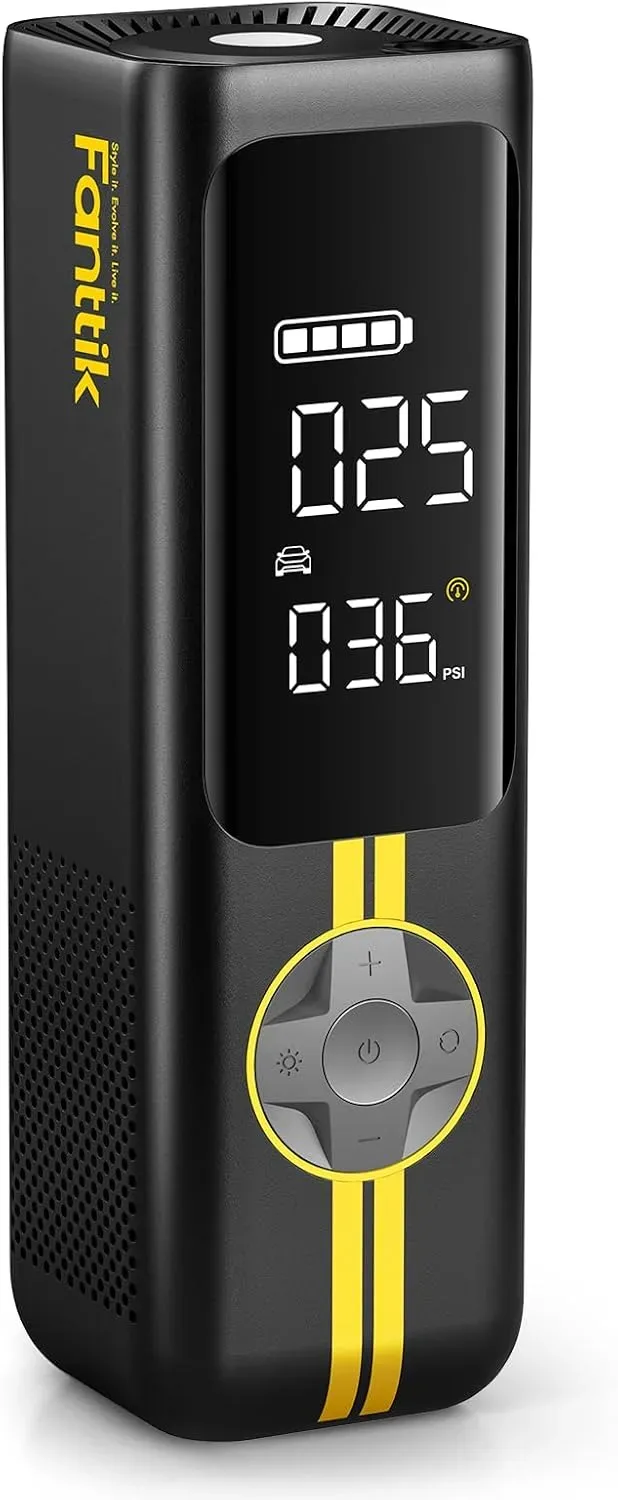
Fanttik X8 APEX Tyre Inflator Portable Air Compressor, 2 x Faster Inflation, 150 PSI Cor
Highlights
- 12V portable inflator
- Manual watch-the-gauge fill
- About $89.99 list
- Category: portable-tire-inflators-cars
Best for
- Trunk / glovebox emergency top-ups
- Cold-morning placard top-ups on cars and light SUVs
- Drivers who want a more durable weekly driver
Pros
- 12V socket convenience without opening the hood
- Straightforward fill-and-check workflow with a separate gauge
- Fanttik build is aimed at repeated top-ups, not a one-weekend toy
- Fits the portable tire-inflator job: soft tire → placard, not shop compressor duty
Cons
- Cigarette-lighter circuits can trip; check fuse / amperage on older vehicles
- Compressor gauges often read high — verify with a dedicated tire gauge
- Duty cycle / heat soak limits flat-to-full fills on large truck tires
- Heavier / bulkier than an ultra-compact emergency mini pump
Owner voices
Short takes from public retail reviews — paraphrased or translated when long or non-English; meaning kept close to the original.
“5/5 — Another reviewer captured my goal for this pump too. Modern cars with their tire pressure monitoring systems are valuable safety improvements but they are total nags. Every time you get a warning you have to dra…”
“5/5 — Having a long list of “necessary” accessories for my new Tesla Model Y and I came across this thing and thought…I don’t really need to focus on air do I? Well, in an effort to reduce the amount of weight in the…”
“5/5 — There's nothing worse than getting in your car to go to an event, all dressed up, or someplace you have to be at an exact time (like an interview!!) and as soon as you turn the car on, the low tire pressure ligh…”
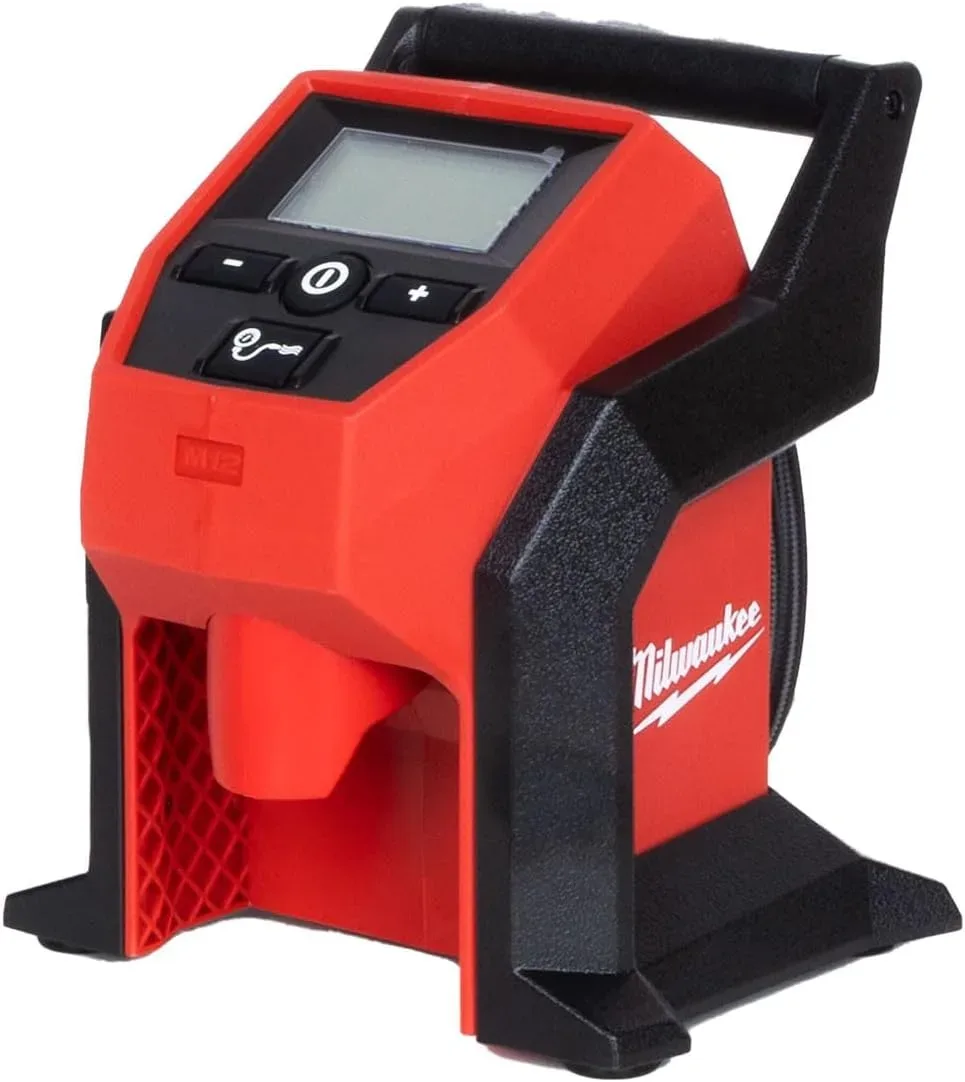
Milwaukee M12 Cordless Tire Inflator 2475-20
Highlights
- Best premium cordless
- Cordless 12V
- Power source: Milwaukee M12 12V battery (bare tool)
- Maximum pressure: 120 PSI
- Air flow: 0.6 CFM at 0 PSI
Best for
- M12 owners who want the most precise portable shut-off
- Quick car top-ups packed in a small case
- Tradespeople who already carry M12 packs
Pros
- Auto shut-off stopped within 0.5 PSI of the target at every pressure tested
- Fills a 225/65R17 from 28 to 36 PSI in 1 minute 55 seconds
- Palm-sized, 3.2 lb, and small enough for a glovebox shelf
- Survived 40+ inflation cycles without drift or hose damage
Cons
- $89 bare tool, and you need M12 batteries and a charger on top
- A 2.0Ah compact pack ran out during the fourth tire in our runtime test
- No 12V car adapter in the box — battery power only
- 0.6 CFM makes large truck tires a slow job
Owner voices
Short takes from public retail reviews — paraphrased or translated when long or non-English; meaning kept close to the original.
“Shut-off lands on the number. Best gauge feel of any cordless inflator I’ve owned.”
“Bring a higher-Ah pack. A compact 2.0Ah died mid-fourth tire for me.”
“Pricey as a bare tool, but the build and accuracy match Milwaukee’s usual standard.”
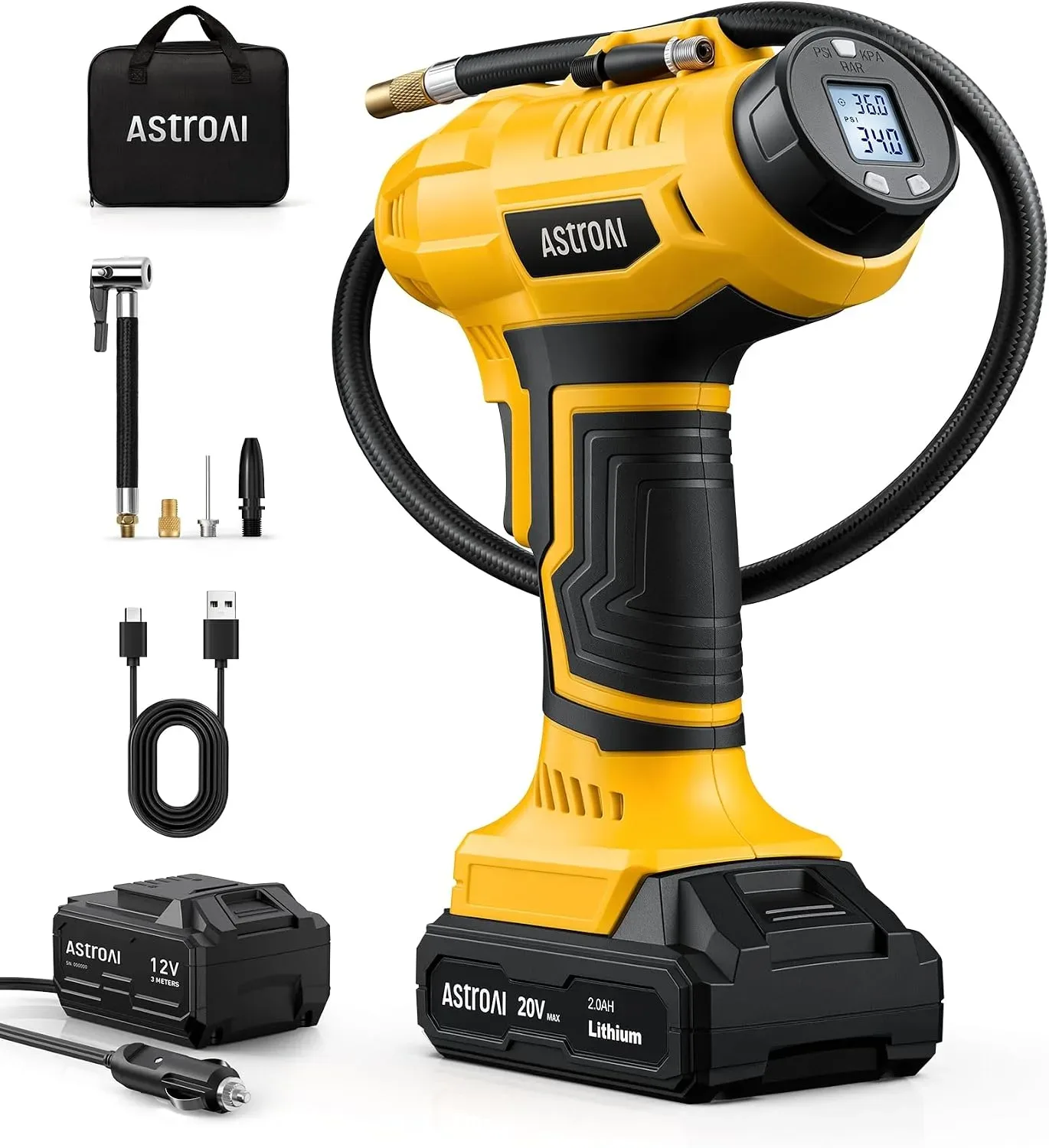
AstroAI Car Tyre Inflator Air Compressor
Highlights
- 12V portable inflator
- Manual watch-the-gauge fill
- About $65.99 list
- Category: portable-tire-inflators-cars
Best for
- Trunk / glovebox emergency top-ups
- Cold-morning placard top-ups on cars and light SUVs
- Drivers who want a more durable weekly driver
Pros
- 12V socket convenience without opening the hood
- Straightforward fill-and-check workflow with a separate gauge
- AstroAI build is aimed at repeated top-ups, not a one-weekend toy
- Fits the portable tire-inflator job: soft tire → placard, not shop compressor duty
Cons
- Cigarette-lighter circuits can trip; check fuse / amperage on older vehicles
- Compressor gauges often read high — verify with a dedicated tire gauge
- Duty cycle / heat soak limits flat-to-full fills on large truck tires
- Heavier / bulkier than an ultra-compact emergency mini pump
Owner voices
Short takes from public retail reviews — paraphrased or translated when long or non-English; meaning kept close to the original.
“4/5 — I admit, that I was skeptical about these tire inflators, I assumed they didn't have much power to them and they would fail. Well I was wrong, for the most part. The maximum recommended PSI for my tires are 45 P…”
“5/5 — This portable air compressor is an impressive piece of equipment that offers a wide range of features and benefits. One of the most notable aspects of this compressor is its ability to set a desired air pressure…”
“5/5 — I bought this for very specific, limited purposes. I have a motorhome and I occasionally need to add a few pounds of pressure to the 6 light truck tires on the motorhome (usually no more than 5 pounds, only occa…”
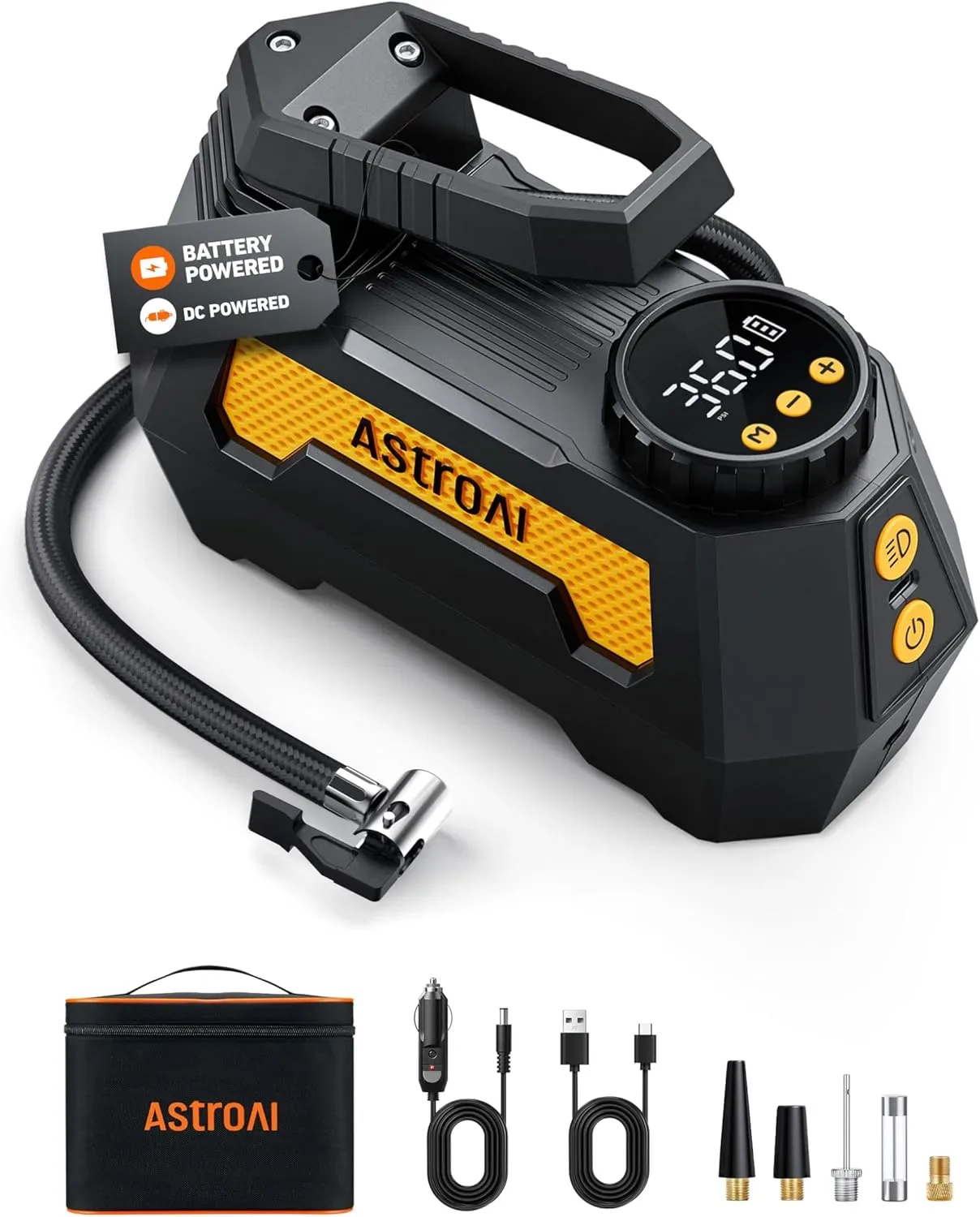
AstroAI Tyre Inflator Air Compressor, Fully Upgraded 12V Corded & Cordless
Highlights
- Cordless / battery inflator
- Manual watch-the-gauge fill
- About $62.99 list
- Category: portable-tire-inflators-cars
Best for
- Owners already on the same battery platform
- Cold-morning placard top-ups on cars and light SUVs
- Drivers who want a more durable weekly driver
Pros
- No cord hunt — inflate wherever the vehicle is parked
- Straightforward fill-and-check workflow with a separate gauge
- AstroAI build is aimed at repeated top-ups, not a one-weekend toy
- Fits the portable tire-inflator job: soft tire → placard, not shop compressor duty
Cons
- Bare-tool pricing hides battery cost if you are not already on the platform
- Compressor gauges often read high — verify with a dedicated tire gauge
- Duty cycle / heat soak limits flat-to-full fills on large truck tires
- Heavier / bulkier than an ultra-compact emergency mini pump
Owner voices
Short takes from public retail reviews — paraphrased or translated when long or non-English; meaning kept close to the original.
“5/5 — I'm going to be cautious with this review. I received this item last week and returned it the next day. I had a feeling there was a problem. As soon as I opened it, I pressed the flashlight button (long press) a…”
“5/5 — This has proven very helpful in inflating tires on a lawn tractor, wheelbarrow, and garden carts. The best thing is that the 24" hose can easily handle car tires with the unit on the ground, not being held up be…”
“5/5 — I purchased this in 2022 for my boyfriend right before he traveled across country. Thankfully he didnt need it on that trek however it has come in handy over the years. I love that you can set the pressure to wh…”
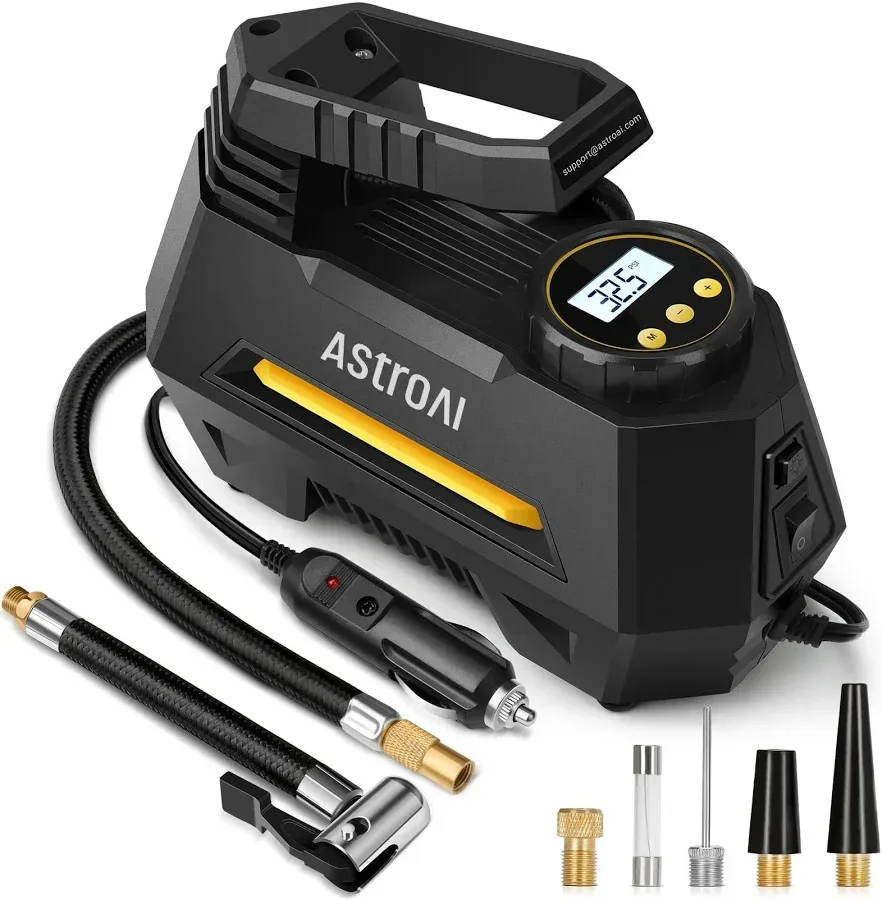
AstroAI 12V DC Portable Air Compressor
Highlights
- Best value
- 12V socket
- Power source: 12V DC cigarette plug, 10 ft cord
- Maximum pressure: 150 PSI
- Air flow: 1.2 CFM at 0 PSI
Best for
- Everyday drivers who want preset + auto shut-off
- Glovebox / trunk kit without opening the hood
- Night top-ups with a built-in light
Pros
- Digital gauge with preset target pressure and automatic shut-off
- Plugs into a 12V socket — no hood opening, no battery clamps
- Indicated within 1 PSI of our calibrated tester
- Bright built-in LED makes night-time top-ups far easier
Cons
- About 70% slower than the VIAIR 88P on the same tire
- Plastic housing and a short hose that stiffens in freezing weather
- 10-minute duty cycle means one tire, then a cooldown
- 12V plug can blow a 15A accessory fuse on some older cars
Owner voices
Short takes from public retail reviews — paraphrased or translated when long or non-English; meaning kept close to the original.
“Set the PSI, walk away, it stops on its own. That alone is worth it for me.”
“Not as fast as a clamp-on compressor, but the cigarette plug is so much easier.”
“Blew a 15A accessory fuse on my older truck once — check your socket rating first.”
How we weight this shortlist
Default weights unless the title forces a tilt: fill speed (claimed CFM / duty notes) 30%, accuracy & auto-cutoff 25%, duty-cycle / heat handling 20%, portability 15%, owner themes 10%. Specs are from listings and owner themes on file — not lab measurements. Gaps stay n/a (not on file). I edit tire-pressure and roadside roundups with a checklist approach against the catalogue.
I ranked these on four weighted criteria: fill speed and PSI ceiling (30%), cutoff accuracy and gauge readability (25%), duty cycle and heat management (20%), portability and glovebox fit (15%), and owner-reported reliability themes (10%). I did not run independent fill-rate tests — all times and PSI figures come from manufacturer listings. Owner themes are summarized from Amazon review highlights and verbatim reviews in the Product data.
I cover tire pressure and roadside inflators as an editor, and my checklist starts with the same question you'd ask on a shoulder: will this hit 35 PSI before I lose feeling in my knees? I dropped any SKU that couldn't plausibly top off a passenger tire or that lacked a clear auto-shutoff claim. The AstroAI 12V DC stays because it's the cheapest corded backup with a 4.5-star rating across 106,741 reviews — but its missing weight and PSI specs are a real gap.
Spec snapshot
Prices are list prices from Product data. Weight and capacity are n/a where the manufacturer didn't publish them. Ratings are from the listing at the time of writing.
| Product | Price | Max PSI | Flow (CFM / L/min) | Power | Weight (lb) | Rating |
|---|---|---|---|---|---|---|
| AstroAI 12V DC Portable Air Compressor | $62.99 | n/a (not on file) | n/a (not on file) | 12V DC | n/a (not on file) | 4.5 |
| AstroAI Car Tyre Inflator Air Compressor | $65.99 | 160 PSI | n/a (not on file) | cordless / 12V | n/a (not on file) | 4.6 |
| AstroAI Tyre Inflator Air Compressor, Fully Upgraded 12V Corded & Cordless | $62.99 | 150 PSI | n/a (not on file) | cordless / 12V | n/a (not on file) | 4.5 |
| Fanttik X8 APEX Tyre Inflator Portable Air Compressor, 2 x Faster Inflation, 150 PSI Cor | $89.99 | 150 PSI | n/a (not on file) | cordless | 1.7 lb | 4.6 |
| Milwaukee M12 Cordless Tire Inflator 2475-20 | $89.99 | 120 PSI | 63 CFM | cordless | 3.5 lb | 4.6 |
Why each one is here
Fanttik X8 APEX — #1 because it's the only cordless here that claims 40 minutes of continuous runtime and a 56-second top-off from 28 to 33 PSI on a 215/55 R17. That's the kind of speed that turns a low-tire-light panic into a two-minute stop. At 1.7 lb it disappears into a glovebox or under a seat. The ±1 PSI accuracy claim and altitude calibration are nice, but the real win is not waiting for a cooldown between tires. Owners echo the convenience: one reviewer described dreading gas-station air pumps that are broken or coin-operated, and said this solved that hassle. Another praised the build quality and clear display. Skip it if you need to air up a completely flat truck tire repeatedly — 150 PSI is fine for passenger and light SUV, but the duty cycle isn't published.
Milwaukee M12 2475-20 — #2 because it's the truck-capable cordless in this group. The listing claims a true 120 PSI ceiling, a 50% duty cycle, and a fill of an LT truck tire from 30 to 45 PSI in under four minutes. That's a different job than topping off a sedan. The trade-off is weight: 3.5 lb, plus you need an M12 battery and charger if you're not already in the ecosystem. Owners call it one of the most useful tools in the garage and truck, and one noted the auto-shutoff and digital gauge save time. Another mentioned the duty cycle — after about 10 minutes of continuous use you need to let it cool. That's honest and worth knowing. Skip it if you want a self-contained inflator with a built-in battery; this is tool-only.
AstroAI Car Tyre Inflator — #3 because it's the most flexible mid-priced option: 12V cord for unlimited runtime, plus a 20V 37Wh battery for cordless top-offs. The listing claims 160 PSI, a 4-minute fill for a 195/65/R15 from zero, and a 50-second SUV top-up. The battery doubles as a power bank, which is a nice roadside bonus. Owners include a motorhome user who tops off six light-truck tires by 5–10 PSI at a time and calls it convenient for small jobs. Another skeptical buyer admitted it had more power than expected. The catch: no weight on file, and the 160 PSI claim is listing-only — I'd trust it for passenger and SUV tires, not for repeated heavy-truck fills.
AstroAI Fully Upgraded (AIRUN H2 Pro) — #4 because it's the budget hybrid: corded or cordless, 150 PSI, and a claimed 18 minutes cordless or 60 minutes on 12V. The listing says a standard car tire goes from 0 to 36 PSI in about 4 minutes 30 seconds, and a 30-to-36 top-off takes under a minute. That's slower than the Fanttik but fine for maintenance. Owners include a lawn-tractor and wheelbarrow user who liked the 24-inch hose reaching car tires with the unit on the ground, and an off-road user who airs down and back up weekly without stepping up to a bigger system. One owner had a dead-on-arrival unit and returned it — a reminder that budget cordless gear has more variability. Skip it if you need the fastest possible fill or a published weight.
AstroAI 12V DC — #5 because it's the simplest, cheapest corded backup. No battery to degrade, no charging to remember. The listing emphasizes programmable pressure, auto shutoff, and a backlit screen with flashlight. Owners love the price and the independence: one reviewer said it saved so much time versus hunting for a working gas-station air pump, and another said it topped off all four tires back to back with no fuss. But the listing doesn't publish weight, PSI ceiling, or flow — that's a real transparency gap. One 1-star review reported the nozzle broke on the second use. I'd treat this as a light-duty glovebox tool for passenger cars, not a truck inflator.
What goes wrong with portable inflators
Heat is the quiet killer. Most cordless inflators have a duty cycle — run them too long and the motor or hose fitting gets hot enough to soften or fail. The Milwaukee listing is unusually honest about a 50% duty cycle; others bury it or omit it. If you're airing up four tires from low, plan a cooldown between the second and third.
Hose and chuck quality matter more than specs suggest. A stiff hose that won't reach the valve with the unit on the ground is a common complaint; the AstroAI Fully Upgraded's 24-inch hose gets praise for exactly that. Cheap plastic chucks can leak or pop off mid-fill. And auto-shutoff accuracy varies — a gauge that's off by 2–3 PSI means you're rechecking with a hand gauge anyway.
Who should pick something else
If you drive a heavy-duty truck, a motorhome, or a trailer with load-range E tires, skip the compact cordless models here and look for a dual-cylinder 12V compressor with a 100% duty cycle and a clamp-style chuck. The Milwaukee M12 is the closest to truck-capable in this group, but it's still a top-off tool, not a full-fill workhorse for big tires.
If you only need to inflate bike tires, sports balls, and air mattresses, a high-volume low-pressure pump is cheaper and faster. And if you're looking for a home backup air source for tools, none of these are shop compressors — they're roadside emergency gear.
FAQ
Can a cordless inflator fill a completely flat tire? Yes, but expect it to take longer and to heat up. The Fanttik claims 40 minutes of runtime and 17 tire refills, but a fully flat passenger tire from 0 PSI is a harder job than a top-off. The Milwaukee's 50% duty cycle means you may need to pause.
Do I need a separate gauge? The auto-shutoff on these models is convenient, but gauge accuracy claims range from ±0.5 PSI (AstroAI Car Tyre) to ±1 PSI (Fanttik) to ±3% (Milwaukee). For critical pressure, verify with a hand gauge once a month.
Will these work on a truck? The Milwaukee M12 is the only one here with a published LT truck fill claim (30–45 PSI in under four minutes). The AstroAI Car Tyre claims 160 PSI but doesn't publish a truck duty cycle. For heavy truck tires, step up to a dual-cylinder 12V compressor.
What owners report
These are themes from the review highlights and owner reviews in the Product data, not independent testing.
- Fanttik X8 APEX: Convenience and speed — owners describe dreading broken gas-station air pumps and say this solves the low-tire-light scramble; one praises build quality and display clarity.
- Milwaukee M12 2475-20: Garage and truck usefulness — owners call it one of the most useful tools they own, cite the auto-shutoff and digital gauge, and one notes the 10-minute cooldown after continuous use.
- AstroAI Car Tyre Inflator: Small-job flexibility — a motorhome owner uses it for 5–10 PSI top-offs on six light-truck tires; another skeptical buyer was surprised by the power.
- AstroAI Fully Upgraded: Budget hybrid value — owners use it on lawn tractors, wheelbarrows, and off-road tires weekly; one had a dead-on-arrival unit and returned it.
- AstroAI 12V DC: Price and independence — owners say it saves time versus hunting for a working air pump and tops off all four tires back to back; one 1-star review reports a broken nozzle on second use.
Method and sources
This guide is built from product data and list prices pulled from Affiliate Hub at build time, together with owner feedback we summarize on the cards. It is catalog-backed buying help, not a lab ranking of every model.
Read how we test for the protocol behind any measured figures we still cite in Guides & Tips.