AstroAI M10 6000A Jump Starter & Inflator: Specs Decoded
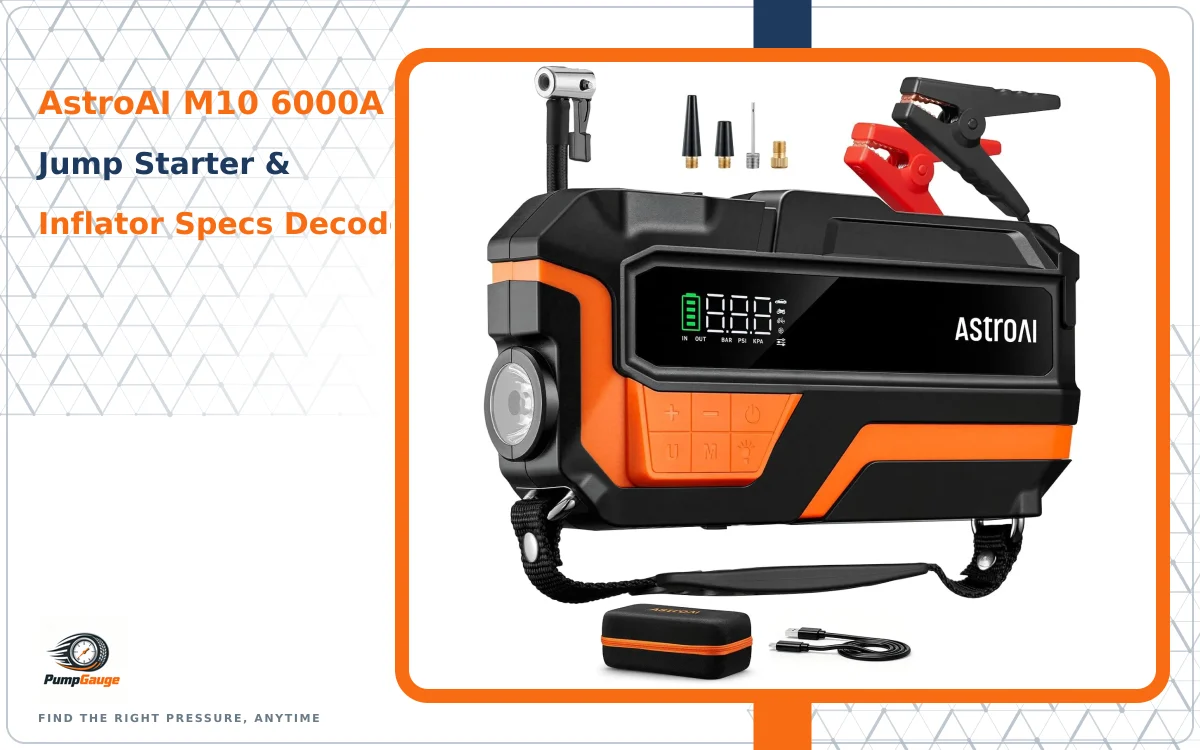
The AstroAI M10 pairs a 6,000A peak jump starter with a 150 PSI inflator for $139.99 (low $89.97). I break down the listing numbers—peak amps, fill time, hose length, duty cycle—and flag which specs actually decide whether this suits your car or your truck.
The spec sheet, translated
The AstroAI M10 is sold as a combo: a lithium jump starter and a tire inflator in one case. The listing leads with 6,000A peak current, which is the number most shoppers see first. Peak amps are a momentary surge rating, not what the clamps deliver continuously. For a dead battery, what matters is whether the unit can supply enough current long enough to crank the engine—typically a few seconds. A 6,000A peak figure is marketing-friendly, but it does not tell you the cold-cranking amps (CCA) the pack can actually sustain. Treat it as a class indicator, not a guarantee.
The inflator side is rated to 150 PSI, per the listing. That is the maximum pressure the pump is designed to reach. Most passenger tires need 30–35 PSI; light-truck tires often run 50–80 PSI. A 150 PSI ceiling means the unit has headroom for truck tires, but headroom is not the same as speed. The listing does publish one fill-time figure: it tops off a tire from 32 to 36 PSI in about one minute. That is a 4 PSI gain on a passenger tire, not a full truck-tire fill from low pressure. The listing does not publish CFM, so you cannot compare inflation speed across brands from the spec sheet alone.
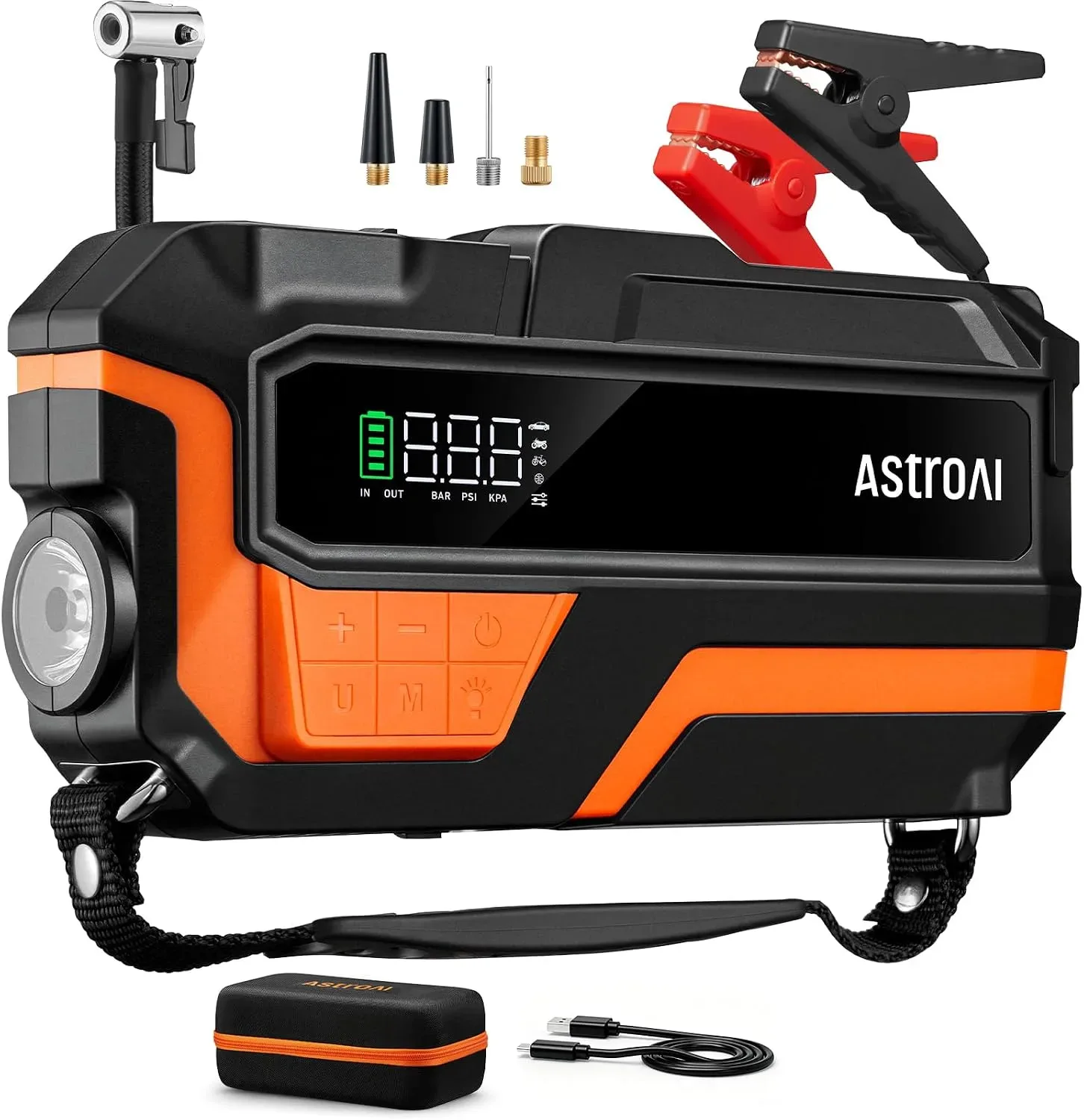
The hose is listed at 24 inches (60 cm), and the listing shows a standard screw-on chuck. Hose length decides whether you can reach all four valve stems without dragging the unit through dirt. Twenty-four inches is workable if you set the unit on the ground next to each tire, but it is not a long-reach hose. The screw-on chuck is secure but slower to attach and remove than a lever chuck—worth knowing if you fill tires often.
Battery capacity is listed at 10000 mAh, and the unit includes USB output for charging phones. That is a convenience spec, not a jump-starting spec. The listing also cites a built-in LED light and 10-layer protection with UL certification. Both are useful, but neither is a performance number. The price is $139.99 list, with a current price and historical low of $89.97. The product shows a 4.5-star rating from 2,575 ratings.
- 6,000A peak current (listing) — surge rating, not sustained cranking amps.
- 150 PSI max inflation pressure (listing) — enough ceiling for truck tires; listing gives one fill-time figure: 32→36 PSI in about one minute.
- 24-inch (60 cm) hose with screw-on chuck (listing) — reaches each tire if the unit sits on the ground; slower to attach than a lever chuck.
- 10000 mAh battery capacity and USB output (listing) — phone charging convenience, not a jump-starting measure.
- $139.99 list, $89.97 current and historical low (listing) — the low is the number to anchor on.
- 4.5-star rating from 2,575 ratings (listing) — a real sample, but still not a substitute for fill-time or CCA data.
AstroAI M10 6000A Car Jump Starter with Air Compressor
Highlights
- 12V portable inflator
- Manual watch-the-gauge fill
- About $139.99 list
- Category: jump-starters-with-inflator
Best for
- Trunk / glovebox emergency top-ups
- Cold-morning placard top-ups on cars and light SUVs
- Drivers who want a more durable weekly driver
Strengths
- 12V socket convenience without opening the hood
- Straightforward fill-and-check workflow with a separate gauge
- AstroAI build is aimed at repeated top-ups, not a one-weekend toy
- Fits the portable tire-inflator job: soft tire → placard, not shop compressor duty
Watch-outs · not ideal when
- Cigarette-lighter circuits can trip; check fuse / amperage on older vehicles
- Compressor gauges often read high — verify with a dedicated tire gauge
- Duty cycle / heat soak limits flat-to-full fills on large truck tires
- Heavier / bulkier than an ultra-compact emergency mini pump
Owner voices
Short takes from public retail reviews — paraphrased or translated when long or non-English; meaning kept close to the original.
“4/5 — E5 Error. And it's stuck on it. Just the light will work. This unit was great, jumped, compressor worked great with nice features. but the life of the unit is short. perhaps the 10th time I used this unit to jum…”
“5/5 — The AstroAI Jump Starter and Tyre Inflator is an excellent product and truly a must-buy for every car owner. The tyre inflator works really fast and does a superb job in pressurizing the tyres quickly and effici…”
“5/5 — This AstroAI jump starter and air compressor combo is one of those things you don't realize you need until you *really* need it. My husband got it for me, and honestly, I probably wouldn't have thought to buy it…”
Which numbers decide the purchase
If you are buying this for jump-starting, the peak amp number is the least useful figure on the page. The deciding factors are the clamp quality, the cable gauge, and whether the pack holds enough reserve to crank a cold engine more than once. None of those are fully specified. The listing gives you 6,000A peak and a 10-layer protection circuit, which tells you it is in the right class for a car or light truck, but it does not tell you how it behaves on the third attempt in winter.
For the inflator, the deciding number is not 150 PSI—it is fill time under your conditions. The listing gives one data point: 32 to 36 PSI in about one minute. That is useful for a passenger-car top-off. It does not tell you how long the pump takes to bring a 31-inch truck tire from 28 PSI to 50 PSI. The listing also states a duty cycle: cool down for at least 10 minutes after 10 minutes of continuous use. That is the spec that determines whether you can fill four truck tires in one session or need to pause between them. If fill speed is your priority, this spec sheet does not let you rank the M10 against a dedicated inflator.
The hose and chuck matter more than most shoppers expect. A 24-inch hose with a screw-on chuck means you will kneel and thread the chuck onto each valve stem. That is fine for occasional top-offs. If you check tire pressure weekly, a lever chuck and a longer hose reduce the friction enough to change how often you actually use the thing. The M10's listed hose length is adequate, not generous.
Battery capacity in mAh is a secondary spec for both functions. For jump-starting, the relevant measure is watt-hours or cranking reserve, not mAh. For inflation, runtime under load is what matters, and the listing gives a duty cycle rather than a runtime. The 10000 mAh figure is best read as a rough indicator of how many phone charges you get, not how many tires you can fill.
Priority order for this category: (1) jump-starting capability for your engine size, (2) inflator fill time and duty cycle, (3) hose length and chuck type, (4) noise, (5) battery capacity for accessories. The M10's listing gives you strong signals on (1) and (3), a partial signal on (2), and a misleading signal on (5).
- Jump-starting capability — clamp and cable quality plus reserve capacity decide this, not peak amps.
- Inflator fill time — listing gives 32→36 PSI in about one minute; truck-tire fill time is not published.
- Duty cycle — 10 minutes on, 10 minutes cool-down (listing); this caps how many tires you can do in one session.
- Hose length and chuck type — 24 inches and screw-on is adequate, not fast.
- Noise — no dB figure in the listing; owner reviews do not mention it.
- Battery capacity — 10000 mAh is a phone-charging spec, not a jump-starting or inflation spec.
Numbers that mislead
Peak amps are the biggest offender. A 6,000A peak rating sounds like it will start anything, but peak amps are measured at a momentary surge, often at the instant of connection. They are not comparable across brands because there is no standardized test protocol for consumer jump starters. One brand's 6,000A peak may deliver less sustained cranking current than another brand's 4,000A peak. Without a CCA or cranking-amps figure, the peak number is a class label, not a measurement you can rank.
Max PSI is the second misleading number. A 150 PSI ceiling tells you the pump can eventually reach that pressure, not how fast it gets there on a large tire or how long it can run before overheating. The listing does give a duty cycle—10 minutes on, 10 minutes off—which is more than most listings provide. But it still does not give CFM or a truck-tire fill time, so you cannot tell from the spec sheet whether the M10 is a one-tire top-off tool or a four-tire workhorse.
mAh is the third. Battery capacity in milliamp-hours is measured at a nominal voltage, and without that voltage the number is not directly comparable to watt-hours. Two packs with the same mAh at different voltages store different energy. For jump-starting, mAh is nearly irrelevant; for phone charging, it is a rough guide. Do not use mAh to compare this unit against a dedicated jump starter.
Finally, the 4.5-star rating deserves context. With 2,575 ratings, it is a real sample, not a handful of reviews. But ratings measure satisfaction across all uses, not the specific gaps that matter here—fill time on truck tires, cold-weather cranking, and noise. A high average does not fill those gaps.
- Peak amps — momentary surge, no standardized test, not comparable across brands.
- Max PSI — ceiling pressure, not fill speed on large tires; listing gives 32→36 PSI in about one minute and a 10-minute duty cycle.
- mAh — voltage-dependent, not a jump-starting measure.
- 4.5-star rating — 2,575 ratings is a real sample, but it does not answer fill-time, CCA, or noise questions.
What the data does not say
The listing does not publish CFM or a truck-tire fill time for the inflator. It gives one fill-time figure—32 to 36 PSI in about one minute—and a 10-minute duty cycle. Those are the numbers that determine whether the M10 is pleasant or frustrating to use on large tires. Without a CFM figure or a truck-tire time, you cannot calculate how long it takes to bring a 31-inch truck tire from 28 PSI to 50 PSI, or whether the pump will thermal-throttle halfway through. Owner reviews do not fill this gap either—the available review mentions using the inflator in the driveway and on the go, but gives no time, no tire size, and no pressure change.
The listing does not publish a dB rating for the compressor. Inflators are loud; that is expected. But without a dB figure or a review comment on noise, you cannot tell whether this one is merely loud or conversation-stopping loud. If you plan to fill tires early in the morning in a residential driveway, that is a real unknown.
The listing does not publish cranking amps or CCA for the jump starter. It gives peak amps and a 10-layer protection circuit. That means you cannot verify from the spec sheet whether the M10 will start a V8 truck engine in cold weather, only that it is marketed for that class. The one detailed owner review describes a family van with a draining battery, which is a lighter-duty scenario than a cold diesel or a large-displacement gas engine.
The listing does not specify the chuck type beyond what is visible in images, and it does not state whether the hose is replaceable. If the chuck fails or the hose cracks, replaceability affects the unit's lifespan. No review addresses this. These are genuine gaps, not things I can infer from the numbers provided.
- No CFM or truck-tire fill time published for the inflator; only 32→36 PSI in about one minute and a 10-minute duty cycle.
- No dB rating for the compressor.
- No cranking amps or CCA published for the jump starter.
- No confirmation of hose replaceability or chuck type beyond images.
Spec-based verdict
Buy the AstroAI M10 if you want one compact unit for occasional jump-starts and occasional tire top-offs, and you are willing to accept that the inflator's speed on large tires is unverified. The 150 PSI ceiling, 6,000A peak class, and 32→36 PSI in about one minute suggest it can handle a car or light truck, and the owner review supports family-vehicle use with a draining battery. At $89.97—the current price and historical low—it is a reasonable convenience buy. At $139.99 list, you are paying full price for specs that do not fully answer the truck-tire fill-time question.
Do not buy it if fill speed on large tires is your priority. The listing gives you no CFM or truck-tire fill-time figure, and no review supplies one. A dedicated inflator with a published CFM rating will be easier to rank and likely faster. Similarly, if you need to start a large diesel or a V8 in cold weather, the absence of a CCA rating means you cannot confirm the M10 is up to it from the spec sheet alone.
The filter is simple: (1) You need both functions in one box and value portability over peak inflator speed. (2) Your engine is a passenger car or light truck, not a heavy-duty diesel. (3) You are comfortable buying at or near the $89.97 low rather than $139.99 list. If all three hold, the spec sheet supports the purchase. If any one fails, the missing numbers—truck-tire fill time, CCA, noise—are exactly the ones you would need to see before spending.
- Buy if: you want jump-start and inflator in one portable unit for a car or light truck.
- Buy if: you can get it near the $89.97 current/historical low, not $139.99 list.
- Skip if: fill speed on large tires, cold-weather cranking, or noise are your deciding factors—those specs are unpublished.
What owners report
Themes below are paraphrased from Amazon owner reviews on file in Hub — not independent lab tests.
- AstroAI M10 6000A Car Jump Starter with Air Compressor: Nvel517 — 5 out of 5 stars, 'A Must-Have for Every Family Van,' reviewed June 1, 2026, Color: Orange, Verified Purchase. Describes a compact unit that packs a punch with both jump-starting and tire inflation; the biggest pro is how often the family van battery drains from tablets, GPS, and phone chargers, making it easy to get going again without waiting for help. Also mentions filling tires in the driveway and on the go, and calls the inflator a huge plus because it is portable.
Method and sources
This guide is built from product data and list prices pulled from Affiliate Hub at build time, together with owner feedback we summarize on the cards. It is catalog-backed buying help, not a lab ranking of every model.
Read how we test for the protocol behind any measured figures we still cite in Guides & Tips.