ARB E-Z Tire Deflator (ARB505) Review: Fast Air-Down
ARB E-Z Tire Deflator - PSI Gauge (ARB505) review: patented valve-core removal for fast air-down, 1 PSI increments, brass/stainless build, and owner feedback on trail speed.
ARB E-Z Tire Deflator (ARB505) review: fast air-down with a live PSI gauge
The ARB E-Z Tire Deflator - PSI Gauge (ARB505) is a mechanical air-down tool built around a patented design that removes the valve core to deflate at amplified speed while an incorporated sliding valve gives a precise pressure reading during the process. It is listed at $54.95 with a 4.7-star rating from 3063 ratings.
If you are matching PSI to terrain—sand, rock, or washboard—the ARB505 is aimed at getting you from street pressure to trail pressure without crouching at each tire with a separate gauge. Owner feedback backs that up: one reviewer with 31-inch tires reports lowering all four to 20 PSI in less than 15 minutes for beach driving.
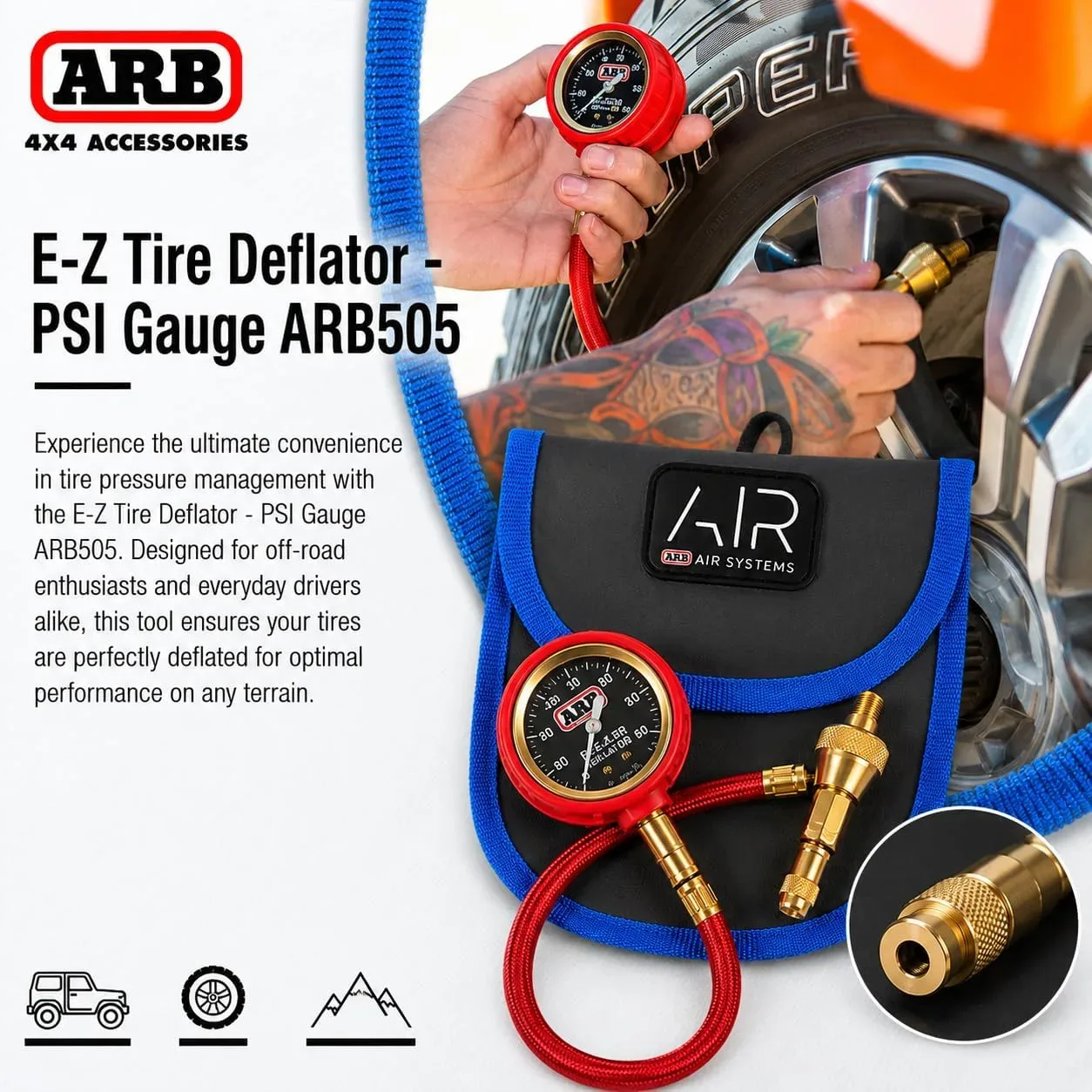
ARB E-Z Tire Deflator - PSI Gauge (ARB505)
Highlights
- Trail tire deflator
- Manual trail control
- On-tool gauge readout
- About $54.95 list
Best for
- Airing down one tire at a time at the trailhead
- Overlanders who already carry onboard or portable air
- Drivers OK watching the gauge while air dumps
Strengths
- Purpose-built for controlled air-down — faster than a bleed button on a check gauge
- On-tool gauge keeps PSI visible while you dump or fill
- ARB kit sits in the overland / recovery gear class rather than a glovebox pencil
- Fewer electronics to fail in dust and weather than a full digital manifold
Watch-outs · not ideal when
- Needs a plan to air back up — this is not a compressor
- One-tire tools are slower on a four-corner air-down
- Easy to overshoot target PSI if you walk away from a wide-open dump
- Trail abuse (sand, rocks, tossed in a drawer) wears seals and QDs over time
Owner voices
Short takes from public retail reviews — paraphrased or translated when long or non-English; meaning kept close to the original.
“5/5 — Works very well. I debated what to use for tire deflation for some time, and I did a lot of research. I am god that I went this way. The Currie version is made by the same folks. I compared my ARB to a friend's…”
“5/5 — I do regular offroading and need to air down my tires to about 15-22 PSI depending on the situation. I learned of these tire deflators while at the sand dunes as I watched someone else "air down" in a fraction o…”
“4/5 — I bought a cheaper knock-off version and now that it failed, I figure I might as well spend a little more on the ARB deflator. It’s really quick to air down my tires from 26 psi that I drive on the street to the…”
How the ARB505 airs down tires
The core of the tool is the valve-core removal handle. Pull the core and the tire deflates through the hose at a much higher rate than a standard gauge deflator. The sliding valve lets you watch the dial and stop at your target—no repeated check-and-bleed cycles.
The dial reads in 1 PSI increments, which matters when you are splitting the difference between, say, 12 PSI for soft sand and 20 PSI for a gravel road. The gauge connection swivels, so you can orient the dial toward you at any wheel position.
- Patented valve-core removal for amplified deflation speed
- Sliding valve provides a precise reading while deflating
- Easy-to-read dial with 1 PSI increments
- Full swivel gauge connection
- Flexible braided hose
- Corrosion-resistant brass and stainless construction
- Fully geared, solid brass precision movement
- Rubber gauge guard
- Includes protective canvas pouch and instruction sheet
Owner trail feedback: PSI and time savings
The most useful data points come from owners using the ARB505 to hit specific trail pressures. One 5-star reviewer who does regular off-roading airs down to 15–22 PSI depending on the situation and switched after watching someone else air down in a fraction of the time it took with a tire pressure gauge. A 4-star reviewer moved to the ARB after a cheaper knock-off failed, and reports going from 26 PSI street pressure to 12 PSI for the trail quickly.
Another 5-star owner with 31-inch tires says it takes less than 15 minutes to lower all four tires to 20 PSI—a concrete benchmark for beach and dune runs. A separate 5-star review notes the ARB and Currie versions are made by the same folks and that the two matched in comparison.
Build, materials, and what is in the box
ARB lists the ARB505 as a corrosion-resistant brass and stainless deflator tool with a fully geared, solid brass precision movement and a rubber gauge guard. The flexible braided hose and full swivel gauge connection are designed to keep the dial readable at awkward valve-stem angles.
The updated version ships with a gray and blue protective canvas pouch to keep dust and water off the tool, plus an instruction sheet. Item weight is 12 ounces and dimensions are 5 x 5 x 5 inches. UPC 881348006929; ASIN B004LQCDOA.
- Material: Brass
- Item weight: 12 ounces
- Dimensions: 5 x 5 x 5 inches
- Includes: protective canvas pouch and instruction sheet
- UPC: 881348006929
- ASIN: B004LQCDOA
Where the ARB505 fits in an overlanding kit
For trail reliability, the ARB505 is a mechanical tool with no batteries or digital calibration to worry about. The 1 PSI dial and valve-core removal method make it a strong match for drivers who air down often and want repeatable pressures—whether that is 12 PSI for sand, 15–22 PSI for general off-road, or 20 PSI for beach driving as owners report.
At $54.95 with a 4.7 rating from 3063 ratings, it sits in the spend-once category. If you are still using a standard gauge and crouching at each tire, the owner time savings above are the main argument for the ARB505.
Method and sources
This guide is built from product data and list prices pulled from Affiliate Hub at build time, together with owner feedback we summarize on the cards. It is catalog-backed buying help, not a lab ranking of every model.
Read how we test for the protocol behind any measured figures we still cite in Guides & Tips.