ALL-TOP 4-Tire Inflator: 150 PSI, 5.5 CFM Specs Decoded
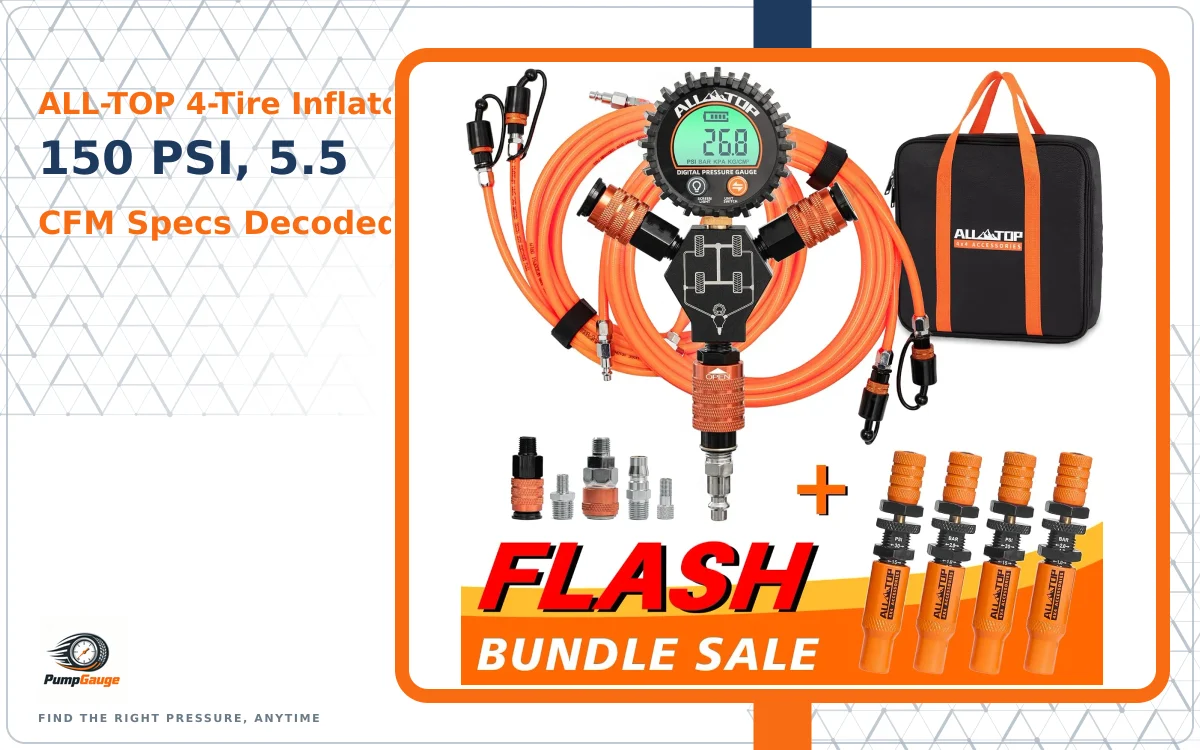
The ALL-TOP 4-tire system lists for $205.99 with no discount history and no owner reviews on file. I break down its published specs — 150 PSI, 5.5 CFM, 4-way hose, auto-stop deflator — and flag which numbers actually decide whether it fits your rig.
The Spec Sheet, Translated
The ALL-TOP 4 is a four-tire inflation and deflation kit: one compressor feeding a four-way hose manifold, plus an adjustable auto-stop deflator. The listing price is $205.99, and the tracked historical low is also $205.99 — meaning this SKU has not gone on sale since it was listed. There are no owner reviews on file, so nothing below is a field report. Every number is a published claim, not a measured result.
Here are the five parameters that carry the most weight, with the official value and what it actually means when you're kneeling in the dirt.
- 150 PSI maximum working pressure (listing). That's the ceiling, not the target. Most passenger tires want 32–38 PSI, light-truck tires 50–80 PSI. A 150 PSI rating means the pump has headroom to push past typical street pressures, but it says nothing about how fast it gets there. High max-PSI numbers are cheap to advertise and easy to inflate (pun intended).
- 5.5 CFM free-air flow (listing). Cubic feet per minute is the honest speed metric. 5.5 CFM is respectable for a portable 12V-class compressor — it's the kind of number that suggests a 35-inch tire from 15 to 35 PSI in a few minutes rather than ten. But 'free air' means at zero back-pressure. Real fill time at 35 PSI will be slower.
- Four-way hose with individual chucks (listing). One compressor, four tires at once. This is the feature that justifies the price premium over a single-chuck inflator. It also means longer total hose runs, which is where flow losses hide.
- Adjustable auto-stop deflator, 0–60 PSI range (listing). You set a target, it stops there. For off-road use, airing down from 35 to 18 PSI is the common move; a 0–60 PSI adjustable range covers that comfortably. The word 'adjustable' matters — fixed-pressure deflators only do one number.
- 12V DC power, alligator clips (listing). Draws from the vehicle battery. No internal battery, no cordless convenience. You're tethered to the hood.
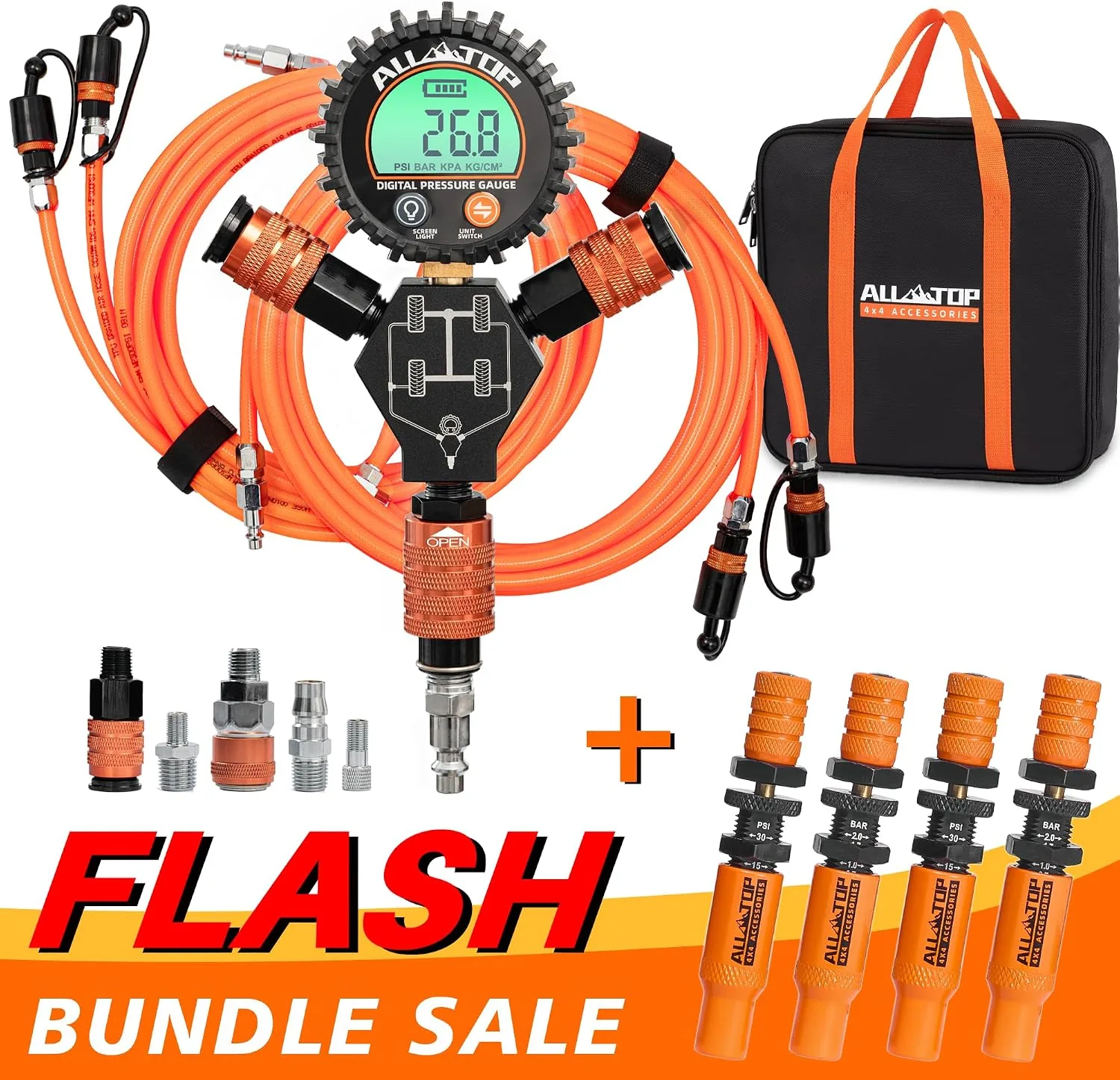
ALL-TOP 4 Tire Inflation & Deflation System with Adjustable Auto-Stop Tire Deflator
Highlights
- Multi-tire air-down / inflate kit
- Adjustable / auto-stop style
- Set-and-watch deflation
- About $205.99 list
Best for
- Airing four corners together on trail days
- Overlanders who already carry onboard or portable air
- Drivers who want a target PSI without babysitting every second
Strengths
- Moves multiple tires in one setup instead of walking the truck tire-by-tire
- Simple mechanical control once you learn the preset / valve rhythm
- This brand kit sits in the overland / recovery gear class rather than a glovebox pencil
- Auto-stop / adjustable designs reduce the “walk away and overshoot” risk
Watch-outs · not ideal when
- Needs a plan to air back up — this is not a compressor
- Hose spaghetti and setup time before the first dump
- Easy to overshoot target PSI if you walk away from a wide-open dump
- Trail abuse (sand, rocks, tossed in a drawer) wears seals and QDs over time
Which Numbers Decide the Purchase
If you're comparing this against a $60 single-tire inflator, the ranking below is the order I'd weigh things. It's not the order the listing presents them in.
- 1. Four-way hose architecture. This is the whole product. A four-tire manifold changes the job from twenty minutes of shuffling to one hookup and a walk away. If you don't need four tires at once, you're paying $205.99 for a feature you won't use.
- 2. CFM (5.5). Flow rate determines fill time more than PSI does. A 150 PSI pump with 2 CFM will lose to a 120 PSI pump with 5 CFM on a 33-inch tire every time. 5.5 CFM is the number that tells you this isn't a toy.
- 3. Auto-stop deflator range and adjustability. Airing down is half the job for off-roaders. A deflator that stops at your set pressure saves you from the crouch-check-crouch loop. The 0–60 PSI range is the spec to verify against your target pressures.
- 4. Hose length and chuck quality. Not always in the headline specs, but it decides whether you can reach all four valve stems without dragging the compressor. Cheap chucks leak at the stem and quietly add minutes.
- 5. Max PSI (150). Last, because it's the most oversold. Unless you're inflating heavy-truck tires to 110+ PSI, 150 is headroom you'll never touch.
Numbers That Mislead
Two figures on this listing are easy to read wrong, and one of them is the headline.
- 150 PSI max pressure. This is a burst/ceiling rating, not a working speed. It tells you the pump won't stall before street pressures, and nothing about how long it takes to get there. Cross-brand comparison of max PSI is close to meaningless — a 150 PSI unit and a 120 PSI unit can have identical real-world fill times if their CFM differs.
- 5.5 CFM free-air flow. 'Free air' means measured at atmospheric pressure with no restriction. Once you're pushing against 35 PSI in a tire, and through a four-way manifold with four chucks, effective flow drops. You cannot compare this 5.5 CFM to a competitor's 5.5 CFM unless both are rated the same way — and many budget listings quote peak or 'instantaneous' CFM instead. Treat cross-brand CFM as directional, not exact.
- Auto-stop deflator '0–60 PSI range.' The range is the span, not the accuracy. A deflator can cover 0–60 PSI and still stop 2–3 PSI off target. The listing doesn't publish a tolerance, so don't assume the number you set is the number you get.
What the Data Does Not Say
There are no owner reviews on file for this SKU, so the gaps below are genuinely open — I'm not going to fill them with guesses.
- Real fill time on a specific tire size. The listing gives CFM and PSI but no timed example. Without a review reporting '35x12.5 from 15 to 35 PSI in X minutes,' fill speed is an inference from flow rate, not a fact.
- Duty cycle and heat soak. No duty cycle is published. Portable compressors get hot; some are rated for continuous run, some need cooldowns. This matters if you're airing up four 35-inch tires back to back. The listing is silent.
- Noise level. No dB figure, and no reviews to report it. Inflators are loud; how loud this one is relative to a Viair or a Smittybilt is unknown.
- Deflator stop accuracy. No tolerance published, no user reports. You won't know if it stops at 18.0 or 20.5 PSI until you own it.
- Chuck and hose durability. No material specs on the chucks, no hose burst rating. These are the parts that fail first on budget kits, and there's no data here either way.
Spec-Based Verdict
With no reviews and no discount history, this is a buy-on-spec decision. The specs support a specific buyer and exclude a few others.
- Buy if you air down and air up four tires regularly. The four-way manifold plus adjustable auto-stop deflator is the entire value proposition. If you're doing that routine monthly, $205.99 is defensible against the time saved.
- Buy if your target pressures fall inside 0–60 PSI and your tire sizes are 33 inches or larger. The 5.5 CFM flow rate is sized for truck and off-road tires, not for topping off a sedan.
- Skip if you need one tire topped off occasionally. A $40–$70 single-chuck 12V inflator does that job, and you'd be paying triple for a manifold you'll never hook up.
- Skip if you need cordless convenience or quiet operation. This is a 12V tethered unit with no published noise figure — assume it's loud and plan accordingly.
Method and sources
This guide is built from product data and list prices pulled from Affiliate Hub at build time, together with owner feedback we summarize on the cards. It is catalog-backed buying help, not a lab ranking of every model.
Read how we test for the protocol behind any measured figures we still cite in Guides & Tips.