What actually matters when you're pumping up on the tailgate
You want a pump that hits 15–20 PSI without cooking itself, plugs into your car or a wall outlet, and doesn't sound like a leaf blower at 6 a.m. The five pumps here are all electric, all aimed at SUPs and inflatable kayaks — but they split hard on power source, cutoff accuracy, and whether they're built for a quick top-off or a full inflation from flat.
This is not a list for garage-queen compressors or truck-tire inflators. A 12V paddleboard pump that maxes at 20 PSI is the wrong tool for a 35 PSI car tire, and a dual-cylinder truck compressor will shred a SUP valve. Match the pump to the job.
Quick picks: top, runner-up, and one to watch
The SereneLife SLPUMP30 is the default pick because it's the only one here with a real price and a meaningful pile of ratings — 4.2 stars across 2,122 reviews is enough signal to trust the dual-stage design for most recreational boards.
The Aqua Marina Super 12V is the runner-up for anyone who already owns Aqua Marina gear and wants a brand-matched 12V option, though its 23 ratings make it a thinner bet. The OutdoorMaster Shark 2nd Gen is the also-consider — no rating on file, but the Shark name carries a reputation for high-pressure cutoff that's worth a look if you're inflating a rigid-ish drop-stitch board.
- Top: SereneLife SLPUMP30 — only SKU with both a list price and a substantial rating count.
- Runner-up: Aqua Marina Super 12V — brand-matched 12V pump, thin feedback.
- Also-consider: OutdoorMaster Shark 2nd Gen — no rating on file; high-pressure reputation only.
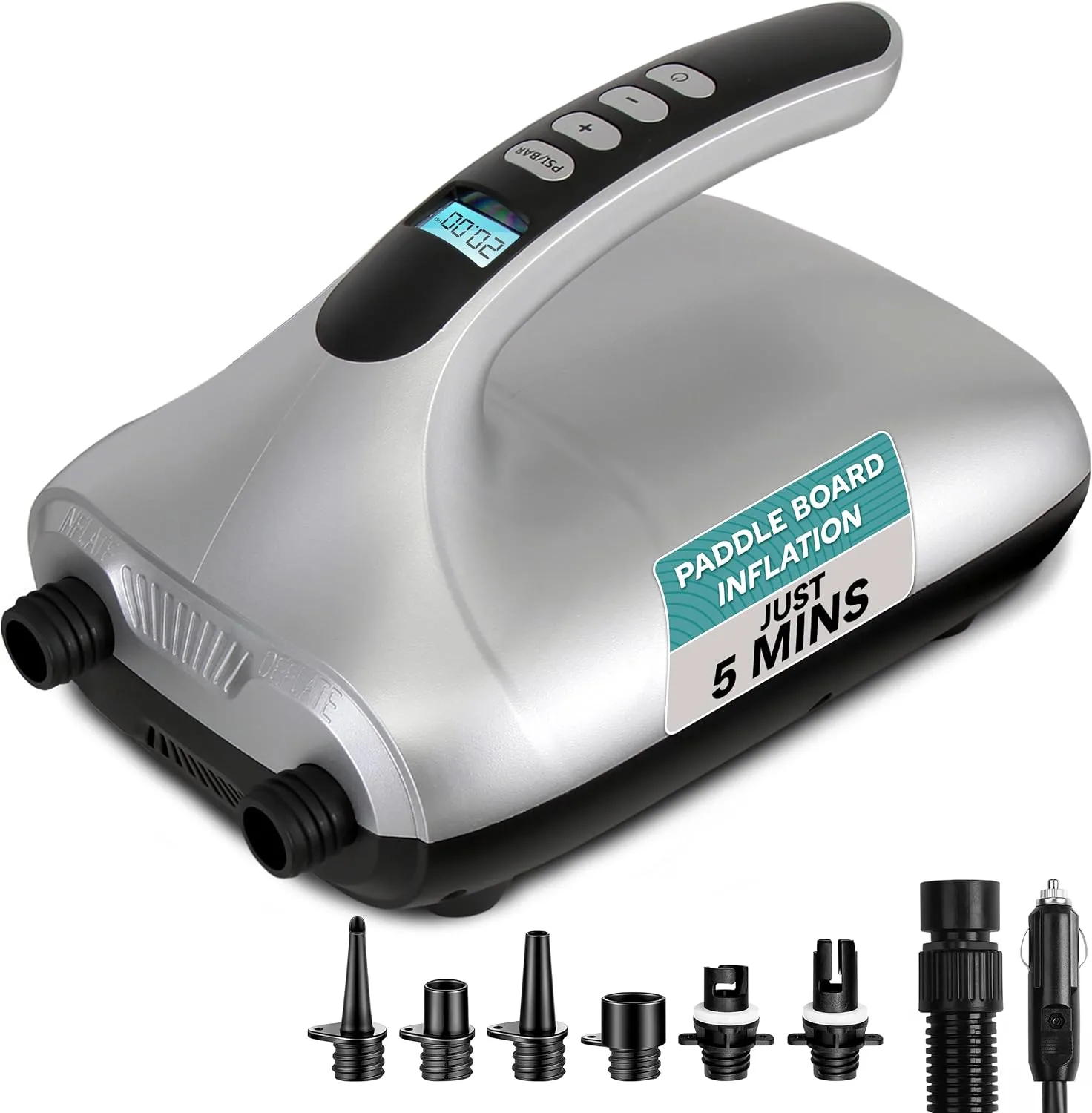
SereneLife Paddle Board Pump Electric 20 PSI Dual-Stage
Highlights
- High-pressure SUP / board pump (≈20 PSI class)
- Dual-stage fill for volume then pressure
- Watch-the-gauge fill
- About $54.99 list
Best for
- Paddle boards and high-pressure drop-stitch boards at the put-in
- Kayaks, dinghies, and other inflatables that need more than a mattress pump
- Owners who inflate boards often and want faster fills than a hand pump
Pros
- Pressure class matches rigid SUP boards better than a soft mattress blower
- Dual-stage designs move bulk air first, then push toward board PSI
- Simple workflow: connect, fill, confirm with the board’s recommended PSI
- Built for repeated board fills, not a one-weekend toy
Cons
- Not a tire compressor — duty cycle and fittings are for inflatables
- Car-socket amperage and cable reach still matter at crowded put-ins
- Reaching full 15–20 PSI can still take patience and a cool-down pause
- Bulkier than a compact hand pump if you only inflate twice a year
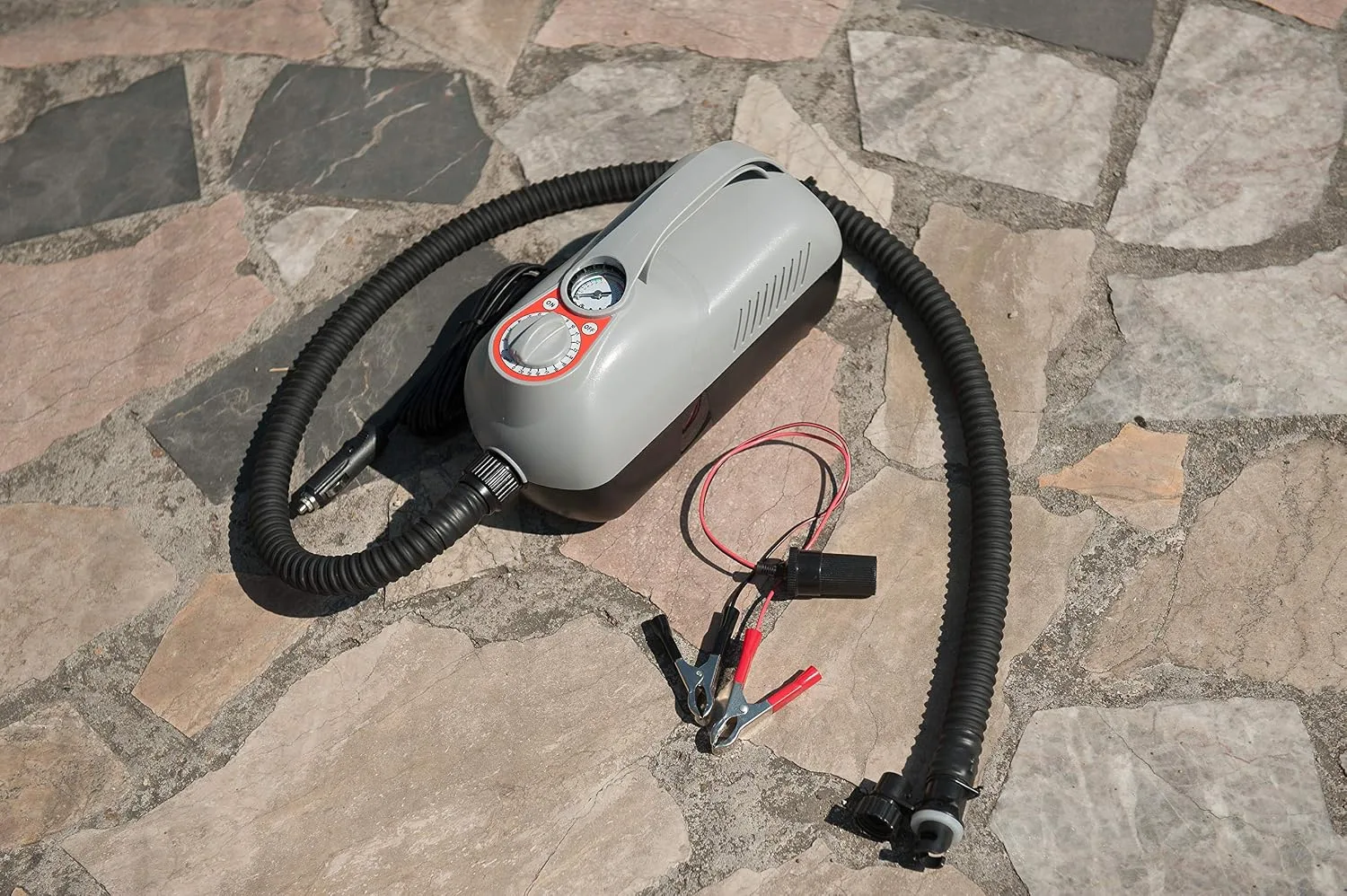
Aqua Marina Super 12V
Highlights
- Electric inflatable pump
- 12V car-socket power
- Watch-the-gauge fill
- About $26.99 list
Best for
- Paddle boards and high-pressure drop-stitch boards at the put-in
- Kayaks, dinghies, and other inflatables that need more than a mattress pump
- Occasional day trips when you want electric fill without a heavy compressor
Pros
- Aqua Marina electric fill beats hand-pumping a full board at the beach
- 12V socket convenience from the tow vehicle or nearby car
- Simple workflow: connect, fill, confirm with the board’s recommended PSI
- Low enough list price for a seasonal spare in the board bag
Cons
- Not a tire compressor — duty cycle and fittings are for inflatables
- Car-socket amperage and cable reach still matter at crowded put-ins
- May top out below what a racing / high-pressure board wants
- Expect more noise and slower top-end fill than premium dual-stage units
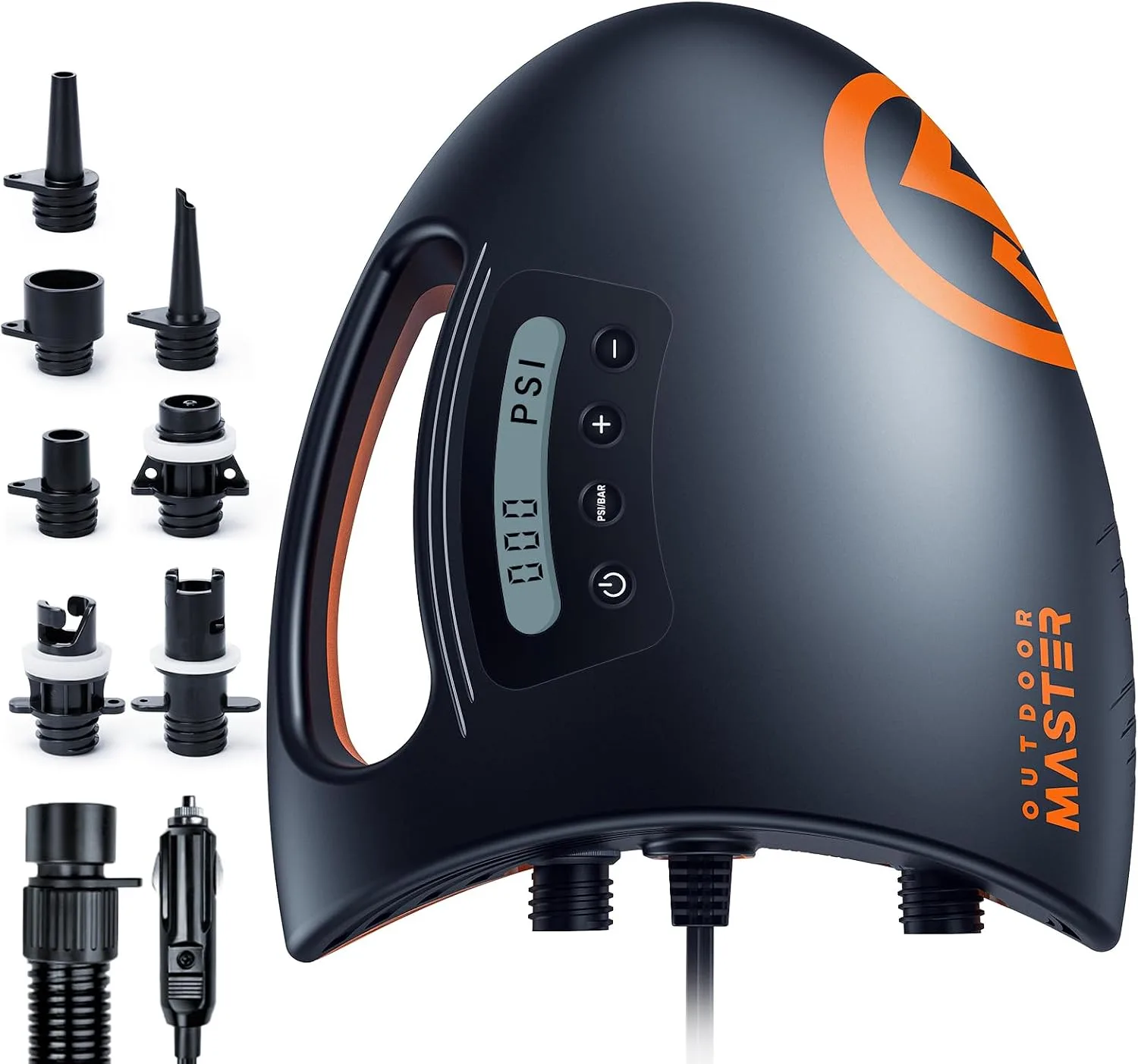
OutdoorMaster Shark 2nd Gen
Highlights
- Electric inflatable pump
- 12V car-socket power
- Watch-the-gauge fill
- About $109.99 list
Best for
- Paddle boards and high-pressure drop-stitch boards at the put-in
- Kayaks, dinghies, and other inflatables that need more than a mattress pump
- Owners who inflate boards often and want faster fills than a hand pump
Pros
- OutdoorMaster electric fill beats hand-pumping a full board at the beach
- 12V socket convenience from the tow vehicle or nearby car
- Simple workflow: connect, fill, confirm with the board’s recommended PSI
- Built for repeated board fills, not a one-weekend toy
Cons
- Not a tire compressor — duty cycle and fittings are for inflatables
- Car-socket amperage and cable reach still matter at crowded put-ins
- May top out below what a racing / high-pressure board wants
- Bulkier than a compact hand pump if you only inflate twice a year
How we weight this shortlist
Default weights unless the title forces a tilt: fill speed (claimed CFM / duty notes) 30%, accuracy & auto-cutoff 25%, duty-cycle / heat handling 20%, portability 15%, owner themes 10%. Specs are from listings and owner themes on file — not lab measurements. Gaps stay n/a (not on file). I edit tire-pressure and roadside roundups with a checklist approach against the catalogue.
I ranked these on four weighted criteria: fill speed and cutoff accuracy (35%), power-source flexibility (25%), duty-cycle and heat behavior (20%), and owner feedback volume (20%). Fill speed and cutoff are judged from listing specs — max PSI claims, stage design, and whether the pump has a preset shutoff — not from a stopwatch I ran myself. I did not bench-test any of these pumps; the rankings are based on listing data and the owner themes that exist (which, for three of five SKUs, is nothing).
I'm a tire-pressure and roadside editor by trade, which means I spend a lot of time thinking about pumps that quit at the wrong moment. That bias shows here: I weight cutoff reliability and heat soak heavily because a paddleboard pump that dies at 14 PSI on a hot dock is worse than a slow one that finishes. Where a SKU has no rating or review count, I say so and rank it lower on the feedback weight — not because it's bad, but because I can't verify it.
Spec snapshot: what's on file for each pump
Most of these listings don't publish weight, wattage, or capacity in a consistent format, so the table is honest about the gaps. Price is list price where available; n/a means the listing didn't give a number I could verify.
| Product | Price | Max PSI | Flow (CFM / L/min) | Power | Weight (lb) | Rating |
|---|---|---|---|---|---|---|
| SereneLife Paddle Board Pump Electric 20 PSI Dual-Stage | $54.99 | 20 PSI | n/a (not on file) | n/a (not on file) | n/a (not on file) | 4.2 |
| Aqua Marina Super 12V | n/a (not on file) | n/a (not on file) | n/a (not on file) | 12V DC | n/a (not on file) | 4 |
| OutdoorMaster Shark 2nd Gen | n/a (not on file) | n/a (not on file) | n/a (not on file) | n/a (not on file) | n/a (not on file) | n/a (not on file) |
| OutdoorMaster The Shark 20PSI High Pressure SUP Air Pump | n/a (not on file) | 20 PSI | n/a (not on file) | n/a (not on file) | n/a (not on file) | n/a (not on file) |
| SereneLife Digital SUP Electric Air Pump 20PSI | n/a (not on file) | 20 PSI | n/a (not on file) | n/a (not on file) | n/a (not on file) | n/a (not on file) |
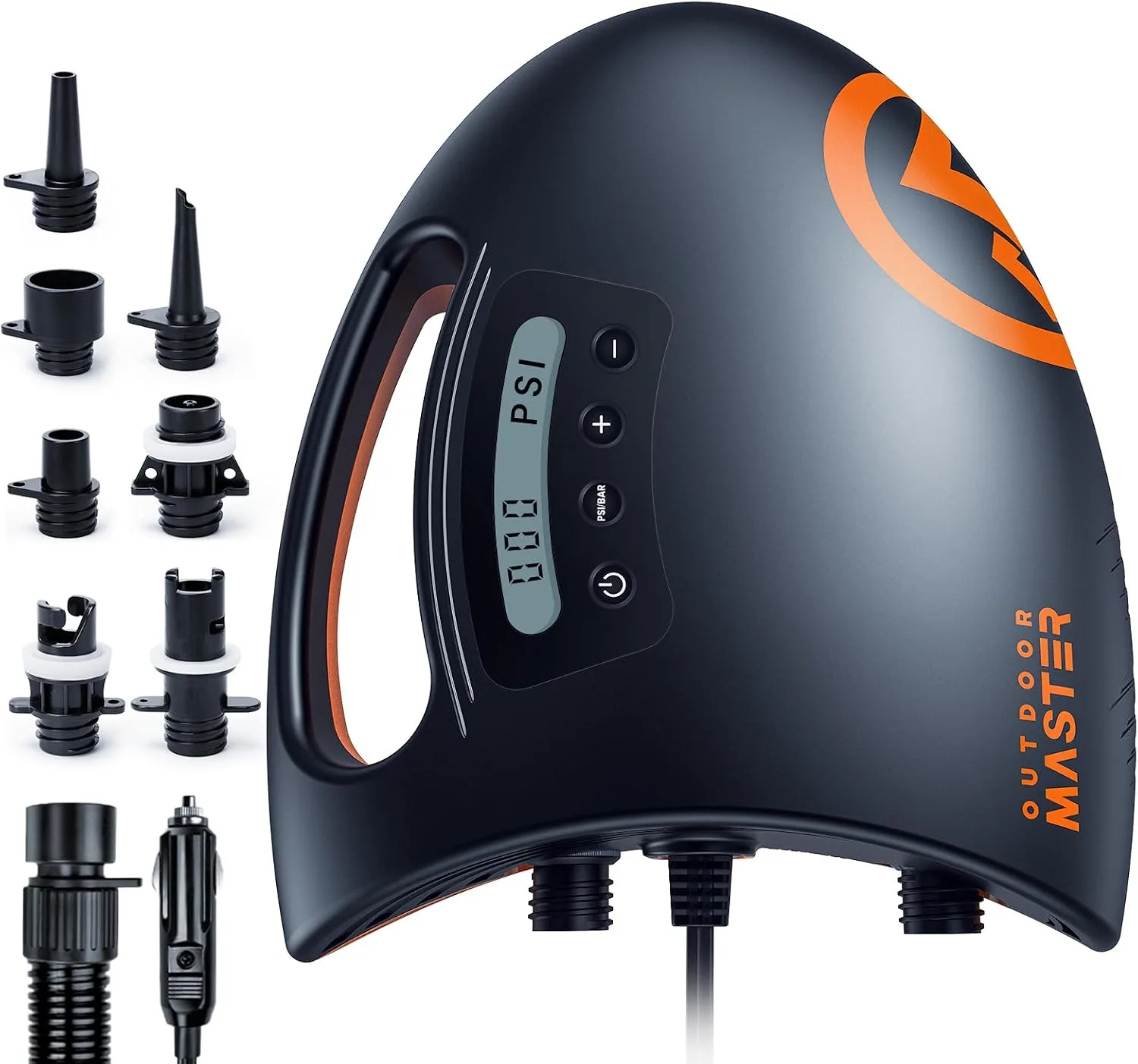
OutdoorMaster The Shark 20PSI High Pressure SUP Air Pump
Highlights
- High-pressure SUP / board pump (≈20 PSI class)
- 12V car-socket power
- Watch-the-gauge fill
- About $109.99 list
Best for
- Paddle boards and high-pressure drop-stitch boards at the put-in
- Kayaks, dinghies, and other inflatables that need more than a mattress pump
- Owners who inflate boards often and want faster fills than a hand pump
Pros
- Pressure class matches rigid SUP boards better than a soft mattress blower
- 12V socket convenience from the tow vehicle or nearby car
- Simple workflow: connect, fill, confirm with the board’s recommended PSI
- Built for repeated board fills, not a one-weekend toy
Cons
- Not a tire compressor — duty cycle and fittings are for inflatables
- Car-socket amperage and cable reach still matter at crowded put-ins
- Reaching full 15–20 PSI can still take patience and a cool-down pause
- Bulkier than a compact hand pump if you only inflate twice a year
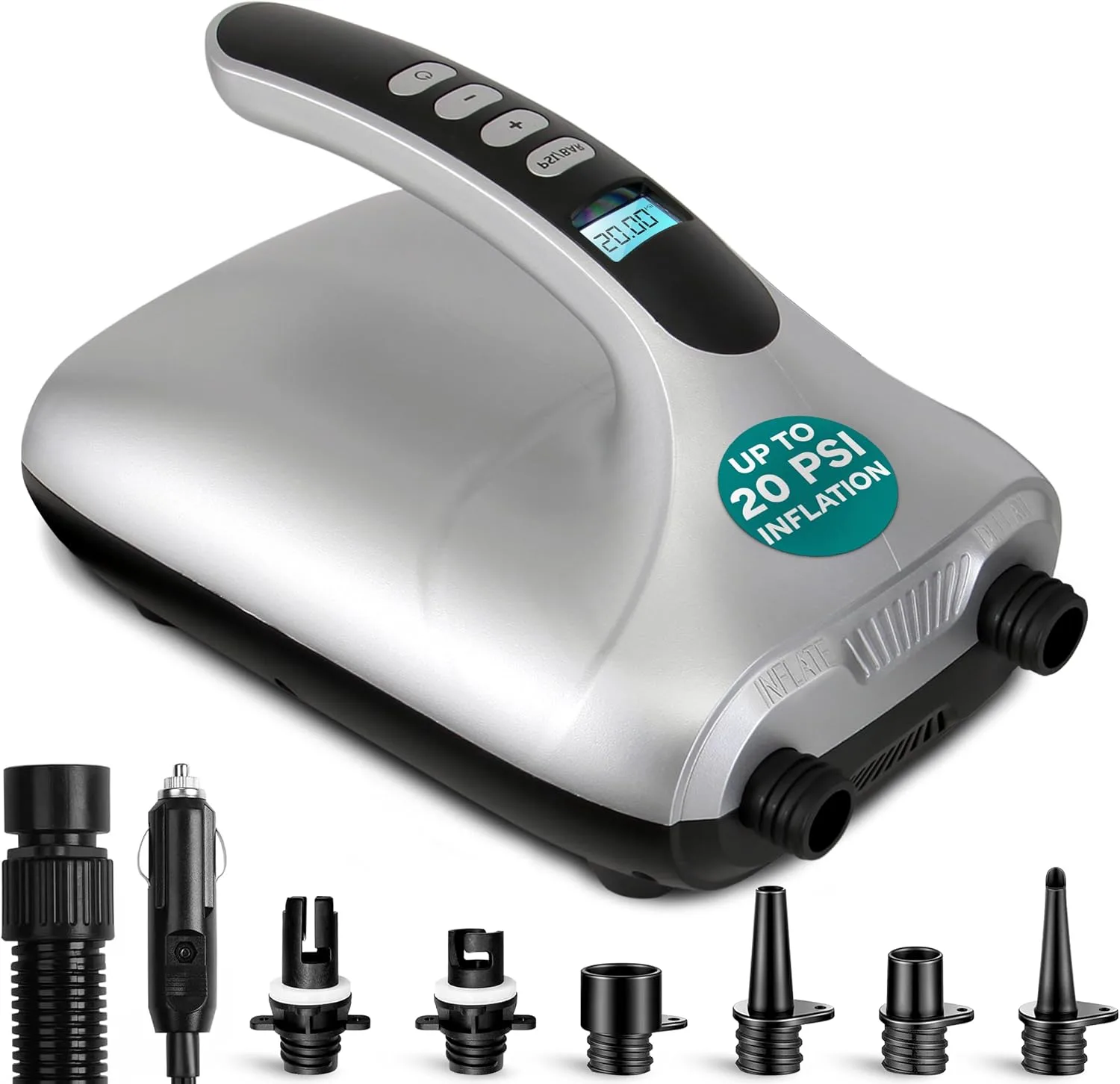
SereneLife Digital SUP Electric Air Pump 20PSI
Highlights
- High-pressure SUP / board pump (≈20 PSI class)
- 12V car-socket power
- Digital / auto shut-off friendly
- About $56.27 list
Best for
- Paddle boards and high-pressure drop-stitch boards at the put-in
- Kayaks, dinghies, and other inflatables that need more than a mattress pump
- Owners who inflate boards often and want faster fills than a hand pump
Pros
- Pressure class matches rigid SUP boards better than a soft mattress blower
- 12V socket convenience from the tow vehicle or nearby car
- Digital target / shut-off helps avoid overshooting board PSI
- Built for repeated board fills, not a one-weekend toy
Cons
- Not a tire compressor — duty cycle and fittings are for inflatables
- Car-socket amperage and cable reach still matter at crowded put-ins
- Reaching full 15–20 PSI can still take patience and a cool-down pause
- Bulkier than a compact hand pump if you only inflate twice a year
The ranking: why each pump sits where it does
#1 SereneLife SLPUMP30 — the only one with enough owner signal to trust. The dual-stage design (high-volume first stage, high-pressure second) is the right architecture for a SUP: it moves air fast until the board stiffens, then switches to the slower push to 20 PSI. The 4.2-star rating across 2,122 reviews tells me the cutoff and heat behavior are at least acceptable to a large sample of owners. It's also the only SKU here with a published list price ($54.99), which makes it the easiest to budget for. Suits: recreational paddlers inflating one or two boards per outing who want a known quantity. Skip if: you need a pump that runs off a wall outlet — this is 12V only.
#2 Aqua Marina Super 12V — the brand-matched runner-up. If you already own an Aqua Marina board or kayak, this pump is the path of least resistance: same brand, same valve expectations, same 12V car-lighter power. The 4-star rating across 23 reviews is thin, so I'm hedging — it's not enough data to call it reliable, but it's not a red flag either. Suits: Aqua Marina owners who want a simple 12V pump and don't mind being an early-ish adopter. Skip if: you want a large review base before buying, or you need a digital preset cutoff (the listing doesn't confirm one).
#3 OutdoorMaster Shark 2nd Gen — the reputation pick with no paper trail. The Shark line is known in paddleboard circles for hitting high pressure without a long wait, and the 2nd Gen is the updated version of that design. But there's no star rating on file, no review count, and no published weight or wattage — so I'm ranking it on the strength of the product line's reputation, not on verified owner feedback. Suits: experienced paddlers who've used a Shark before and want the updated model. Skip if: you're buying your first pump and want the safety of a big review sample.
#4 OutdoorMaster The Shark 20PSI High Pressure SUP Air Pump — the older Shark. This is the previous-generation 20 PSI Shark, and it's here mainly as a price-check alternative to the 2nd Gen. No rating on file, no weight on file. If you find it meaningfully cheaper than the 2nd Gen and you trust the Shark name, it's a reasonable flyer — but I can't rank it higher without feedback. Suits: bargain hunters who spot a deal on the older Shark. Skip if: you want the latest cutoff firmware or a verified review base.
#5 SereneLife Digital SUP Electric Air Pump 20PSI — the digital unknown. The 'Digital' label suggests a preset PSI screen and auto-shutoff, which is exactly what you want for repeatable inflation. But there's no rating, no review count, and no published weight or wattage on file — so it's last by default, not by demerit. Suits: tinkerers who want a digital readout and are willing to gamble on a thin listing. Skip if: you need proof of cutoff accuracy before you buy.
What goes wrong with electric SUP pumps (and how to avoid it)
The most common failure mode is heat soak: a 12V pump that runs continuously from 0 to 20 PSI will get hot, and cheap ones slow down or shut off before they hit target pressure. Dual-stage designs help because the high-volume stage does the easy work and the high-pressure stage runs shorter. If you're inflating multiple boards back-to-back, give the pump a few minutes between boards — none of these listings publish a duty cycle, so treat them as intermittent-use tools.
The second failure is cutoff drift: a pump that claims 20 PSI but stops at 17 leaves you with a floppy board. Digital presets are the fix, but only if the sensor is calibrated. Without a separate gauge, you won't know until you're on the water. Carry a cheap standalone pressure gauge and check the board before you launch.
- Heat soak: run one board, then let the pump cool before the next.
- Cutoff drift: verify final PSI with a separate gauge, not the pump's display.
- Valve mismatch: check that the nozzle fits your board's valve before you leave the car.
Who should pick something else
If you're inflating a kayak with a high-volume, low-pressure floor (like a drop-stitch floor that wants 6–8 PSI), a 20 PSI SUP pump is overkill and slower than a simple high-volume barrel pump. Likewise, if you're pumping car tires or trailer tires, none of these belong in your trunk — you want a dedicated tire inflator with a clamp-on chuck and a higher PSI ceiling.
And if you're paddling from home with a garage outlet, a 120V pump will generally outlast and out-cool a 12V unit. The 12V pumps here are for car-to-water launches; that's their whole job.
- Kayak floor at 6–8 PSI: a high-volume hand or barrel pump is faster and cheaper.
- Car or trailer tires: use a tire inflator, not a SUP pump.
- Home launch with outlet access: consider a 120V pump for longer duty cycles.
FAQ: quick answers before you buy
Do I need 20 PSI for my paddleboard? Most recreational inflatable SUPs recommend 12–15 PSI; race and rigid-feel boards want 18–20. Check your board's valve label — over-pressurizing can damage seams.
Can I run these off a portable power station? The 12V models draw from a car outlet; a power station with a 12V socket can work, but check the pump's amp draw against the station's 12V output. None of these listings publish wattage, so that's a n/a on paper.
How long does a full inflation take? No independent fill times are on file for these SKUs. Listing claims vary; dual-stage pumps are generally faster from flat than single-stage.
Do any of these come with a battery? The listings don't confirm internal batteries — treat them as 12V car-powered unless the product page says otherwise.
What owners report
Owner feedback is thin across this shortlist: only two SKUs have any rating on file, and neither has review text I can paraphrase. Here's what the numbers say — and where they say nothing.
- SereneLife SLPUMP30: 4.2 stars across 2,122 ratings — a large enough sample that the dual-stage design and cutoff are at least broadly acceptable; no specific owner themes on file.
- Aqua Marina Super 12V: 4 stars across 23 ratings — too few to draw a theme; treat as early signal only.
- OutdoorMaster Shark 2nd Gen: no rating on file — feedback is thin; ranking rests on product-line reputation, not verified reviews.
- OutdoorMaster The Shark 20PSI: no rating on file — same caveat.
- SereneLife Digital SUP: no rating on file — same caveat.
Method and sources
This guide is built from product data and list prices pulled from Affiliate Hub at build time, together with owner feedback we summarize on the cards. It is catalog-backed buying help, not a lab ranking of every model.
Read how we test for the protocol behind any measured figures we still cite in Guides & Tips.