How to Set the Right Tire Pressure (Without Guessing)
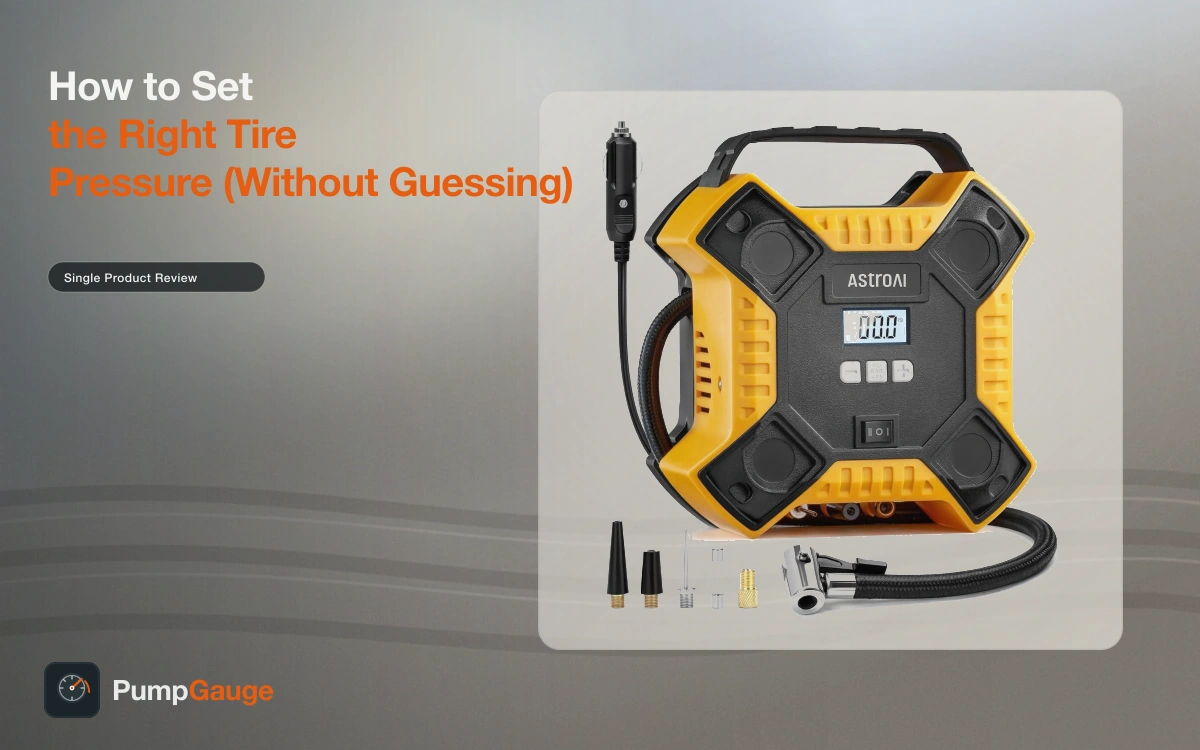
The number on your tire sidewall is a ceiling, not a target. Here's how to find the real PSI for your car, measure it cold, and use a 12V inflator without cooking it.
What you're actually trying to do
As an Amazon Associate I earn from qualifying purchases. Recommendations here are based on fit and the evidence below — not commission size.
You're not trying to hit a number you saw on a forum. You're trying to put each tire at the pressure the vehicle manufacturer specifies for the load you're carrying — and to do it when the tire is cold, so the reading means something.
Success looks like this: all four tires within a pound or two of the door-jamb spec, measured before you've driven more than a mile, with a gauge you trust. That's it. The tire sidewall's max PSI is a limit, not a recommendation, and treating it as a target is how people end up with a hard, skittish ride and uneven wear.
- Target: placard PSI, cold, all four tires matched.
- Not the goal: sidewall max pressure, or a 'feel' guess.
- This guide is not a buying ranking — it's a method. Tools are mentioned only as examples.
Find the right number (two sources, one winner)
Open the driver's door and look at the jamb — the placard there lists front and rear PSI for normal load, and often a higher rear figure for full cargo. That placard is the manufacturer's spec for your exact vehicle. The owner's manual repeats it and may add a towing or heavy-load column.
The tire sidewall is the second source, and it's the one people misread. 'Max 44 PSI' or 'Max 51 PSI' means do not exceed that when cold — it does not mean inflate to it. Use the sidewall number only as a ceiling, and only when the placard is missing (older trailers, some aftermarket wheels).
- Primary: door-jamb placard (front/rear, normal vs. loaded).
- Secondary: owner's manual, especially for towing columns.
- Ceiling only: tire sidewall max PSI — never the default target.
Measure cold — the numbered routine
Cold means the car has sat at least three hours, or you've driven less than a mile. Sun on one side counts for less than people think, but direct summer heat on dark pavement can nudge a reading a pound or two. Morning before a drive is the cleanest window.
Here's the routine I use, and it's the one that keeps readings comparable week to week:
- 1. Park on level ground, engine off, parking brake set.
- 2. Remove the valve cap and keep it where you can find it.
- 3. Press the gauge straight onto the valve — a short hiss is normal; a long one means you're crooked.
- 4. Read and write down each tire's PSI (yes, write it down).
- 5. Compare to the placard, note the gap per tire.
- 6. Inflate or bleed to spec, re-check, then cap.
Adjust with an inflator or gauge — and don't cook it
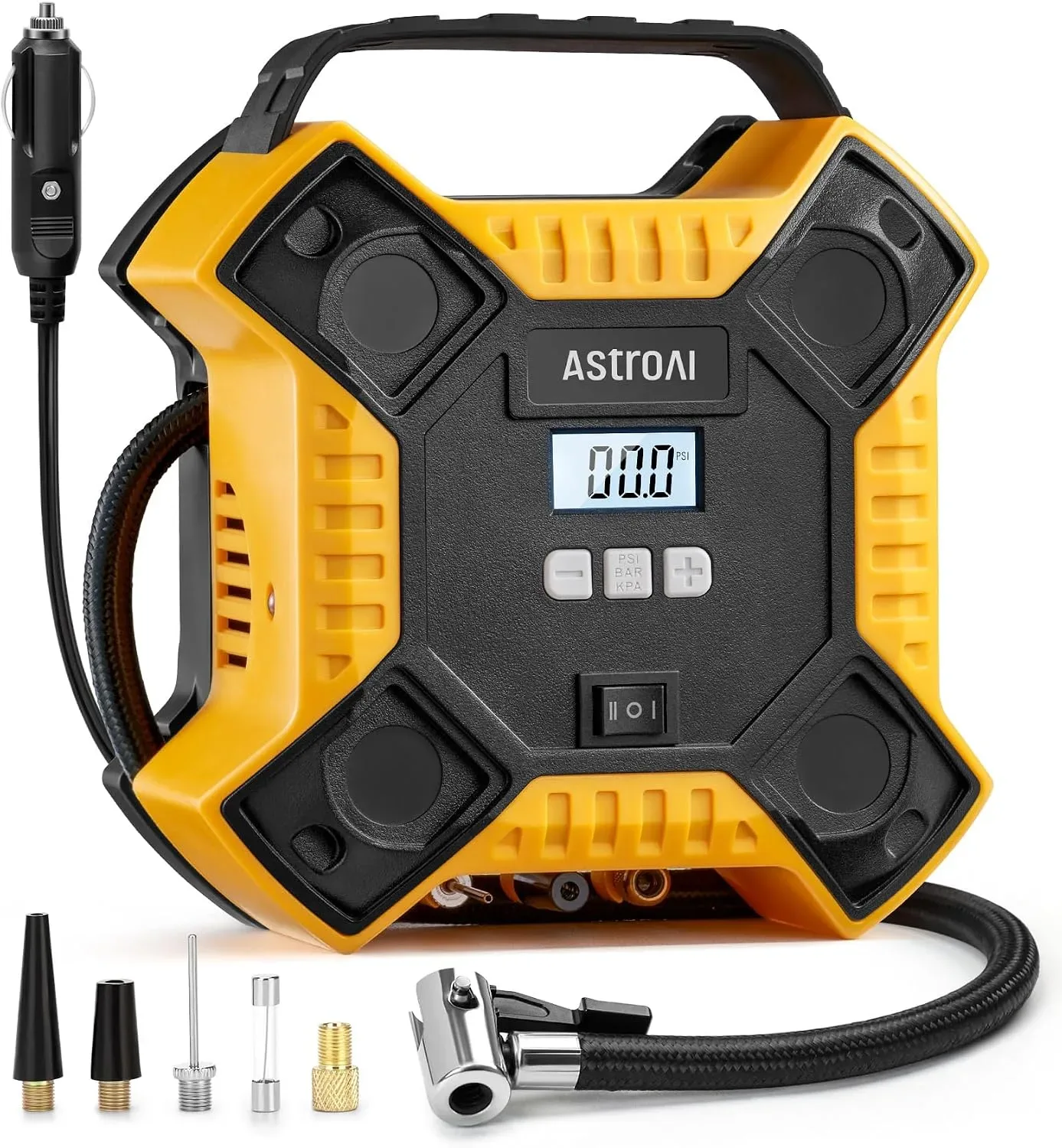
A 12V inflator like the AstroAI 160PSI Tire Inflator Portable Air Compressor 12V DC Metal (listing: 160 PSI max, 2.7 lb, 10 ft cord, 65 dB, $34.12) is a top-off tool, not a shop compressor. Set the target on the LCD, let auto-shutoff do the work, and keep the engine running so you're not draining the battery through the socket.
The safety note that matters: heat. The listing claims up to 20 minutes of continuous operation and four 195/55/R15 tires from 0 to 35 PSI in one session — but owners report the unit gets hot and loud near 38–40 PSI, and one 3-star reviewer said it sounded like it was going to blow up at that point. Treat the duty cycle as a ceiling, not a challenge. If the body is too hot to hold comfortably, stop and let it cool.
- Set target PSI, start, and let auto-shutoff finish — don't babysit the trigger.
- Engine running while plugged into the 12V socket.
- Pause between tires if the pump body gets hot; never exceed the listed continuous run.
- Bleed overshoot with the gauge's bleed button, not by loosening the chuck.
Supporting tool
Astro AI 160PSI Tire Inflator Portable Air Compressor 12V DC Metal Cylinder Auto
Highlights
- CLEAR LCD DISPLAY & BRIGHT LED LIGHT: No more guessing your tire pressure. The large LCD screen clearly displays three common pressure units, PSI, KPA, and BAR, so you can easily monitor and adjust pressure with confidence, even if you are a beginner. The built-in LED light adds extra convenience in low-light situations, whether you are inflating a flat tire at night, checking tire pressure in a dark garage, or using this car tire air pump portable as an emergency light during a power outage.
- TOUGHULTRA FOR RUGGED DURABILITY: Astro AI Tough Ultra Technology uses an integrated powder metallurgy molding process to create a stronger cylinder, motor gear, and connecting rod, improving the tire inflator’s service life by 30%. It is built to handle frequent use, rough vehicle storage, and extreme outdoor conditions, so you can count on long-lasting reliability. This car tire inflator dependable performance also makes it a thoughtful gift option for family and friends.
- PORTABLE & COMPACT: It takes up small space in your car’s glove box or trunk, so it is always within reach when you need it. The 10ft(3 meter)power cord stores neatly inside the unit, and all accessories fit into the pump, so there are no loose parts to misplace. Whether you need to top off tire pressure before a long drive or inflate balls for a family outing, it is always ready to help. It is a must-have car accessory for drivers, helping ensure you are never caught off guard by a low tire.
Strengths
- CLEAR LCD DISPLAY & BRIGHT LED LIGHT: No more guessing your tire pressure. The large LCD screen clearly displays three common pressure units, PSI, KPA, and BAR, so you can easily monitor and adjust pressure with confidence, even if you are a beginner. The built-in LED light adds extra convenience in low-light situations, whether you are inflating a flat tire at night, checking tire pressure in a dark garage, or using this car tire air pump portable as an emergency light during a power outage.
- TOUGHULTRA FOR RUGGED DURABILITY: Astro AI Tough Ultra Technology uses an integrated powder metallurgy molding process to create a stronger cylinder, motor gear, and connecting rod, improving the tire inflator’s service life by 30%. It is built to handle frequent use, rough vehicle storage, and extreme outdoor conditions, so you can count on long-lasting reliability. This car tire inflator dependable performance also makes it a thoughtful gift option for family and friends.
- PORTABLE & COMPACT: It takes up small space in your car’s glove box or trunk, so it is always within reach when you need it. The 10ft(3 meter)power cord stores neatly inside the unit, and all accessories fit into the pump, so there are no loose parts to misplace. Whether you need to top off tire pressure before a long drive or inflate balls for a family outing, it is always ready to help. It is a must-have car accessory for drivers, helping ensure you are never caught off guard by a low tire.
Watch-outs
- Specs and fitment vary by vehicle — check hose and plug type
Owner voice
- “5/5 — Llegó cuando me lo programaron y iba en su caja perfectamente. Lo he utilizado de momento en 6 ruedas. Tengo también el inflador , desde hace más de dos años, pequeño de Michelín 009518 Mini compresor digital para coche de 12 V, 3,5 bares…” — paraphrased from public reviews
- “5/5 — This is a wonderful and powerful little compressor! Slides on and off of the valve stems effortlessly and the light is very handy when using in dimly lit areas. The cord is long enough to reach front and back tires on my Honda Civic. The a…” — paraphrased from public reviews
- “4/5 — Winter in the midwest leads to tires that are constantly underinflated, so this has been a great tool to have. It plugs into the car power port, so easy to pack in the trunk and take along without having to maintain a charge. I wish it fil…” — paraphrased from public reviews
- “3/5 — 160 PSI ??? You get to 38 pounds and it sounds like it's going to blow up. But I was able to get 4 tires to 40psi , in the winter. FYI: All these pumps tell not to get them hot. See more reviews Top reviews from other countries Translate a…” — paraphrased from public reviews
Common mistakes (I've made most of these)
The big one is measuring after a highway run and 'correcting' down to spec. Hot tires read high by design; bleed them to the cold number and you'll be underinflated by the time they cool. Measure cold, adjust cold, and if you must top off warm, aim a couple PSI above the cold spec and re-check in the morning.
Second: inflating to the sidewall max because it 'holds more air.' That's a ceiling, and running there hot gives you a harsh ride and center wear. Third: trusting the inflator's gauge as gospel without cross-checking a stick or digital gauge once a month — the listing doesn't publish an accuracy figure, so I'd verify rather than assume.
- Hot-tire correction: don't bleed a hot tire to the cold spec.
- Sidewall max as target: wrong source, wrong result.
- Skipping the cross-check: one gauge, one opinion.
- Overworking a 12V pump: heat is the failure mode, not pressure.
When to get a second opinion
If one tire keeps losing 2–3 PSI a week, or the TPMS light returns within days of setting pressure, stop topping off and get the tire checked for a nail, bead leak, or valve-stem issue. A portable inflator is for maintenance and emergencies — it won't diagnose a slow leak, and repeatedly airing up a leaking tire just delays the repair.
Same goes for a tire that won't reach spec at all. One listing reviewer reported the unit wouldn't get a tire to 35 PSI; if you hit that wall, verify with a separate gauge before blaming the pump, then have a shop look at the tire.
- Persistent loss or recurring TPMS: shop inspection, not more air.
- Won't reach spec: cross-check gauge first, then tire.
- Sidewall damage or bulge: stop driving, don't inflate.
What owners report about this inflator
The themes that repeat across the AstroAI's reviews (listing aggregate 4.5/5 from 6,014 ratings) are auto-shutoff, cord reach, and winter convenience. A 5-star owner said they set 35 PSI and it stops automatically — 'no over pressure.' Another 5-star noted the cord reaches front and rear tires on a Civic and the built-in light helps in dim garages.
The pushback is speed and heat. A 4-star Midwest owner called it great for winter top-offs but wished it filled faster; a 3-star reviewer said it gets loud and hot near 40 PSI. That matches the listing's own duty-cycle language — this is a maintain-and-top-off pump, not a four-tire-from-flat race.
- AstroAI 160PSI: auto-shutoff and cord length praised — set-and-forget top-offs.
- AstroAI 160PSI: winter convenience noted — plugs in, no charge to maintain.
- AstroAI 160PSI: speed and heat are the recurring complaints — respect the duty cycle.
The decision rule
Buy a 12V inflator if you want to stop hunting for a working air machine and you're willing to measure cold and respect the run time. Skip it if you need to seat a bead, run a shop, or inflate large truck tires at 80 PSI regularly — that's a different class of tool.
For the AstroAI specifically: it fits if you're topping off passenger-car tires at 32–38 PSI and want auto-shutoff at $34.12. Skip it if you expect fast fills from flat or you're working above 40 PSI often — the owner reports and the listing's 20-minute continuous claim both point to heat as the limit, not the 160 PSI badge.
When to walk away
Walk away if this scenario is not your job — open a shortlist page instead of stretching advice that does not fit.
Frequently asked
- Can I use the AstroAI to set pressure on all four tires in one go?
- The listing claims four 195/55/R15 tires from 0 to 35 PSI in one session, but owners report heat near 40 PSI — I'd top off two, let it cool, then finish.
- Does the AstroAI's gauge match my stick gauge?
- The listing doesn't publish an accuracy spec, so cross-check once a month and trust the gauge you've verified.
- What PSI for a truck or SUV?
- Use the door-jamb placard for your vehicle and load — not the tire sidewall max, and not a number from a different truck.
- Why does my TPMS light stay on after I set pressure?
- Some systems need a drive cycle or relearn; if it persists, check for a slow leak before assuming the sensor is bad.
Method and sources
Specs, prices, and owner ratings come from our product catalog rows tied to live Amazon listings and retailer feeds (as of October 30, 2026). We do not invent lab measurements. Scorecards synthesize public listing signals for decision support — see methodology.
- NHTSA tire equipment & consumer pressure guidance — cold-tire / placard practice baseline
- ANSI gauge accuracy classes (B40 series) — how dial/digital accuracy grades are framed in industry standards
- Manufacturer or Amazon listing pages linked from each product card — the live source for PSI, CFM, and price claims quoted in this article